Encountering scripture in the company of artists and authors.
You can join the Bible study in person on Tuesdays at 1:00 PM in the EASE Gallery at Saint Stephen’s, 30 W. Woodruff Avenue. Or you can enjoy it here. Please feel free to comment if you’d like.
We’ve been doing about two chapters of the Gospel of Matthew a week, but now we’re going to slow down and lavish our time on the Beatitudes, the ten verses that begin the Sermon on the Mount. They speak volumes. There are hundreds of ways to think and feel about the beatitudes, and no doubt this Bible study will leave out a lot. The beatitudes are poetry in and of themselves. Some commentators say that the first clause of each beatitude, the “blessed are the…” part, comes out of very standard cultural ideas about who should be blessed: the poor in spirit, the meek, etc. For these commentators, the radical nature of Jesus’s method becomes clear in the second clause. Everyone can agree that the poor in spirit are blessed, but it’s a wild idea to think that they’re the ones who will get to inherit the Kingdom of Heaven. But Frederick Buechner thinks that every part of the beatitudes is radical, both first and second clauses. Here’s what he writes in Whistling in the Dark:
IF WE DIDN’T ALREADY KNOW but were asked to guess the kind of people Jesus would pick out for special commendation, we might be tempted to guess one sort or another of spiritual hero—men and women of impeccable credentials morally, spiritually, humanly, and every which way. If so, we would be wrong. Maybe those aren’t the ones he picked out because he felt they didn’t need the shot in the arm his commendation would give them. Maybe they’re not the ones he picked out because he didn’t happen to know any. Be that as it may, it’s worth noting the ones he did pick out.
Not the spiritual giants, but the “poor in spirit;” as he called them, the ones who, spiritually speaking, have absolutely nothing to give and absolutely everything to receive, like the Prodigal telling his father “I am not worthy to be called thy son,” only to discover for the first time all he had in having a father.
Not the champions of faith who can rejoice even in the midst of suffering, but the ones who mourn over their own suffering because they know that for the most part they’ve brought it down on themselves, and over the suffering of others because that’s just the way it makes them feel to be in the same room with them.
Not the strong ones, but the meek ones in the sense of the gentle ones, that is, the ones not like Caspar Milquetoast but like Charlie Chaplin, the little tramp who lets the world walk over him and yet, dapper and undaunted to the end, somehow makes the world more human in the process.
Not the ones who are righteous, but the ones who hope they will be someday and in the meantime are well aware that the distance they still have to go is even greater than the distance they’ve already come.
Not the winners of great victories over evil in the world, but the ones who, seeing it also in themselves every time they comb their hair in front of the bathroom mirror, are merciful when they find it in others and maybe that way win the greater victory.
Not the totally pure, but the “pure in heart;” to use Jesus’ phrase, the ones who may be as shopworn and clay-footed as the next one, but have somehow kept some inner freshness and innocence intact.
Not the ones who have necessarily found peace in its fullness, but the ones who, just for that reason, try to bring it about wherever and however they can-peace with their neighbors and God, peace with themselves.
Jesus saved for last the ones who side with heaven even when any fool can see it’s the losing side and all you get for your pains is pain. Looking into the faces of his listeners, he speaks to them directly for the first time. “Blessed are you;” he says.
You can see them looking back at him. They’re not what you’d call a high-class crowd-peasants and fisherfolk for the most part, on the shabby side, not all that bright. It doesn’t look as if there’s a hero among them. They have their jaws set. Their brows are furrowed with concentration.
They are blessed when they are worked over and cursed out on his account he tells them. It is not his hard times to come but theirs he is concerned with, speaking out of his own meekness and mercy, the purity of his own heart.
Now that Buechner has provided us with some introductory thoughts, let’s see what authors and artists have to show us about the beatitudes.
Gerard Manley Hopkins poem “I wake to feel the fell of dark, not day,” to accompany Matthew 5:3, “Blessed are the poor in spirit, for theirs is the kingdom of heaven.”
In 1884 Hopkins, a Roman Catholic Priest, was sent to Ireland to teach at University College Dublin. Hopkins was very petite, only 5’2″ tall, and full of personal idiosyncrasies. The students mocked him and the other teachers didn’t like him. He was a great poet, but no one had noticed or acknowledged this fact. The experience of isolation and rejection led to the period of deep depression in which he wrote what are called his “terrible sonnets.” They were called “terrible” because of the psychic terror invoked by their content, not because they were bad. ‘I wake to feel the fell of dark, not day’ is one of the most powerful statements of spiritual despair that I’ve ever encountered.
I’m accompanying it with a painting by Eric Holmes, who’s work is in NAEMI‘s collection. NAEMI (National Art Exhibitions of the Mentally Ill) is based in Florida, and seeks to promote the art of people with mental illnesses.
I wake and feel the fell of dark, not day.
What hours, O what black hours we have spent
This night! what sights you, heart, saw; ways you went!
And more must, in yet longer light’s delay.
With witness I speak this. But where I say
Hours I mean years, mean life. And my lament
Is cries countless, cries like dead letters sent
To dearest him that lives alas! away.
I am gall, I am heartburn. God’s most deep decree
Bitter would have me taste: my taste was me;
Bones built in me, flesh filled, blood brimmed the curse.
Selfyeast of spirit a dull dough sours. I see
The lost are like this, and their scourge to be
As I am mine, their sweating selves; but worse.
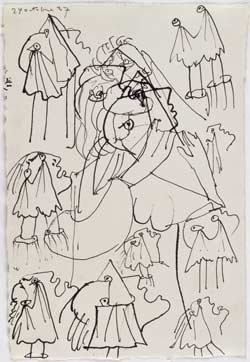
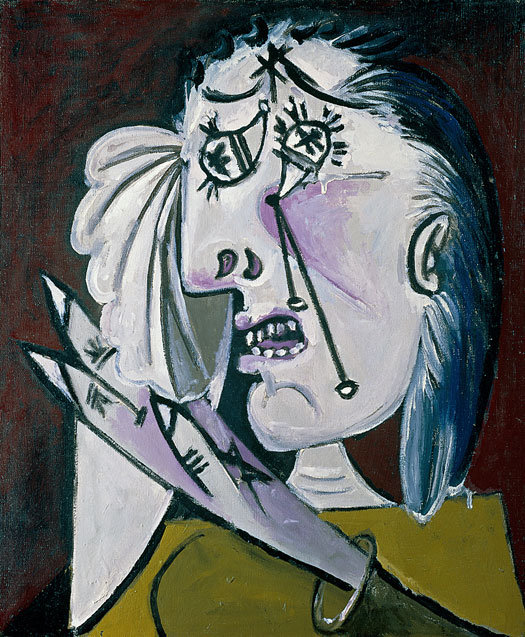
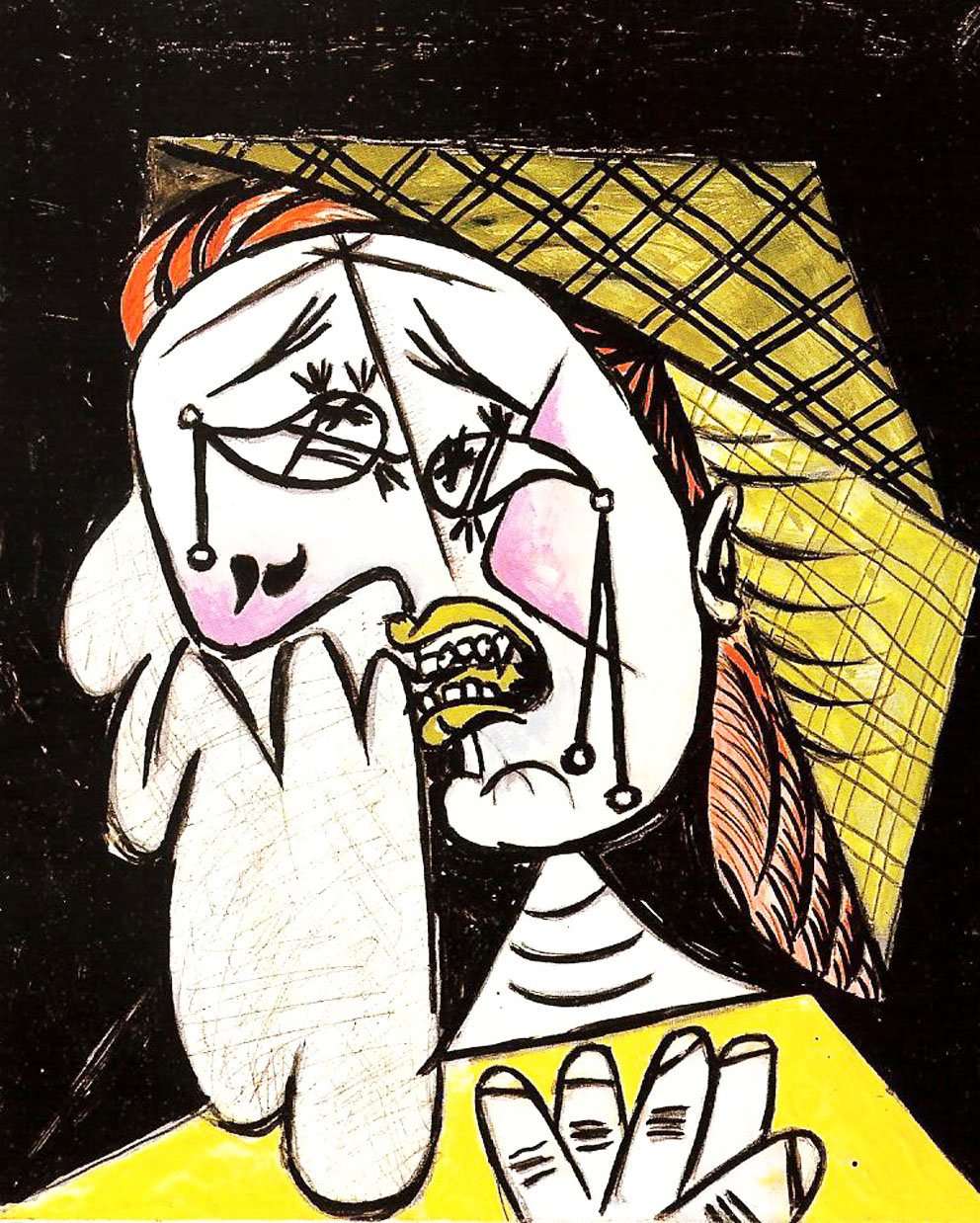
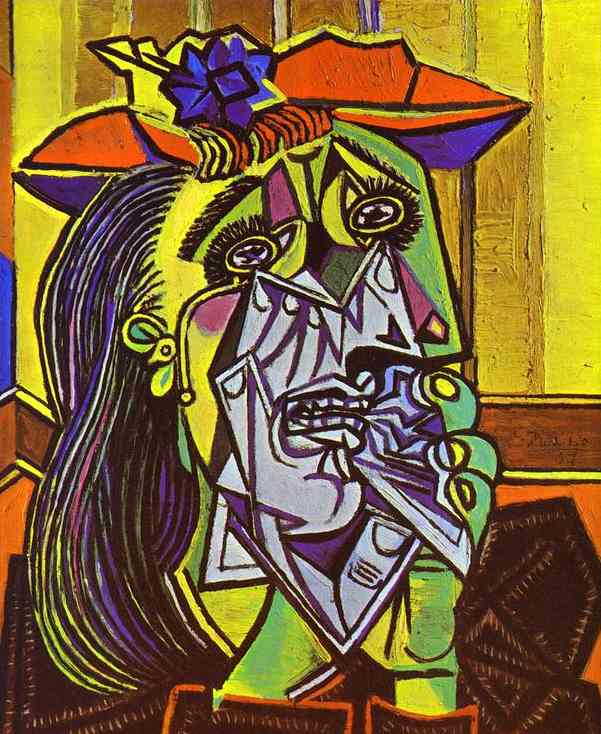
Pablo Picasso’s ‘Weeping Woman’ series, to accompany Matthew 5:4, “Blessed are those who mourn, for they will be comforted.’
On April 26, 1937, the Luftwaffe bombed the Spanish town of Guernica. This wasn’t a German invasion, but a German interference in the Spanish Civil War on behalf of Francisco Franco. Picasso was living in Paris at the time. He saw pictures of the bombing in the newspaper, and began sketching images for his famous painting, titled after the town. After he completed the painting, he began making portraits of his lover, the photographer Dora Maar. These portraits play on the idea of the Mater Dolorosa, the weeping Virgin Mary, which was common artistic theme in Spain. They’re a continuation of the sense of grief, anger, and protest that’s present in Guernica.
George MacDonald’s ‘Blessed are the Meek for They Shall Inherit the Earth,’ and Aimee Nezhukumatathil’s ‘The Rolling Saint’ to accompany Matthew 5:5, “Blessed are the meek for they will inherit the earth.’
Blessed are the Meek for They Shall Inherit the Earth
by George MacDonald
A quiet heart, submissive, meek,
Father do thou bestow;
Which more than granted will not seek
To have, or give, or know.
Each green hill then will hold its gift
Forth to my joying eyes;
The mountains blue will then uplift
My spirit to the skies.
The falling water then will sound
As if for me alone;
Nay, will not blessing more abound
That many hear its tone?
The trees their murmuring forth will send,
The birds send forth their song;
The waving grass its tribute lend,
Sweet music to prolong.
The water-lily’s shining cup,
The trumpet of the bee,
The thousand odours floating up,
The many-shaded sea;
The rising sun’s imprinted tread
Upon the eastward waves;
The gold and blue clouds over head;
The weed from far sea-caves;
All lovely things from south to north,
All harmonies that be,
Each will its soul of joy send forth
To enter into me.
And thus the wide earth I shall hold,
A perfect gift of thine;
Richer by these, a thousandfold,
Than if broad lands were mine.
The Rolling Saint
by Aimee Nezhukamatathil
Lotan Baba, a holy man from India, rolled on his side for four thousand kilometers across the country in his quest for world peace and eternal salvation.
—Reuters
He started small: fasting here and there,
days, then weeks. Once, he stood under
a banyan tree for a full seven years, sitting
for nothing—not even to sleep. It came
to him in a dream: You must roll
on this earth, spin your heart in rain,
desert, dust. At sunrise he’d stretch, swab
any cuts from the day before, and lay prone
on the road while his twelve men swept
the ground in front of him with sisal brooms.
Even monkeys stopped and stared at this man
rolling through puddles, past storefronts
where children would throw him pieces
of butter candy he’d try and catch
in his mouth at each rotation. His men
swept and sang, swept and sang
of jasmine-throated angels
and pineapple slices in kulfi cream.
He rolled and rolled. Sometimes
in his dizzying spins, he thought
he heard God. A whisper, but still.
Jorge Luis Borges ‘Lamed Wufniks’ from The Book of Imaginary Beings, and Thomas Merton’s ‘Louisville Epiphany’ from Conjectures of a Guilty By-Stander, to accompany Matthew 5:6, “Blessed are those who hunger and thirst for righteousness, for they will be filled.”
Borges was one of the most influential writers of the 20th century. His stories strongly influenced all of the post-modern literature that followed him. What he calls the “lamed wufniks” are called the Tzadikim Nistarim in Judaism. His term for them comes from the Yiddish, Lamedvavniks. But his understanding of the term is essentially right. Rabbi Raymond A Zwerin says of them that: “In our folk tales, they emerge from their self-imposed concealment and, by the mystic powers, which they possess, they succeed in averting the threatened disasters of a people persecuted by the enemies that surround them.” The idea of them is drawn from the Book of Genesis, and Abraham’s argument with God before Sodom and Gomorrah. God is going to destroy the cities, but Abraham convinces him that the presence of only a few righteous men within the city walls is reason enough to leave the cities standing. The Lamedvavniks represent a fascinating idea of righteousness, but also a somewhat disturbing idea of God.
There are on earth, and always were, thirty-six righteous men whose mission is to justify the world before God. They are the Lamed Wufniks. They do not know each other and are very poor. If a man comes to the knowledge that he is a Lamed Wufnik, he immediately dies and somebody else, perhaps in another part of the world, takes his place. Lamed Wufniks are, without knowing it, the secret pillars of the universe. Were it not for them, God would annihilate the whole of mankind. Unawares, they are our saviors.
Thomas Merton had his Louisville Epiphany after he had become a Trappist monk. He was struggling with celibacy, attracted to women on the street, and yet clinging to a sense of his own righteousness in order to fight that attraction. But he knew that there was something wrong in this, that if we claim that we’re righteous but look down on other people, it becomes a false claim. His epiphany led him into a much truer sense of righteousness.
In Louisville, at the corner of Fourth and Walnut, in the center of the shopping district, I was suddenly overwhelmed with the realization that I loved all those people, that they were mine and I theirs, that we could not be alien to one another even though we were total strangers. It was like waking from a dream of separateness, of spurious self-isolation in a special world, the world of renunciation and supposed holiness. The whole illusion of a separate holy existence is a dream. Not that I question the reality of my vocation, or of my monastic life: but the conception of “separation from the world” that we have in the monastery too easily presents itself as a complete illusion: the illusion that by making vows we become a different species of being, pseudo-angels, “spiritual men,” men of interior life, what have you.
Thomas MertonCertainly these traditional values are very real, but their reality is not of an order outside everyday existence in a contingent world, nor does it entitle one to despise the secular: though “out of the world,” we are in the same world as everybody else, the world of the bomb, the world of race hatred, the world of technology, the world of mass media, big business, revolution, and all the rest. We take a different attitude to all these things, for we belong to God. Yet so does everybody else belong to God. We just happen to be conscious of it, and to make a profession out of this consciousness. But does that entitle us to consider ourselves different, or even better, than others? The whole idea is preposterous.
This sense of liberation from an illusory difference was such a relief and such a joy to me that I almost laughed out loud. And I suppose my happiness could have taken form in the words: “Thank God, thank God that I am like other men, that I am only a man among others.” To think that for sixteen or seventeen years I have been taking seriously this pure illusion that is implicit in so much of our monastic thinking.
It is a glorious destiny to be a member of the human race, though it is a race dedicated to many absurdities and one which makes many terrible mistakes: yet, with all that, God Himself gloried in becoming a member of the human race. A member of the human race! To think that such a commonplace realization should suddenly seem like news that one holds the winning ticket in a cosmic sweepstake.
I have the immense joy of being man, a member of a race in which God Himself became incarnate. As if the sorrows and stupidities of the human condition could overwhelm me, now that I realize what we all are. And if only everybody could realize this! But it cannot be explained. There is no way of telling people that they are all walking around shining like the sun.
This changes nothing in the sense and value of my solitude, for it is in fact the function of solitude to make one realize such things with a clarity that would be impossible to anyone completely immersed in the other cares, the other illusions, and all the automatisms of a tightly collective existence. My solitude, however, is not my own, for I see now how much it belongs to them — and that I have a responsibility for it in their regard, not just in my own. It is because I am one with them that I owe it to them to be alone, and when I am alone, they are not “they” but my own self. There are no strangers!
Then it was as if I suddenly saw the secret beauty of their hearts, the depths of their hearts where neither sin nor desire nor self-knowledge can reach, the core of their reality, the person that each one is in God’s eyes. If only they could all see themselves as they really are. If only we could see each other that way all the time. There would be no more war, no more hatred, no more cruelty, no more greed…I suppose the big problem would be that we would fall down and worship each other. But this cannot be seen, only believed and “understood” by a peculiar gift.
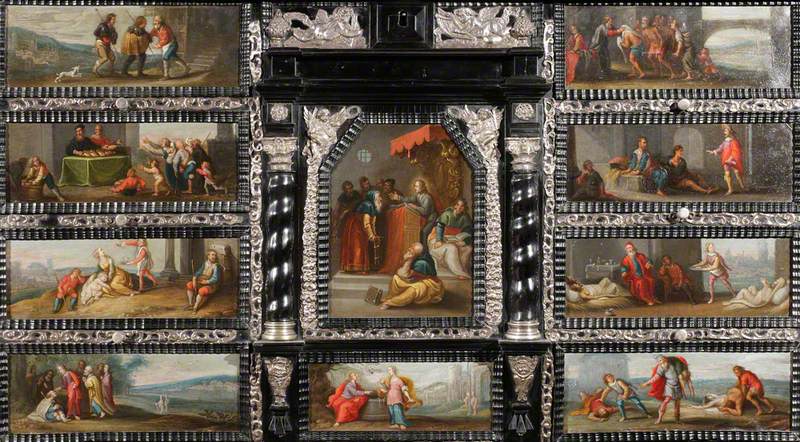
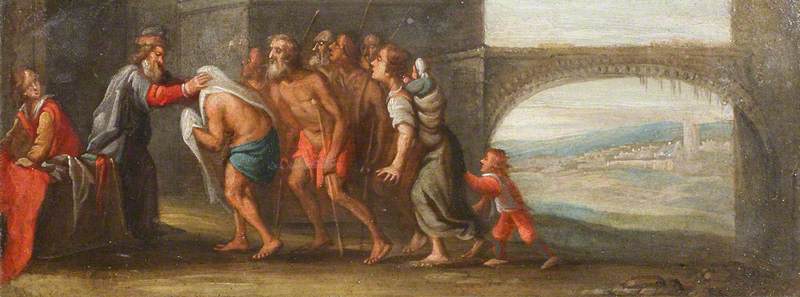
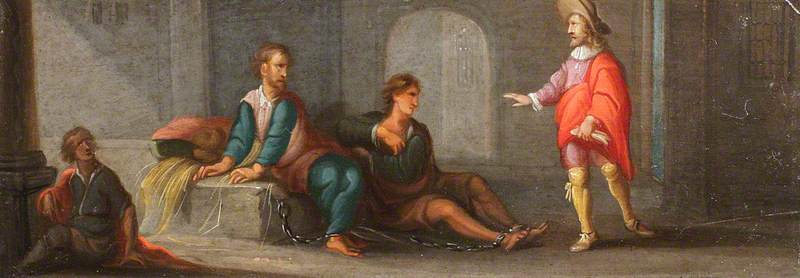
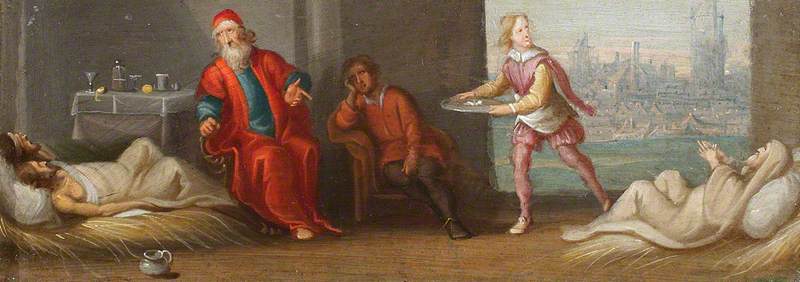
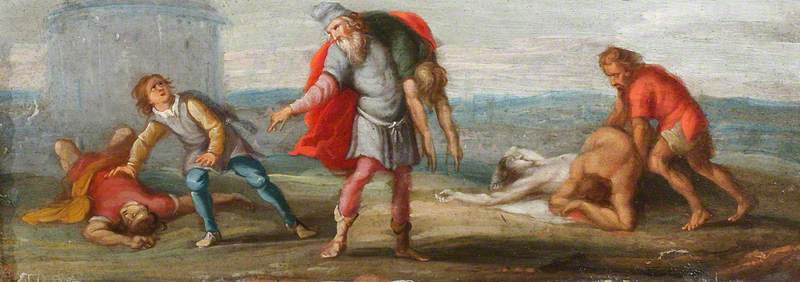
Frans Francken II’s Chirk Cabinet, to accompany Matthew 5:7, “Blessed are the merciful, for they will receive mercy.”
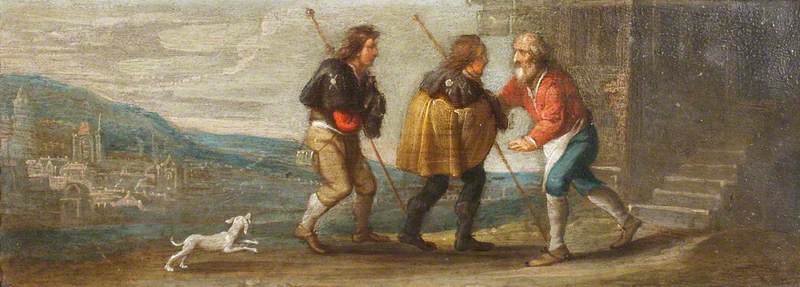
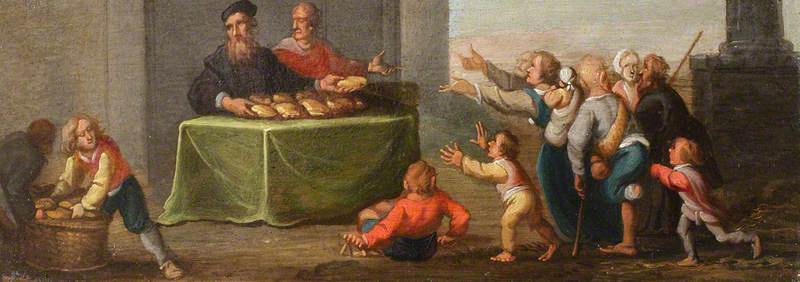
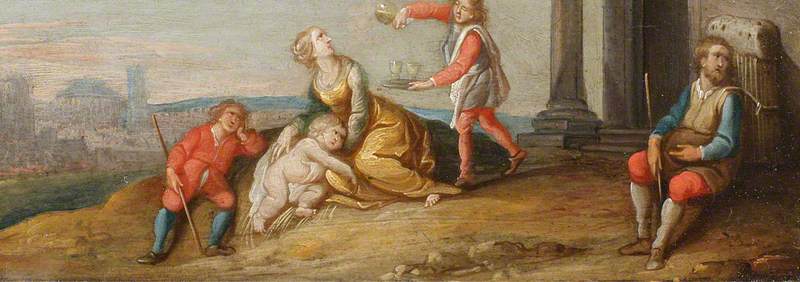
Frans Francken the Younger was a Flemish baroque painter from Antwerp, and very popular in his day. The seven allegorical images that he painted onto the Chirk Cabinet depict the seven corporeal works of mercy that are part of Roman Catholic belief and are derived, mostly, from Matthew 25:34-46. The only one of the seven acts that doesn’t come from this passage is the burial of the dead, which comes from the Book of Tobit.
 The Chirk Cabinet
 To shelter the stranger.
 To feed the hungry.
 To give drink to the thirsty.
 To clothe the naked.
 To visit the prisoner.
 To visit the sick.
 To bury the dead.
John Keble’s ‘Blest are the pure in heart’ to accompany Matthew 5:8, “Blessed are the pure in heart, for they will see God.”
John Keble is an Episcopal saint. He was one of the leaders of the Oxford Movement, which brought old forms of liturgy back into the Anglican church. The distinction between low and high church became prevalent during his life time, and he and the other members of the Oxford Movement were definitely on the high church side of the divide. As a poet, he’s most famous for having written The Christian Year, which has poems for every Sunday and for major feasts.
Blest are the pure in heart,
For they shall see our God;
The secret of the Lord is theirs;
Their soul is Christ’s abode.
The Lord, Who left the heavens
Our life and peace to bring,
To dwell in lowliness with men
Their Pattern and their King.
Still to the lowly soul
He doth Himself impart;
And for His dwelling and His throne
Chooseth the pure in heart.
Lord, we Thy presence seek;
May ours this blessing be;
Give us a pure and lowly heart,
A temple meet for Thee.
Denise Levertov’s “Making Peace,” and Mark Brunner’s photograph of Keshia Thomas, to accompany Matthew 5:9, “Blessed are the peacemakers, for they will be called children of God.”
Denise Levertov was one of the great 20th century English poets, and one of the great religious poets during a period of increasing secularism.
A voice from the dark called out,
“The poets must give us
imagination of peace, to oust the intense, familiar
imagination of disaster. Peace, not only
the absence of war.”
But peace, like a poem,
is not there ahead of itself,
can’t be imagined before it is made,
can’t be known except
in the words of its making,
grammar of justice,
syntax of mutual aid.
A feeling towards it,
dimly sensing a rhythm, is all we have
until we begin to utter its metaphors,
learning them as we speak.
A line of peace might appear
if we restructured the sentence our lives are making,
revoked its reaffirmation of profit and power,
questioned our needs, allowed
long pauses. . . .
A cadence of peace might balance its weight
on that different fulcrum; peace, a presence,
an energy field more intense than war,
might pulse then,
stanza by stanza into the world,
each act of living
one of its words, each word
a vibration of light—facets
of the forming crystal.
In 1996, 17 members of the Klu Klux Klan held a rally in Ann Arbor, Michigan. More than 200 protestors showed up to oppose them. When some protestors noticed a man wearing a confederate flag t-shirt in their midst, they began to shout at him and chase him. At first Keshia Thomas, then 18 years old and still in High School, joined his pursuers. But when they knocked him to the ground and began to beat him, she threw herself on top of him and protected him. “When they dropped him to the ground, it felt like two angels had lifted my body up and laid me down,” she said.

Tom Sleigh’s poem “Fable,” to accompany Matthew 5:10, “Blessed are those who are persecuted for righteousness’ sake, for theirs is the kingdom of heaven.”
A little village in Texas has lost its idiot.
-Caption on a protest sign
Let us deal justly.
-Edgar, disguised as Poor Tom, from Shakespeare’s King Lear; act 3, scene 6
But where, oh where is the holy idiot,
truth teller and soothsayer, familiar
of spirits, rat eater, unhouseled wanderer
whose garble and babble fill rich and poor,
homeless and housed, with awe and fear?
Is he hiding in the pit of the walkie-talkie,
its grid of holes insatiably hungry,
almost like a baby, sucking in the police sergeant’s
quiet voice as he calls in reinforcements?
Oh holy idiot, is that you sniffing the wind
for the warm turd smell on the mounted policemen
backing their horses’ quivering, skittish
haunches into the demonstrators’ faces?
Oh little village among the villages,
the wild man, the holy Bedlamite is gone,
and nobody, now, knows where to find him…
Lying in mud? lying caked in mud, hair elfed into knots?
Some poor mad Tom roving the heath
for a warm soft place to lie his body down,
his speech obsessed with oaths, demons,
his tongue calling forth the Foul Fiend, Flibbertigibbet
as the horses back slowly, slowly into the crowd
and he eats filth, he crams his ravenous mouth with filth—
and then he sits on his stool in the trampled hay
and deep-rutted mud, he anoints himself
with ashes and clay, he puts on his crown
of fumiter weed and holds his scepter
of a smouldering poker and calls the court to order.