The Image and the Word Bible Study: Matthew 1-2

I wanted a way of reading the Bible in the company of artists and poets, of paying attention to their commentary on scripture.  I couldn’t find any one book that did this, so I decided to start collecting resources here.  We hold a weekly Bible study in the EASE Gallery, and today we’ll be looking at the first two chapters of the Gospel of Matthew.  Here are some paintings and poems I’ve collected to accompany our study.

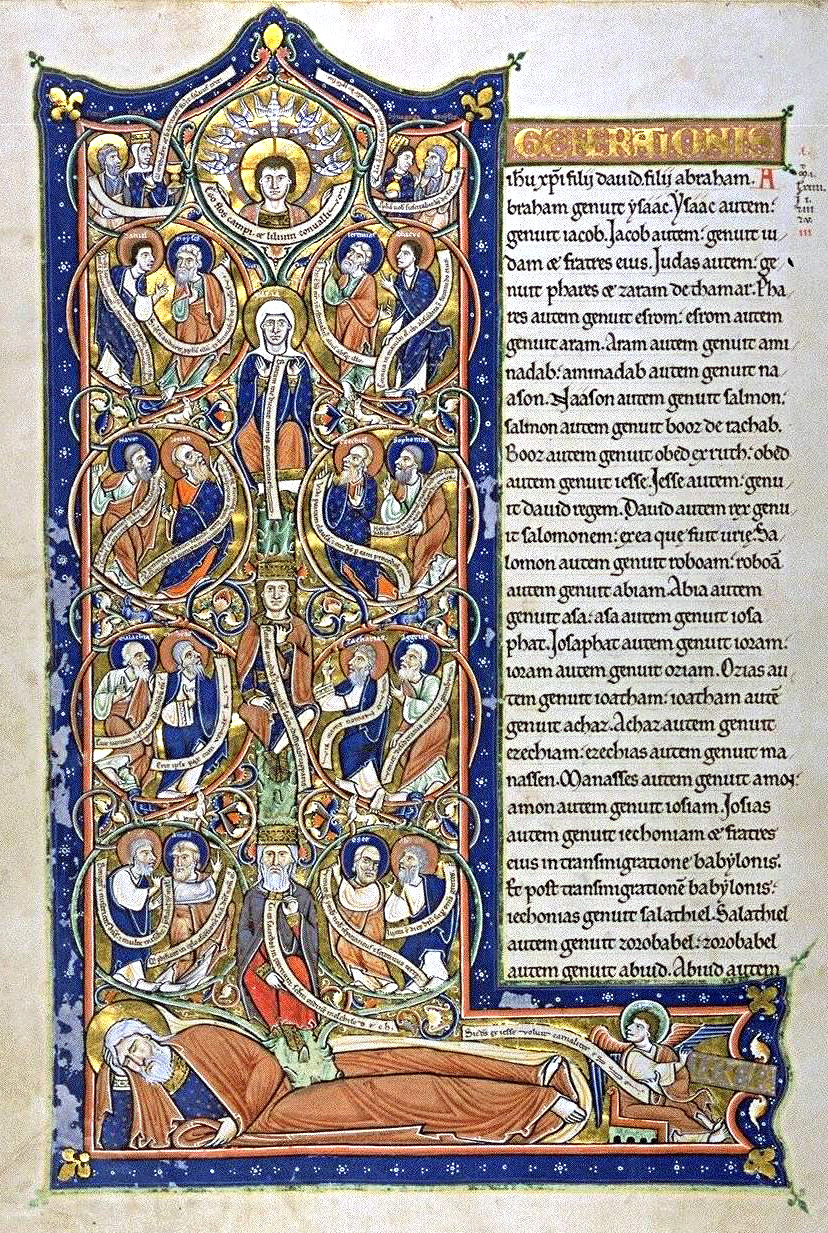
The Jesse Tree from the Capuchin Bible, to accompany the genealogy in Matthew 1:1-17

Jesse Trees began appearing in Medieval manuscripts like the Capuchin Bible in the 11th century.  They soon showed up in stained glass windows, most notably in Chartes Cathedral.  You will notice Jesse lying at the base of the image, with the tree growing out of his belly.  It’s trunk grows up through depictions of King David and King Solomon, to a depiction of the Virgin Mary, to Christ himself.  Those figures to the sides, draped with scrolls of text, are the prophets.

jesse tree Capuchin's Bible


“The Temptation of Joseph,” an excerpt from W.H. Auden’s For the Time Being, to accompany Matthew 1:18-25

For the perpetual excuse
Of Adam for his fall—”My little Eve,
God bless her, did beguile me and I ate,”
For his insistence on a nurse,
All service, breast, and lap, for giving Fate
Feminine gender to make girls believe
That they can save him, you must now atone,
Joseph, in silence and alone;
While she who loves you makes you shake with fright,
Your love for her must tuck you up and kiss good night.

For likening Love to war, for all
The pay-off lines of limericks in which
The weak resentful bar-fly shows his sting,
For talking of their spiritual
Beauty to chorus-girls, for flattering
The features of old gorgons who are rich,
For the impudent grin and Irish charm
That hides a cold will to do harm,
To-day the roles are altered; you must be
The Weaker Sex whose passion is passivity.

For those delicious memories
Cigars and sips of brandy can restore
To old dried boys, for gallantry that scrawls
In idolatrous detail and size
A symbol of aggression on toilet walls,
For having reasoned— ”Woman is naturally pure
Since she has no moustache,” for having said,
“No woman has a business head,”
You must learn now that masculinity,
To Nature, is a non-essential luxury.

Lest, finding it impossible
To judge its object now or throatily
Forgive it as eternal God forgives,
Lust, tempted by this miracle
To more ingenious evil, should contrive
A heathen fetish from Virginity
To soothe the spiritual petulance
Of worn-out rakes and maiden aunts,
Forgetting nothing and believing all,
You must behave as if this were not strange at all.

Without a change in look or word,
You both must act exactly as before;
Joseph and Mary shall be man and wife
Just as if nothing had occurred.
There is one World of Nature and one Life;
Sin fractures the Vision, not the Fact; for
The Exceptional is always usual
And the Usual exceptional.
To choose what is difficult all one’s days
As if it were easy, that is faith. Joseph, praise.

T.S. Eliot’s “The Journey of the Magi,” to accompany Matthew 2:1-12

The Journey Of The Magi
‘A cold coming we had of it,
Just the worst time of the year
For a journey, and such a long journey:
The ways deep and the weather sharp,
The very dead of winter.’
And the camels galled, sorefooted, refractory,
Lying down in the melting snow.
There were times we regretted
The summer palaces on slopes, the terraces,
And the silken girls bringing sherbet.
Then the camel men cursing and grumbling
and running away, and wanting their liquor and women,
And the night-fires going out, and the lack of shelters,
And the cities hostile and the towns unfriendly
And the villages dirty and charging high prices:
A hard time we had of it.
At the end we preferred to travel all night,
Sleeping in snatches,
With the voices singing in our ears, saying
That this was all folly.

Then at dawn we came down to a temperate valley,
Wet, below the snow line, smelling of vegetation;
With a running stream and a water-mill beating the darkness,
And three trees on the low sky,
And an old white horse galloped away in the meadow.
Then we came to a tavern with vine-leaves over the lintel,
Six hands at an open door dicing for pieces of silver,
And feet kicking the empty wine-skins.
But there was no information, and so we continued
And arriving at evening, not a moment too soon
Finding the place; it was (you might say) satisfactory.

All this was a long time ago, I remember,
And I would do it again, but set down
This set down
This: were we led all that way for
Birth or Death? There was a Birth, certainly
We had evidence and no doubt. I had seen birth and death,
But had thought they were different; this Birth was
Hard and bitter agony for us, like Death, our death.
We returned to our places, these Kingdoms,
But no longer at ease here, in the old dispensation,
With an alien people clutching their gods.
I should be glad of another death.

Henry Ossawa Tanner’s Flight Into Egypt, to accompany Matthew 2:13-15

Tanner was raised in the African Methodist Church, and turned to religious painting in the 1890s.  The Flight into Egypt was his favorite biblical story, echoing, as it did, the black experience in America of danger, oppressions, and flight.

flight into egypt


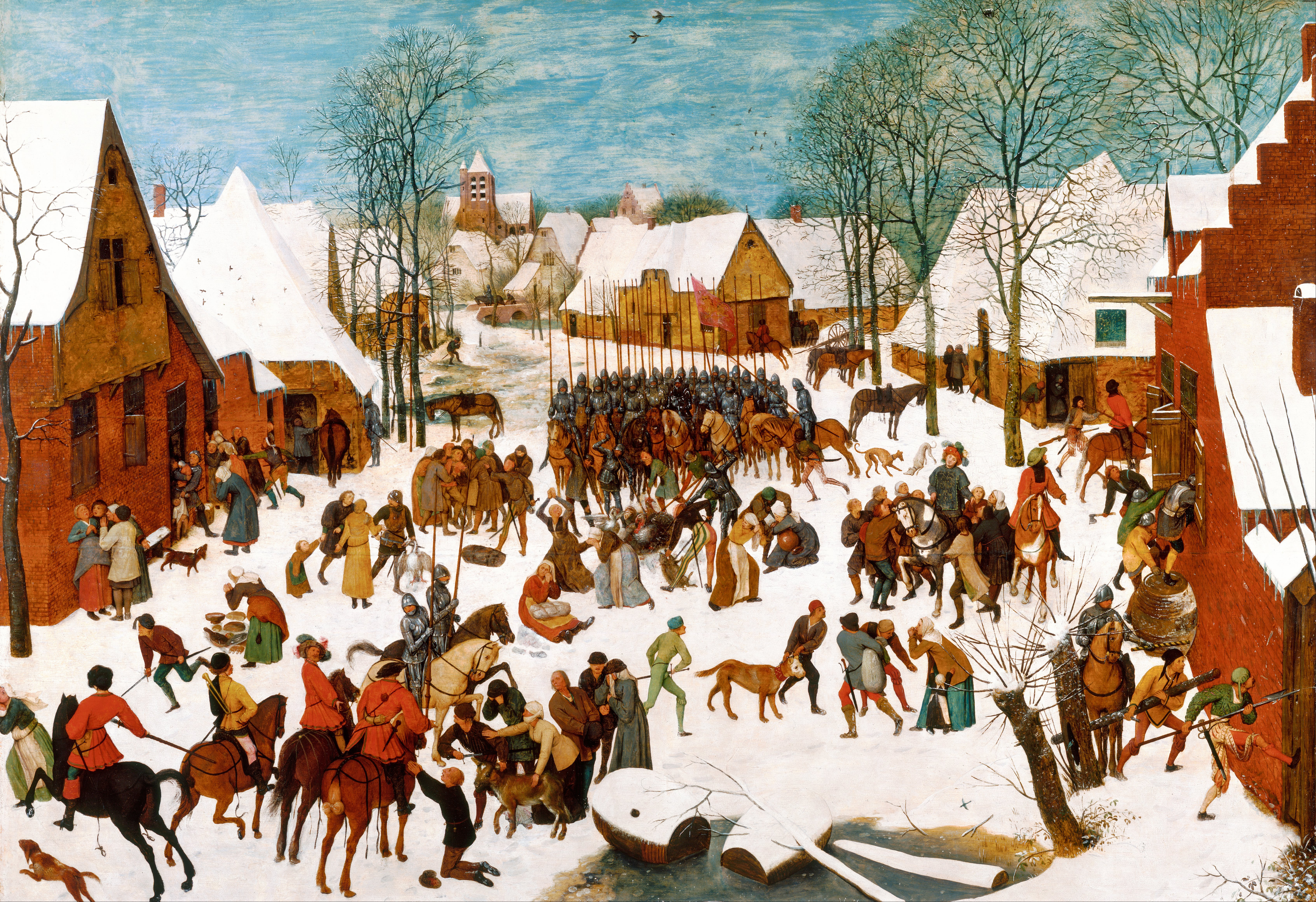
Pieter Bruegel The Elder’s Massacre of the Innocents, to accompany Matthew 2:16-18

Study the painting and you’ll see hardly any innocents in it at all.  Where are the children whom Herod ordered killed?  They’ve been painted over.  Bruegel originally painted them, and he painted Herod’s soldiers to resemble the Spanish armies of the Holy Roman Empire who were rampaging across Flanders at the time.  But Rudolph II, the Holy Roman Emperor, soon came into possession of the painting.  Understanding that it represented a criticism of his own empire, he had it overpainted.  Screaming children were turned into jugs and livestock.  It’s as if Herod himself had gotten a chance to edit Matthew’s Gospel and alter the story of the massacre of the innocents.

massacre of the innocents


Joseph Brodsky’s “Flight into Egypt,” translated by Melissa Green, to mark the return from Egypt to Israel and accompany Matthew 2:19-23

…where the drover came from, no one knew.

Their affinity made the heavens slate
the desert for a miracle. There, they chose to light
a fire and camp, the cave in a vortex of snow.
Not divining his role, the Infant drowsed
in a halo of curls that would quickly become
accustomed to radiance. Its glow would climb—
beyond that dark-skinned enclave—to rise
like the light of a star that endures
as long as the earth exists: everywhere.

T.S. Eliot’s “The Journey of the Magi”

I like to think that T.S. Eliot knew something about me, about the ways in which my encounters with God, and faith, have often left me dissatisfied and restless.  Of course he died before I was born, but I think he understood my kind of believer.  It’s all right there in “The Journey of the Magi,” after all.  A belief that’s uncertain, questing, and having to put up with all the discomforts of the journey.  And then, at the end of the journey, encounters something unexpected, and feels both amazed and confused.  A belief that returns home and can’t find comfort in the old life anymore, but doesn’t really have a sense of what the new life truly is.  I think, on this cold winter’s day, that I am one of the magi, and that I’m not alone in that.

The magi in his poem spend a lot of time describing the journey itself.  They’re wise, they see how the things they observe – hands dicing, “three trees on the low sky” – are symbolic, how they predict something mysterious and meaningful, in the future.  Human beings are meaning-makers, and I sometimes think that the main job of the church is to help people make meaning.  But lately the symbols point to some future meaning, to something that I don’t think has happened yet, and all I can do is nod and say, “yes, that is symbolic,” without being able to say what the symbol is for.

And then, when they finally get to Bethlehem, their response to the babe in the manger is strangely cold – “it was (you might say) satisfactory.”  Eliot seems to think that they really weren’t expecting it, and the very strangeness of it made it hard for them to be all that joyful.  In his poem, the Nativity is a weird, disjointed thing.  All it’s usual meanings, the cosy sense given to it by children’s plays and Christmas carols, haven’t been assigned yet.  What they see is a baby laying on a cow’s dinner plate.

But still, it changes everything for them.  They return home but find themselves foreigners in their own countries, and they’re “no longer at ease here, in the old dispensation,/with an alien people clutching their gods.”  But what has changed for them?  What does it mean, that scene in Bethlehem?

I feel like we’re living in the age of the magi, when the old dispensations seem alien and strange, but the new dispensation – whatever will happen next to the church and to humanity – hasn’t fully been established yet.  To make meaning of it is impossible, because there aren’t enough words on the page, not enough lines in the play, not enough lyrics in the song.  All we have is a half sung tune that we know is important, perhaps the most important thing of all.  But we can’t understand it’s importance until it’s all the way sung.  And in the meantime, we have discomfort and confusion.  “This birth was/Hard and bitter agony for us, like Death, our death.”

Here’s the full poem:

The Journey Of The Magi
by T.S. Eliot

‘A cold coming we had of it,
Just the worst time of the year
For a journey, and such a long journey:
The ways deep and the weather sharp,
The very dead of winter.’
And the camels galled, sore footed, refractory,
Lying down in the melting snow.
There were times we regretted
The summer palaces on slopes, the terraces,
And the silken girls bringing sherbet.
Then the camel men cursing and grumbling
and running away, and wanting their liquor and women,
And the night-fires going out, and the lack of shelters,
And the cities hostile and the towns unfriendly
And the villages dirty and charging high prices:
A hard time we had of it.
At the end we preferred to travel all night,
Sleeping in snatches,
With the voices singing in our ears, saying
That this was all folly.

Then at dawn we came down to a temperate valley,
Wet, below the snow line, smelling of vegetation;
With a running stream and a water-mill beating the darkness,
And three trees on the low sky,
And an old white horse galloped away in the meadow.
Then we came to a tavern with vine-leaves over the lintel,
Six hands at an open door dicing for pieces of silver,
And feet kicking the empty wine-skins.
But there was no information, and so we continued
And arriving at evening, not a moment too soon
Finding the place; it was (you might say) satisfactory.

All this was a long time ago, I remember,
And I would do it again, but set down
This set down
This: were we led all that way for
Birth or Death? There was a Birth, certainly
We had evidence and no doubt. I had seen birth and death,
But had thought they were different; this Birth was
Hard and bitter agony for us, like Death, our death.
We returned to our places, these Kingdoms,
But no longer at ease here, in the old dispensation,
With an alien people clutching their gods.
I should be glad of another death.

An Interview with Ruben Castilla Herrera – A Word and Table Special

In this special edition of Word and Table, Karl interviews Ruben Herrera about the interrelation between community organizing and the church.  Ruben has long been a force in Columbus, building a diverse community of activists who work on diverse issues.  Most recently he’s been involved in the effort to get Wendy’s to sign on to the Fair Food Program.  You can listen to the podcast here or by subscribing through the iTunes store.

Program note – we will be taking the holidays off, and resume broadcasting after January 1st.

At Wendy’s with the Immokalee Workers

On Monday afternoon I was one of about one hundred and twenty people who gathered outside of the new Wendy’s flagship restaurant in Dublin, OH.  We were there to bring pressure on the nation’s second largest fast food chain, asking that they join the Fair Food Program, which eleven other major corporations, including four of the big five fast food chains, have signed onto.  The Fair Food Program provides a wage increase for farm workers and enforces a Code of Conduct among the companies that have signed onto it, which has been instrumental in reducing human rights abuses in the fields.  After talking to some very kind and decent Dublin police officers, a Wendy’s executive, Bob Bertini, came out to talk to us.  He tried to cover his anger and impatience under a patina of cheerfulness, but it was obviously there.  One of our spokespeople, Jessica Shimberg, asked him why Wendy’s was unwilling to sign-on to something that has helped so many people, and been embraced by the company’s competitors, especially when Wendy’s is usually a very good corporate neighbor, and the values of their founder, Dave Thomas, should lead them to embrace opportunities for justice and civil welfare like the Fair Food Program.

I participated in this action during a week in which I’ve been delving deep into Doris Kearns Goodwin’s new book The Bully Pulpit, which is about the progressive era.  Many of the political leaders in that era were rich men.  But they were men who were raised within a very specific ethic of wealth.  They thought that wealth was only justified if it could do good for one’s community.  They were also intellectually curious men.  Teddy Roosevelt, especially, read everything and delved into everything.  He began his time in the New York legislature as someone who was indifferent to the plight of the workers.  He was from the monied, property owning class, and believed that it was a property owner’s civil right to do whatever they wanted with their land and wealth.  But when he began to hear reports about the conditions of cigar makers in the New York tenement factories, he made a deal with a social crusader.  He would go on a tour of the factories, and if he found that the claims about abuse and maltreatment were true, he would support legislation to help the workers.  The reports were true, and he began to change his opinion about the civil rights of landlords.

What would the world be like if corporate CEOs, such as Wendy’s Emil Brolick, woke up in the morning asking themselves ethical questions about their company’ wealth and influence?  They would have to expand their understanding to realize that, in a global economy, everyone is in your community.  Corporations are very good at conjuring an image of community.  Their commercials show their customers, their ideal community, smiling and chatting with their employees, and enjoying their products with something close to rapture.  But of course a community is more than just employees and customers.  It’s more than those who live in the city or neighborhood in which a corporate office is located.  In a global economy, the community is the world.  And for Wendy’s, that means that their community includes the farm workers in Florida who provide tomatoes for their hamburgers, and who have seen a marked decrease in sexual harassment, unsafe working conditions, and even modern slavery because of the Fair Food Program.

What is wealth for, if not for the benefit of the communities we live in?  Moral psychologist Joshua Greene points out that, throughout time, generosity and cooperation within a community have benefitted the individuals who have those traits in abundance.  Those who are incapable of generosity and cooperation have failed within their communities, not just morally, but also in terms of evolution.  Using wealth for the benefit of one’s community also benefits the benefactor.  At this moment in time, we all live in a community that encompasses the world.  It might have surprised Wendy’s that a hundred and twenty Ohioans would show up in support of farm workers in Florida.  But they’re going to have to adjust to the fact that community has expanded if they want to prosper, and they’re going to have to sign on to the Fair Food Program.

Americans Don’t Trust Each Other

Americans don’t trust each other.  That’s the main finding of the General Social Survey, which has been tracking all sorts of things for forty years.  You can read about it on the Huffington Post.  What struck me most was that almost two thirds of respondents said that you can’t be too careful in your interactions with other people, the highest level of distrust ever, but only for the white majority, which is skewing the results.  As the Huff Po article makes clear, African American people have been distrustful for a long time.  Does this mean that trust is a result of economic and racial privilege?  I never really thought of trust as a privilege before, and now that I am I find my mind divided.  On the one hand, I think it’s good for people to surrender some of their privilege on behalf of others, and to experience what life is like for the rest of America.  On the other hand, I don’t think that justice is really served by us all just becoming miserable.  Wouldn’t it be better if the trend was for trust to increase across the board, and for minorities to begin to feel the economic and social security that would allow them to trust like the majority?  Instead the opposite is happening, and I wonder if the church has any role to play in rebuilding neighborliness.

Most of our churches abandoned trust long ago.  Buildings are locked most of the time, and the idea that a church could provide a place for quiet contemplation or sanctuary for those walking in off the street is complicated by our fear of theft or other dark deeds.  But what if our solution wasn’t to lock the doors, but to try to increase the use of our buildings, to make sure that people were always around who could keep an eye on things?  Imagine a church that had three different groups meeting at once, most or all of them outsiders to the actual congregation.  They would have the opportunity to exchange ideas with each other, and to teach church people about their dreams and ideas.  And they would keep the buildings safe.

One of the culprits that’s constantly sited for our decline in trust is our lack of a public forum.  There is no central meeting place where Americans gather.  Could this be the new mission of the church, especially churches like ours, that have big, crumbling buildings?  Could we become the tide that rises all boats, all people towards a greater sense of trust in one another?

jesus