The last installment in our three part series about Alternative Economics in the Episcopal Church. Our collection of farmers, bike repair people, and fair trade advocates critique the church and envision new directions for the faith.
Author: KPB Stevens
Why I Draw
As of this morning, the official count of those who have died in the Philippines stands at 1,800. It’s a faceless number, a mere estimate, and it will rise. Yesterday I went to the New York Times website and looked at the photos. I tried drawing some of them. Then, in the evening, I celebrated the Eucharist at Bexley Hall. I couldn’t say the words of the Eucharistic prayer without thinking about the faces that I saw. The man, his body bent to the curve of the child he held against his chest, as the wind whipped across his hair and his wife placed a hand on her child’s back, her clothes billowing towards him, possibly a final gesture. Today I woke and read on CNN’s website about a woman who took refuge with her husband and six children in a bus. They were swept away by the storm, while she survived. She’s wandering through the ruins of Tacloban, looking for their bodies.
In 2011, when 30,000 children starved to death because of a draught in East Africa, I was barely aware of it. When 6.9 million people were displaced because of the monsoon floods in India in 2012, I didn’t pay much attention. I, like so many other people, can’t wrap my head around the numbers, or put faces to them. And each escalating disaster serves to inoculate me against compassion. People are always dying, suffering, grieving, and it doesn’t feel like there’s much I can do about it.
But losing my grasp on my compassion is a step towards total acquiescence to a sinful world, a studied willingness to enjoy my health and prosperity now, without worrying about those who suffer because of it, or what might happen tomorrow. I believe that we need societies that pay attention and care, if we are to be capable of making the changes that could help us all survive. A dispassionate society is one that’s blind to the future and indifferent to the present, and I belong to that substance-less kingdom more than I belong to the Kingdom of God. But I want to belong to the Kingdom of God, and I want the world to survive. Training my compassion is the first spiritual step to taking action and aligning myself with Jesus’s vision of the kingdom.
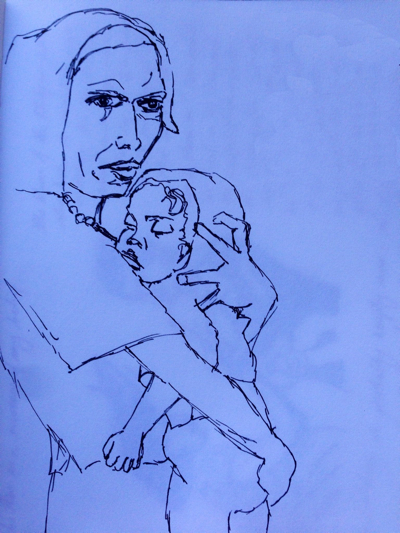
And so I draw. Yesterday I sat and stared at the face of a displaced woman, clutching her sleeping child to her chest. I took my pen and tried to capture the dark worry in her eyes, the shock, the slight hardening that happens to those who wait. I drew the man who curved his body to the shape of his child as his wife reached towards him. I noticed, as I drew, that the man was holding a water bottle, and I realized that the picture was taken four days ago, and that there’s a terrible shortage of drinking water now. That bottle means life to the child the man is cradling, and the water is almost certainly gone. I drew, even though it hurt to consider these things, and it still hurts. But if I am going to be a man who prays, who dares to stand before God and touch bread and wine in the way that Christ did, I have to allow the world to hurt me, and to feel my own sense of sin. I have to try to move beyond the comfort of my prayers into that same wilderness of loss and searching that the woman in Tacloban walks through as she searches for the bodies of her husband and her six children. So I draw as a training in compassion, knowing how little it means, but hoping it will change me.
Spiritual Mastery
Saint Luke’s feast day was a few Fridays ago. In additional to writing his Gospel and the Book of Acts, Luke is the patron saint of artists, for the simple reason that he’s believed to have been the very first Christian artist. The earliest icons, showing Christ and Mary, were thought to have been painted by Luke, and that’s why iconographers are so careful to take themselves and their own artistic vision out of the equation when they write icons. In their minds, they’re simply copying the original portraits of Our Savior and his mother.
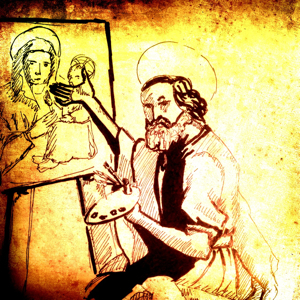
In the middle ages, artists organized into Guilds of Saint Luke. When an artist wanted to be considered a master, he had to submit a masterwork to the guild. Often, these masterworks show a scene in which Saint Luke, sitting at an easel, paints the Virgin with the infant Christ sitting in her lap. The painter himself is sometimes pictured as well, but always in a subordinate role – cleaning Saint Luke’s brushes or performing some other menial task.
Learning about this got me thinking about the idea of mastery. Obviously, if Christian artists and other craftsmen were trying to attain the status of “master,” the idea of mastery can’t be entirely foreign to the Christian church. But how often do we think of our spiritual lives as leading to some goal, some master work? Would it change the way we thought about our faith if we had some distinct purpose in mind when we went to church or prayed privately during the course of our day?
A Christian masterwork could be anything, really. When I was working in a hospital for a summer I had a friend and mentor who was an elderly Roman Catholic priest. He and another priest had a spiritual practice of meditative walking, which they did in downtown Chicago. As they walked, they tried to open themselves to the world around them, the sound of street traffic, sunlight cutting its way across the buildings. One day, as they were walking through a park, they encountered a man who was assaulting a woman. Without hesitation or fear for their own safety, they interfered and protected the woman. I consider this their master work.
The one prerequisite to producing a master work seems to be humility. Medieval and renaissance artists were often arrogant fellows, but they subordinated themselves in the paintings they made of Saint Luke. My friend the Roman Catholic priest could only help the woman who was being attacked because he’d been humble enough to try to make himself truly aware of the world around him.
I found myself thinking about humility this past week, when I served as chaplain during the Stand Down for Homeless Veterans in Columbus. This is a yearly event where agencies and companies and politicians gather in the Veteran’s Memorial to provide gifts and services to vets who are living on the street. Humility was the prevailing ethic of the day. Danny, one of the chief organizers, told me what he tells all volunteers, that the men and women who came through the door were veterans first and foremost, and that we wouldn’t dwell on the fact of their homelessness. Ask them about their service, not about their poverty. This seemed very humble to me, this willingness to concentrate wholly on the dignity of the people we would meet.
But an even greater humility belonged to the ROTC cadets who lined up by the door. These were high schoolers in baby blue shirts and neckties. As the veterans came in, they stepped forward to push shopping carts, carry bags, and guide the men and women through the Memorial Hall. I watched them and thought about the fact that in five or ten years these kids will be leading troops in combat. That day in the Veterans Memorial they were engaging in a kind of training in humility. A good officer has the humility to set their own needs aside in order to look after their troops. Because of this early training in humility, these young people may, someday, be capable of a masterwork in leadership. They may, through their attentiveness and caring, be able to save the lives of those who serve under them.
If I were to describe a spiritual path to Christian mastery, the first station would be humility. No skill can be learned, no human relationship truly established, until we learn humility. Without humility, we are deaf to the voice of God in our lives, and blind to the needs of those around us. This, I think, is why Jesus so clearly values the tax collector in Saint Luke’s parable, the one who prays “God, be merciful to me, a sinner.” It’s not because Jesus wants us to demean ourselves. Jesus wants us to be like him, a spiritual master. But the first step on the road to mastery is humility, the ability to set ourselves to the task of cleaning Saint Luke’s brushes and not assuming that we already have the skills to create a masterwork.
The Fancy of Self, The Imagination of God
When I was a young man, I had a fantasy that when I became an adult, really became an adult, I would have everything all figured out. That the insecurity of trial and error would go away, and I’d know what to do and what not to do about any situation that might arise. It never happened. There was never a moment when I crossed the river into a clear and untroubled adulthood. I’m calmer and more patient than I used to be. I no longer think that mistakes say something terrible and permanent about my character. But I still make them, and sometimes I wonder who I truly am.
These days I tend towards a different fantasy. What if I could go back and live my teenage and college years again? Not as the person I was, but as the person I’ve become. Because even though I still make plenty of mistakes, a lot of the angry posturing of my post-punk college days is gone. I’ve aligned myself to a faith and a creed, and that’s brought a lot of peace. But not so much peace that I don’t regret the past, and fantasize about going back and knowing people in a different way, being wise and kind, the rare kid who is honestly interested in taking care of other people. The rare kid who has the confidence to go off by himself when he needs to, as well, and who knows himself well enough to pursue his own particular interests without caring what other people think of them.
Both of these fantasies are equally meaningless, and therefore bad for me. Malcolm Guite, in his book Faith, Hope, and Poetry: Theology and the Poetic Imagination, talks about Coleridge’s distinction between imagination and fancy. Imagination is deep. In Christian terms, to truly imagine something is to enter into God’s vision for it. Fancy is superficial. It’s to indulge in goofy fantasies, telling oneself stories that are, ultimately, self-glorifying. Both of my fantasies are about my being more perfect, either in the future or in the past, and both are equally silly. All the energy that I put into fantasies of the future or the past is a distraction from my own deepest feelings about the world, and distract my ability to truly think about God’s will, to imaginatively align myself to God.
Back when I was in college, I learned about the four life-stages, or ashrama, of Hinduism. I find it helpful to think about them now. I’m in the middle of the householder stage, which is all about duty, taking care of one’s family, doing good for one’s community, and working to make money. Traditionally, this stage ends when you’re forty-eight, which for me is only six years from now. Already I find myself drifting towards the next stage, in which one begins withdrawing from the world and concentrates on sharing whatever spiritual wisdom she or he has attained so far. But I find it reassuring to think that the chaos and confusion of my young life was essentially appropriate to the first stage, when I was a student and therefore meant to learn and make mistakes. And that the householder stage I’m in now isn’t really about perfection, but a set of purposes and the meanings that I make of them.
The pleasure of thinking about life in this way is that it releases us from the fancy of perfection. Instead of thinking that adulthood is something that suddenly happens, a single, sharp break in human life, it’s useful to subsume it in other categories. There are stages of adulthood, and some of them include portions of our childhood. I am not perfect, and will never attain the pure perfection of God. But by putting aside my fantasies of perfection, I can free myself to enter into the imagination of God, to go deep and try to see the world the way God does, which means seeing myself through the eyes of love rather than criticism – the kind of love that frees one from regret.
Trips to Asia
The last time I traveled to Asia was in 1992, when I was a college sophomore. My parents were spending a sabbatical year teaching college English in Malaysia, and during my visit we were going to go to Thailand. I arrived in the middle of a full-blown spiritual quest. I was taking classes in Chinese and Japanese Buddhism, and my mind was full of monks in saffron robes, voices raised in chant, and the possibility that enlightenment was hovering just beyond my reach. I wanted life to be exotic, and thought that I would be transported back to some older and better world which was free of the corruption and dullness of America.
I was quickly disabused of this notion. Asian cities are much like American cities – the same cars, the same buildings, the same kind of infrastructure. Bangkok let me down. We drove on busy highways past concrete buildings. The world around me didn’t resonate with esoteric spirituality.
I expected more when we took a tour out into the countryside. We rode on a wobbly cable car across a mountain gorge and found ourselves in a Buddhist monastery. I saw a young monk in a saffron robe. He saw me. He beckoned me over. “Are you from America?” he asked.
“Yes,” I said.
“Do you know Michael Jordan?” he asked.
We looked at each other. We had both expected the other to be exotic. He was supposed to represent ancient spiritual force. I was supposed to represent the excitement of a technological modern life. We were both disappointed. I didn’t know Michael Jordan, and he didn’t teach me how to reach enlightenment.
I returned to Asia this fall. In the intervening years I’ve become a Christian. I still love the idea of the exotic. I’ve spent a lot of time reading the legends of saints and finding a teasing sense of the wonderful in their lives and miracles. But I’ve also come to need the exotic less, and become more open to God in the ordinary.
I met another Buddhist monk, this time in Tokyo. He was on a silk painting in the National Museum. His name was Kyogen Chikan, and four hundred years ago he attained enlightenment while cleaning, when a tile fell off the roof of the monastery. I spent a long time looking at that painting, and came away smiling. We don’t have to travel half way around the world to experience the divine. God, enlightenment, spiritual force, are right here, in our ordinary lives. All we have to do is listen closely enough so that we can hear the tile fall and shatter, be open enough so that its shattering can crack our spirits apart and let something wonderful come flooding in.