Notes from a Bible Study

We gathered after the heat broke, after a day of rain, and tried to imagine Egypt.  Exodus chapters 5-7, Moses and Aaron’s first encounter with Pharaoh, and the beginning of the plagues.  Becky wanted to know who was the younger brother, Moses or Aaron, and we found the answer in Chapter 6 – it was Moses, of course.  Again and again, it’s the younger brother whom God chooses, the one who should be lowlier, less important.  But unlike other older brothers, who resent being passed over, Aaron seems more than happy to serve as spokesman for Moses, because Moses, in the memorable phrase of Robert Alter, has “uncircumcised lips.”  Meaning that he can’t speak well, but also that he sees himself as unfit for his sacred task, just as, much later on, an uncircumcised priest wouldn’t be fit to serve at the altar in Jerusalem.

Still, when the actual dual between Moses and Pharaoh begins, Moses seems more than willing to do most of the talking.  First he gets his orders from God.  This is happening a lot in Exodus.  God tells Moses exactly what will happen, Moses becomes afraid and complains, God reassures and tells him to get working.  Now, God tells Moses that He will “harden Pharaoh’s heart,” a phrase that made us pause and consider.  Doesn’t it seem like God is setting Pharaoh up, ensuring that Pharaoh will misbehave so that God will have an excuse to punish him, and all of the Egyptians, with the plagues?  God wants to show great power so that the world will pay attention.  Remember, up until this point God has been so obscure that even Moses didn’t know who He was.  God had to introduce Himself from the burning bush, and remind Moses that “I am the God of your ancestors.”

But this seems like a very unsatisfying, even disturbing reason for the plagues.  We would  be horrified by a human being who caused disasters and killed people just to get attention.  Should we just throw up our hands and say that this is a very old and no longer relevant understanding of God?  We were stumped, sitting around the table, staring at our Bibles, until Kelsey suggested that God is, in effect, taking the blame for Pharaoh’s actions.  Perhaps, she suggested, God wants Moses to still be able to love Pharaoh, just as God wants all of us to love each other.  And if God knows that Pharaoh is going to act obstinately, this might be God’s way of explaining that obstinacy in advance.

Then we moved on to the plagues themselves, to the river of blood and the frogs.  Robert Alter, in his footnotes to The Five Books of Moses, points out that the plagues parallel the seven days of creation.  God creates water at the beginning of the world, and here God transforms water into blood.  God creates the things that creep upon the earth, and here God summons forth the most abominable version of those creeping things, frogs that get into the bed and the kneading bowls and presumably the bread.  This is a dark version of creation, so dark that it reverses creation and verges towards destruction itself.  The part of God’s personality that is so evident in the story of Noah appears again here, the part of God that meets human injustice with destructive despair.

And that was where we ended, closing our Bibles and going out into a dark and clement evening.  Next week we’ll have to examine and try to understand these things.  But for now it was enough to go home, to our studies, to our rest, driving or walking through a world that seemed creatively alive.

What Kind of God Exists?

In the second semester of my sophomore year of college – a semester when I was alone most of the time, and sad, mourning the end of a relationship and trying to figure out who I was without the girl who had left – during this depressing semester I took a class called “Philosophy of God.”  I got a D in it, and not just because I didn’t do the work.  Within the first few weeks of class, it became apparent to me that the professor was interested in answering a question that I didn’t care about – does God exist?  I had enrolled because I wanted an answer to a very different question – what kind of God exists?

It might be that I’m a natural believer.  Every once in awhile we hear about a “God gene” or a neurological explanation for why some people are religious and others aren’t.  But until I was seventeen I thought of myself as an atheist, and any religious longings that I felt were easily filled by art.  I liked writing and I liked drawing.  The two activities took me to a place that was somehow outside of myself, a place where time could go by without my noticing it, and I could feel the taut excitement of creativity mixed with the satisfaction of beauty.  When I was seventeen, I encountered God.  I moved outside of myself while walking on a hilltop in Northern California, and saw everything around me with a precision and clarity that I’ve never experienced again.  I knew that God existed, and didn’t need philosophical proofs for that existence.

What kind of God exists?  I’m still asking that question, although I think I have more answers now.  And I feel okay about being a priest and asking that question, being a priest and admitting that I don’t entirely know.  I’m just echoing the confusion of the early church, the confusion that the author of the Letter to the Hebrews spoke into when he said: “You have not come to something that can be touched, a blazing fire, and darkness, and gloom, and a tempest, and the sound of a trumpet, and a voice whose words made the hearers beg that not another word be spoken to them.”  Obviously there was an argument going on, which wasn’t atypical in the early church.  Some of the believers thought of God in the good, traditional, Old Testament way.  What kind of God exists?  Why, the God who spoke to Moses out of the burning bush, and the God who whispered to Elijah on a mountainside, and the God who appeared to Job in a whirlwind.  But there were believers who thought of God as an idea, and believers who thought of God as a revolution, and, finally, believers who thought of God as a person.  A specific person, whom they had known.  Jesus of Nazareth, a man who walked among them and ate with them and shared jokes and stories with them.

It must have blown their minds, this thought that they had personally known God.  Only a few people in the entire history of humankind had been so lucky.  The patriarchs and the prophets, people whom God chose as collaborators in the great project of restoring creation to its original peace and beauty.  And a few people who God signaled out for no apparent reason other than to be kind, such as Hagar, as she and her son Ishmael lay dying of thirst in the desert.  But never before had God come into the presence of so many and various people, and never before had God come in such a mellow way, simply as a man, and a man who was willing to be decidedly un-Godlike, to let them hit him and insult him and kill him.

There’s a beautiful prayer from the early church that, to me, speaks to exactly this sense of intimacy and wonder:

We give thanks to you, every life and heart stretches toward you, O name untroubled, honored with the name of God, praised with the name of Father. 2 To everyone and everything comes the kindness of the Father, and love and desire. 3 And if there is a sweet and simple teaching, it gifts us mind, word, and knowledge: mind, that we may understand you; word, that we may interpret you; knowledge, that we may know you. 4 We rejoice and are enlightened by your knowledge. We rejoice that you have taught us about yourself. 5 We rejoice that in the body you have made us divine through your knowledge. 6 The thanksgiving of the human who reaches you is this alone: that we know you. 7 We have known you, O light of mind. O light of life, we have known you. 8 O womb of all that grows, we have known you. 9 O womb pregnant with the nature of the Father, we have known you. 10 O never-ending endurance of the Father who gives birth, so we worship your goodness. 11 One wish we ask: we wish to be protected in knowledge. 12 One protection we desire: that we not stumble in this life.

You can hear their sense of wonder in that repeated phrase, “We have known you.”  This is a prayer that is as much about the people who wrote it as it is about God.  They’re reflecting on something that has happened to them.  What kind of God exists?  The one we actually knew and sat down with and ate with.

Somewhere along the line we lost that sense of intimacy.  We began to think about God as more distant.  Christ became a king, and then an emperor, someone so mighty and awe-inspiring that we couldn’t approach him directly, but had to ask his mom or one of the other saints to talk to him on our behalf.  But we’ve been trying to get back to that earliest understanding of Christ for awhile now, since at least the 1970s.  Diana Butler Bass, in her fantastic and exciting book Christianity After Religion, talks about how the Pentecostal movement began the process of re-orientating our faith to intimacy and experience, and how this reorientation was picked up by the Evangelical movement as a whole, and how it has become standard now in Mainline churches, and a normal part of American life in general.  We live in a society that values experience, Diana Butler Bass says, and people expect some pretty exceptional experiences when they come to church.

There’s a word I learned a couple of months ago.  Heirophant.  A heirophant is someone or something that leads people into a direct experience of God.  Ever since learning this word, I’ve been looking for a heirophant.  I wish I could say that I was a heirophant myself, just by virtue of being a priest, but I’m not.  I, like many people, long for experience of God but have little idea of how to get there.  Yet I have experienced God in my adult life – never with the intensity of that first experience when I was seventeen, but still, in ways that are powerful and meaningful.  Twice this year – once in a moment of extreme and unlooked for happiness when I was driving past North Market in Columbus, and once in a state of raw emotion when I was working on a painting.  You may notice that I wasn’t in church on either of those occasions.

But then, I think it’s unfair of me to demand that church become heirophantic, or consistently be heirophantic, all of the time.  I think that we should hope for the chance to experience God when we’re in church, but that we should also bring all of those outside experiences with us, and share them with each other.  Maybe it’s okay to experience a moment of profound joy while driving past North Market and then go to church without the expectation of repeating it, but merely to say thank you.  And maybe it’s okay if, on many Sundays, church is simply the place where we go to be with other people who have had similar experiences of God to our own, and know where we’re coming from.

Some of us have had experiences of God in our moments of most profound distress.  I have a friend who went through an excruciating, agonizing divorce.  The world changed for her, everything became very sharp and focused, magnified by her pain.  And yet, at the same time, she couldn’t shake a perception of angels, hovering just beyond her view, a careful, guarding presence.  Some of us have had experiences of God in our moments of greatest joy,  when we were immersed in beauty, like another friend, a former student who was camping last Easter Sunday and stepped out of her tent into a mountain morning and experienced the fullest sense of resurrection that she’d ever known.  Some of us have experienced God best when engaged in acts of justice, like my friend Marco Saavedra, who knows God as a perfect love that wells up in him as he stages protests and takes wild and extravagant action in the struggle for immigrant rights.  Some of us have had experiences of God that are based in Christian worship, and hard to explain – the moment when light breaks across the pews, and the soloist’s voice rises high and pure from the choir, while the words of scripture still resonate and the table is set for communion.  Some of us know God best in the simplest way, in the joy and support of community, without the need for any extensive experience beyond that which is offered by friends and supported by an ethic of love.  And, finally, there are some who come here out of a sense, a nagging, itching sense, that there is a strong truth to the world, if only they could find it.  That even if the world often seems crass, and cruel, and tiring, there is, in Gerard Manley Hopkin’s words, “the dearest freshness deep down things.”  A small, quiet grandeur that is just waiting to burst out.

What kind of God exists?  I don’t entirely know.  It’s a question I’m learning the answer to all of the time, gathering the answer from friends and neighbors and my fellow Christians.  I know two things.  I know that I want to experience the answer, and not just receive it as an intellectual proposition.  And I know that I want to experience the answer in the company of other people.  Thank you for being church, for bringing your experiences and your questions, for listening to me talk, for greeting each other at the peace, for sharing a meal with each other.  For creating experience, in other words, and letting me be a part of it.

Under the Covers

by The Rev. Karl Stevens

“Why didn’t Jesus have sex?”  One of my students asked me this some years ago.  We were in the middle of cooking dinner for our weekly campus ministry meal, and my thoughts were on the onions simmering in a pan and on gathering the ingredients to make dessert.  I was distracted and the answer I gave her wasn’t well thought out.

“Because Jesus’s love is for everybody,” I said.  “There’s something about sex that creates a really deep intimacy between just two people, and Jesus’s intimacy is for everyone.  He either had to have sex with no one or everyone.”

I don’t think my student was satisfied with this answer.  I think she was probably asking a more specific question, “Is sex related to God,” or “does having sex take me out of my relationship with Jesus?”  If I had been able to hear these real concerns beneath the question that she did ask, I would have answered differently.

rothschild insertThere’s a lovely illumination in the Rothschild Canticles that shows a nun, meditating upon her bed.  The Godhead appears above her in the shape of a sun, and one ray of that sun is reaching under the sheets.  It’s an image that reflects a late medieval spirituality that sought mystical union with God through erotic imagery.  I like it very much, because I think that it has something to teach us.  That teaching can be simplified to this – Jesus is with us under the covers.  He’s engaged in our intimacy, not absent from it.

My friend Laurie and her friends used to open the hymnal when they were bored in church and add the words “under the covers” to the ends of hymn verses.  They giggled at phrases such as “Lo how a rose ever blooming, under the covers,” or “Come thou font of every blessing, under the covers.”  But this game was unexpectedly theological, even though they may not have intended it to be.  It was probably the only acknowledgement they ever heard in church of the idea that God is present with us in our intimacy.  Why is this idea so unnerving that preachers can’t preach on it, and it only gets expressed in the titillation of giggling children?

Imagine the gift that the church could give to people if it only dared to talk about the ways in which God can be present in our intimacy.  One of the paradoxes of sex is that it’s bodily, but also out-of-body at the same time.  The accumulation of physical sensations leads us into a kind of physicality that we don’t experience in any other way – the scent of a lover, the caress of a hand, the movement of a gaze across the body of a beloved, these things create a kind of altered state, a holistic sense of being present in the body so thoroughly that we transcend it.  There is a deep spirituality in sex, and Christians are always called to make Christ part of our spirituality.  Sex is intensified when we acknowledge that spirituality and invite Christ’s participation in it.  We could begin to define a Christian sensuality, one that acknowledges the godhead as a ray of light that’s with us under the sheets, and then offer this definition to others.  Our relatively shallow American conversation about sex could be deepened by this in a way that would help individual lives.

The Episcopal church, like many mainline denominations, has gone through a decade of pain and contention over issues of sexuality.  One of the things that make these disagreements so hard is that we lack a language for talking about sex at all, let alone about sexual orientation.  But such language hasn’t always been missing from Christianity, as the Rothschild Canticles and other medieval texts show.  Perhaps one of the fruits of the debate about sexual orientation is that it’s allowed us to talk about sex more generally, and start articulating real answers to people who ask us simple questions, such as “Why didn’t Jesus have sex?”  Jesus the man may not have had sex, but Jesus our Lord and Savior is surely with us under the covers.

The Man with the Withered Hand

IMG_1072

He was there, in the synagogue on a Sabbath, an observant Jew.  His withered hand didn’t limit his worship – he wasn’t a Levite, he wasn’t a priest.  He couldn’t work because of it, but this wasn’t a day that required work.  It was the one day when his hand didn’t matter, the Sabbath, when all work went still.  Wouldn’t such a man love the Sabbath law, the law that allowed him to sit quietly with his neighbors and not feel that his withered hand made him an outsider?

Perhaps he agreed with the Pharisees’ denunciations of Jesus, who had just defended his disciples for picking grain on the Sabbath.  Picking grain, something he couldn’t do, in defiance of sitting quiet and being at rest, one thing he could do quite well.  Agreed with them, until Jesus took pity on him, and asked him to stretch out his hand.  Was he angry, even as he obeyed, not wanting to turn into a demonstration of power?  Or perhaps he was considering the day after, when he would be useless again, when he’d have to beg and accept charity and feel that he was somehow lesser than other people.  It was a finely balanced act, that stretching forward of his arm, the withered hand balancing on the end of it.

“Stretch out your hand,” Jesus said.  He could stretch his fingers without pain.  A glance back at the Pharisees, at their anger.  He had stepped from one camp into another, had ceased to be an observant Jew in their eyes, had become a grain-picker, a miracle-scrounger, a hopeful child.  And yet.  And yet, his hand moved, he could grasp the cloth of his tunic with it, could rub the fabric between thumb and forefinger and feel everything without pain.  He could return to his seat and hold his hand in his lap, looking at in, and then realize that it was no longer a passive object, that it could do more than nest in the cradle of his other hand, that it could stretch, the fingers could drum on his legs, the knuckles could curve them into fists.

But it was still the Sabbath.  No one would be working until sundown.  Even Jesus, who had proved his point, would rest now.  And the Pharisees, the angry Pharisees, had gone away.  The Sabbath, and there was little to do but return to the street, to the piece of shade that rested against the synagogue wall, where he must wait, watching the angle of the sun across the roofs of the houses, resting and waiting for sunset.

The Fig Tree Canticle

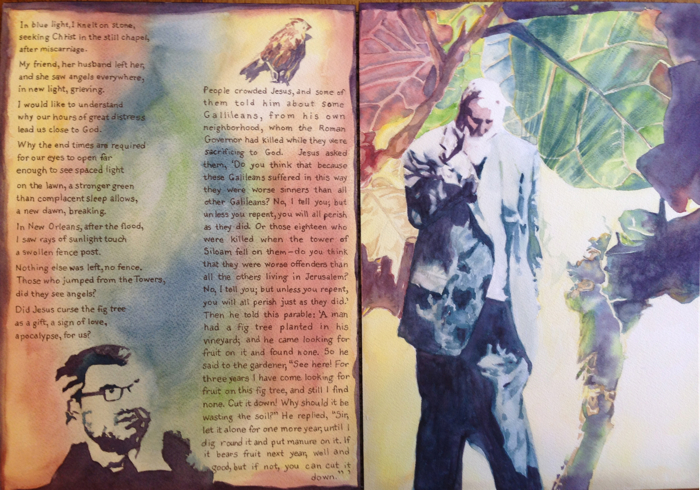
Here’s a painting, or actually two paintings, that I’ve been working on for the last few weeks.  They’re really meant to be an entry into prayer, a meditation on Luke 13 and Mark 11, on the apocalyptic imagery in Jesus’s language and the call to redemption.  Many of the visual ideas come from the Rothschild Canticles, the late medieval prayer book that I’m absolutely fascinated by.  The figure on the right is from a photo that appeared in F.A.M.E. NYC Magazine, of a businessman fleeing ground zero on September 11th, 2001.  I couldn’t find an attribution, and don’t know who took it, but appreciate the photographer and the image.

fig tree canticle painting