Genesis 25

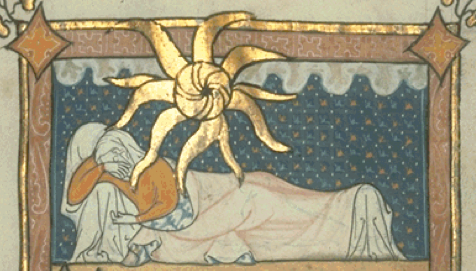
The fabric of the tent moves as if its a veil pulled across a face, in and out with the breath of wind.  She watches it, prone among red blankets.  They’re musty with her sweat, and smell like the goats that the wool was sheared from.  In the center of her body, there is pain.  A full, struggling pain.  She cries, but there’s no one to see her, no one to complain to.  Isaac is out by the cook fire.  She can hear his voice as he talks to the men.  She can smell the seared flesh on the spit.  Alone, she talks to God, rattles out her complaint in the same wheedling voice she’d use with her husband.  “If it is to be this way, why do I live?”  She feels the struggle in her womb, places her hands over her stomach.    A smooth, hard shape moves beneath her skin.  She feels with her fingers, and her voice falls away.  She neglects the tears in her eyes, and gazes up at the side of the tent, the fabric breathing in and out.  She feels another arm, or another leg, with her hands on her womb, and understands.  This is a different child.  There are two in her womb, and they’re wrestling.

The second baby is born clinging to the first baby’s heel.  She nurses them both.  The first baby, the red one, covered with soft down, is stronger, more vital, and less interested in taking the breast.  It is the second infant, who is slight and smooth, who wants to cling to her, who’s little mouth is always clutching at her nipple.  He walks later but speaks first.  He lies with her in the nest of blankets and she teaches him words.  The day is bright outside the tent, and shadows move across it, voices drift in.  They watch together as Esau, her red son, toddles past the screen of fabric.  The men take Esau to the fields, up onto the hills with the flocks, into the wilderness, and he clutches their shins as they shoot their bows.  He has come home from the hunt even redder, with the blood of a gazelle smeared across his cheek.  But when the men are gone, she and Jacob, the heel grabber, watch the side of the tent and see it breathe in and out, and she whispers to him about the voice that told her “Two nations are in your womb, and two peoples born of you shall be divided; the one shall be stronger than the other, the elder shall serve the younger.”

“My brother is greedy,” Jacob says.  He’s nine now, and will often go and wander by himself across the land, from the well to the pasturage, his toes scraped by the grit that kicks up into his sandals.  But he comes back to spend the soft part of the afternoon with his mother, laying on the blankets still, listening with her to the voices of the camp.  He likes to go to the well with her in the morning, and carry the water back for her, and to sit with her beside the fire as she cooks, staring into the embers and letting the smoke tease his eyes and nostrils, resisting the urge to turn away from it.

Outside, the men have come back from the hunt.  They’ve spitted a gazelle, and are laughing.  Mother and son don’t know what they’re laughing at, until they hear Isaac say, “It won’t cook any faster, with you turning the spit so much.”  Jacob sits up and feels the blood rush to his head.  He peers out through the slit of the tent’s entrance, and there’s his brother, beside the fire, his hands on the handle of the spit, his head tilted towards the searing meat, and Jacob can see the greed in his eyes.  He feels his mother sit up behind him.  She’s staring, too, and he can feel the slow working of her mind.  He steadies his own mind into a similar readiness, and they wait for the idea to come.

There are lentils in his hand.  It’s evening, and the sunlight slices into them, and follows them as they drop from his palm into the heart of a kettle.  They are so smooth and dry, and he regrets their dribbling away from him, and lays his palm against the skin of his own shoulder, so that he can feel a similar hard smoothness.  His mother is whispering to him, showing him how much water to pour in, and her hands are dusted with red spices.  Away in the hills they can hear the goats, and she bends to add fuel to the fire.  He’s content to sit, to watch the water boil in the kettle, to see the scum rise on it and then dissipate, and then to wait, observing how the lentils, beneath the tinted, simmering water, slowly, slowly begin to thicken and surrender their smooth form.

“Give me some of that.”  It is his brother, lurking over him.  The smell of goat wafts from his clothing.  His eyes are wide and dark with hunger.

Jacob looks into the pot.  He wants to raise his head, to see where his mother has gone, but he doesn’t.  The men are still coming in from the hills, his father is striding among them, making sure the day’s work is done.  For the moment, he and his brother are alone.  He mutters, his voice no louder than the voice of the stew as it simmers.  “First sell me your birthright.”

His brother leans in to hear him.  There’s a pause, and Jacob wonders if he’s understood.  Esau squats down, jabs his fingers into the stew, licks them.  “I’m dying of hunger.  What’s the use of a birthright to me?”

“Swear to me first.”

A crooked smile on Esau’s red face.  “I swear.  Let me eat.”

Jacob spoons stew into a bowl.  He gives bread to his brother.  He can see that Esau thinks they’re playing, that he doesn’t believe in the transaction that’s just occurred.  He will tell his mother this later, when they’re alone, and she’ll say “He’ll come to believe it.”  But for now, they’re peaceful together, Esau eating and Jacob watching the thick stew bubble and gasp.  A wind picks up.  It’s large and billowing.  It feels like a hand in his hair.

What should we do with our pasts?

I’ve been watching Girls on HBO lately.  Amy and I curl up in bed, watch, and cringe.  The characters treat each other so horribly.  Watching the show makes me remember what I was like at that age, and realize that I didn’t treat people any better.  My cringing is as much about my own shame as it is about anything the characters do.

I spent last week revisiting that shame, but while I was thinking about my youth, I happened to read a passage written by Bernard of Clairvaux.  Bernard was twenty-two years old when he decided to enter the Cistercian abbey at Citeaux.   He convinced his brother and twenty-five of their closest friends to join him.  It’s hard to imagine that Bernard had much to feel guilty about in his previous life.  But apparently he was assailed by the same guilty memories as the rest of us.  Still, he didn’t think that these memories should or even could be ignored.  “In what way will my life be displaced from my memory?” he wrote.  And then went on to write that it wouldn’t be – that his life, all of the things he’d done, good or bad, could not be forgotten.  But he could be forgiven.  “God’s forgiveness blots out sin, not in causing it to be lost from my memory but in causing something which before used to be both in my mind and dyed into it by my moral habits to still be in my memory but no longer to stain it in any way.”

I wish that I could just push that past self away, and forget the things it did. But memory doesn’t work like that – it can’t be abandoned.  But it can be forgiven.  I once described my past to a mentor, and he asked me, “Who loved you, then?”  I thought back to that time when I was being so reckless and indifferent to the damage I caused.  I was able to name quite a few people who loved me.  “Were they fools?” he asked me.  No.  They must have found something lovable in me, even when I couldn’t see it in myself.

So, says Bernard, does God.  If we can face our pasts with the awareness of God’s forgiveness, the story changes.  We no longer live within stories of our shame, but within stories of God’s forgiveness.  God isn’t interested in knowing only half of us, the half we’re proud of and choose to show to the world.  God wants to know all of us, and is willing to forgive and absolve us in order to be part of our wholeness.

A Poem for the OSU Memorial Service tonight

I’ve been asked to lead the OSU Memorial Service tonight, and to come up with some opening remarks.  While I was at Kenyon, I got in the habit of writing poems to serve as invocations and benedictions.  Here’s what I’ve written for tonight:

There can be loneliness in grief.
People pass us on the street
never knowing how closely we
hold to all our memories.
The past means more to us then them;
the past is where our loved ones lived.

We remember how hair smelled
on a child’s head after a bath,
or how a whole small body shook
with laughter, and we shook too,
our bodies moving with their joy.

Now the rooms in which they lived
are transformed by emptiness,
the children who decorated
the walls, who filled the empty air
with their sounds, their smells, are gone.

They outgrew their child selves, and we
follow them on pilgrimage,
to the places they went without us,
and seek sympathy from faces
that were familiar to them,

though not to us.  If each person
is made by the people they know,
then remembrance must include
the world they knew without us.
Their lives gave us to each other.
Let our memories be released
and, set free, release our loneliness.

Two Images of the Wounds of Christ

church born from the wounds of Christcaravaggio

The first image is from a moralized Bible from the 13th century.  The cosmic Christ acts as midwife for himself, the Jesus on the cross, who gives birth to the church through the spear wound in his side.  The second image is Caravaggio’s painting of Saint Thomas, who was absent when the resurrected Jesus first appeared to his disciples, and who insisted that he wouldn’t believe their story until he touched Christ’s wounds himself.

I love both of these images.  I had never heard of nor conceived of the idea that the church was born from the wounds of Christ until I saw this illustration in an art history class, and I’ve been trying to understand what it means for the last week.  I’ve been familiar with images that show Christ as a mother, but a dual image, where he’s both mother and midwife, where the cosmic Christ is standing beside the incarnate Christ, is new to  me.  But I like the theological implication – that Christ plays many roles in the cosmos, and all at once.  I like, too, the idea that the church was born from Christ’s wounds, although I don’t know why I should.  It is, on its surface, a depressing idea.  We’re born from pain and suffering.  But of course, pain and suffering isn’t the real meaning of the cross.  The cross is a symbol of self-sacrificing love.  We are the children of self-sacrificing love.  Doesn’t that mean that such love is hereditary to us?

The second image is much more familiar to me.  Thomas inserts his finger into Christ’s wound up to the fore knuckle.  Christ seems very calm and unconcerned about this prodding and probing.  The flap of skin seems sanitized – this isn’t the bloody wound of the late medieval period, but a wound that seems to absorb the aesthetic of light in Caravaggio’s painting.  The wound seems too small for anything to be born through it.  In many ways, this painting is the reverse of the first image.  The church isn’t born out of the wound.  The disciple, a stand-in for the church, inserts himself into the wound.  There’s something clinical about this, and perhaps it reflects a desire to climb back into the body of Christ.  To remove the church from the messy, dirty, distrusted world and retreat into a place of sanitized safety.

The church is always struggling between the two poles that these images represent.  Should we entirely enter the world, be born into it, and learn to walk and live in it?  Or should we stay within the body of Christ, isolated from the world by the skin and muscle and viscera of our Savior?  Is it our doubt that makes us want to crawl inside Christ’s body, where doubt can be overcome by the insistent reality of a beating heart?

In my meditation on these images, I’ve come to prefer the first, and not only because I’m drawn to the aesthetics of 13th century manuscript painting.  It is the figure of Christ as midwife that I prefer.  The reassurance that, if the church is to leave the warm and nurturing body of Christ, and act with sacrificial love within the world, we will do so with the swaddling arms of the midwife Christ around us.

Maundy Thursday

My parents moved to Malaysia at the start of my sophomore year of college, and our connection to the small Wisconsin town where I’d gone to high school was severed.  I had never made connections to any place for long.  My dad was a United Methodist minister, and we moved every six or seven years.  But the friendships I made in high school were some of the most important in my life, and although I haven’t retained close contact to the people I knew then, I can’t think of them without happiness and gratitude.  I remember especially one summer afternoon, after I’d just gotten back from a family trip to California.  I’d encountered God on that trip.  I’d had an epiphany in the John Muir woods, an indescribable experience of ferns and tall trees and clear light.  When I arrived back home, I wanted to tell my friends about it, and we walked together to a grassy hill behind the high school.  They weren’t religious, and I hadn’t been up until that point in my life, but there was no judgement when I told them about my epiphany.  They were open to anything.  They accepted my experience as valid, because I had experienced it, and we didn’t try to assess or control each other’s experiences.

But by the beginning of my sophomore year, I had new college friends.  My girlfriend was my one remaining link to the home of my high school years, and that only tangentially, since she’d gone away to college as well, and we’d spent the summer together in Madison, detached from the place where we’d grown up.  When I thought of home, I thought of her.  So when my parents prepared to leave the country, I wasn’t worried.  I was part of a college social group, and had been initiated the previous spring in a rite that was full of joy and weirdness and a kind of grace.  I had places where I thought I belonged.

That October, my girlfriend broke up with me.  It seems amazing that this break-up was one of the most devastating experiences of my life, given that my adult life hasn’t been devoid of devastating experiences, moments that, in any hierarchy of crisis, should have been far more traumatic.  But I was nineteen, and I hadn’t learned how to deal with devastation yet.  It was all new to me, and more anguishing because it was so surprising.  And the most surprising part was that I found that I couldn’t turn to my new friends for help.  Members of my college social group soon got tired of my depression.  While sitting at dinner one night, one of my friends said “I know you loved your girlfriend and everything, but she’s moved on to a new thing, and you need to just accept that.”  To be fair, I must have been a terribly downbeat person to be around.  Whiny and mopey and angry.  But I also realized that the community I belonged to was only about fun, and that when I ceased to be fun, I lost my membership in it.

Maundy Thursday is all about good and bad communities, and the fact that a single community can often be both good and bad.  As we commemorate the day, we start with a vision of a very good community.  Jesus and the disciples gathered together for dinner, for celebration, for the pleasure of being in each other’s company.  As they ate and drank, they could forget, for a moment, that Jesus had told them that everything was going to end in death and dishonor.  He washed their feet, an act of love and vulnerability that it’s still hard for many people to reconcile themselves to.  The sense of closeness in that room must have been profound.  But almost as soon as that sense of closeness was really and truly established, it began to break apart.  Jesus told his disciples that one of them would betray him.  The disciples, alarmed by this prospect, began to quibble about which one of them was the greatest.  Then Jesus told Peter that he would deny him three times.  And all of the darkness in the life of a community was present in the room.

Communities can be places of grace and love, of true acceptance and non-judgement.  They can be composed of people who want nothing more than to journey together towards some barely defined goal, who are more interested in the journey than the goal itself.  People who will support and stand with each other in both good times and bad.  And they can be places of control, betrayal, and indifference, full of people who are all too willing to abandon each other.  Maundy Thursday is about both kinds of community.  It speaks to a fundamental truth about life.  People will fail us.  We will be hurt.

After dinner Jesus and the disciples went to the Garden of Gethsemane.  The disciples fell asleep.  Jesus prayed alone.  This is the final statement that this day has to make about community.  Community can never take the place of God.  In the end, the perfection we are looking for doesn’t exist within human institutions.  It exists only in God, and only very rarely can other people follow us to the moment when we encounter God.  But there is always the chance to return from these lonely sojourns into God’s presence, and find the people who are willing to hear what we’ve encountered.  To hear, and help us make sense of these encounters, not through judgement, but patient listening.  Through summer walks to grassy hills.  Through friendship.