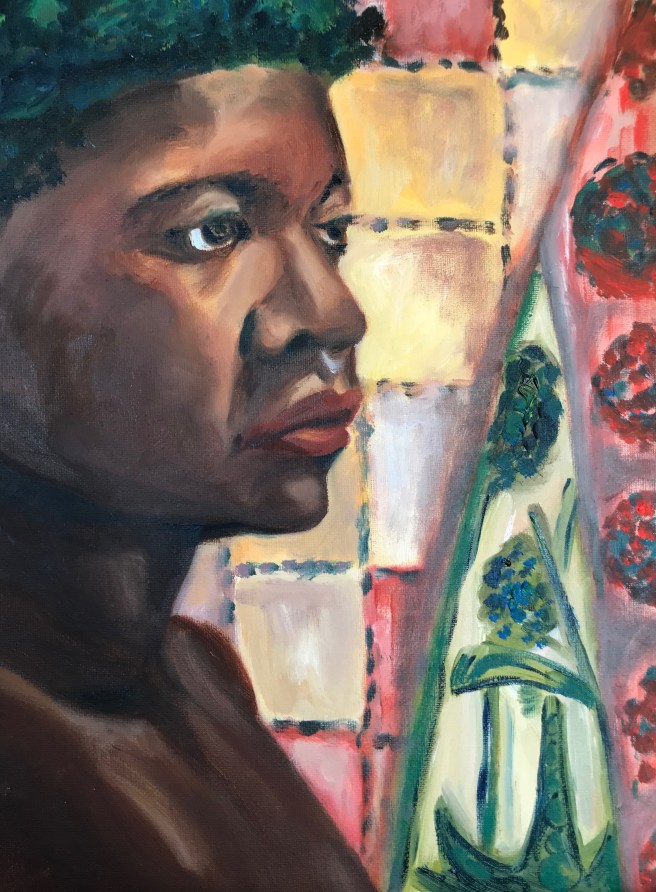
Invocation #3

Invocation #3
Oil on canvas. KPB Stevens, 2018. go to prayerbookart.com to buy.

Oil on canvas, 11″ x 14″.  

God of the weed spikes and white flowers,
and half-dusk from the shadows of trees,
help us to shatter carefully arranged light,
the idea that everything must have its place,
the insistence on more symmetry than you require.  

Give the All for the All

Having found in many books different methods of going to God and diverse practices of the spiritual life, I thought this would serve rather to puzzle me than facilitate what I sought after, which was nothing but how to become wholly God’s. This made me resolve to give the all for the All. After having given myself wholly to God, to make all the satisfaction I could for my sins, I renounced, for the love of God, everything that was not God, and I began to live as if there was none but God and I in the world.

-Brother Lawrence

This, truly, is for me the most intimidating quote from Brother Lawrence.  I am a person who likes methods, practices, liturgies, and literary forms.  I feel more comfortable if there’s a roadmap, if I can feel myself surrounded by spiritual mentors and forebears. The very desire to use someone else’s spiritual writings in prayer arises from this tendency.  I find many different methods of going to God and diverse practices in books, and I like doing this, and trying out those methods and practices for awhile, depending on my season of life.  But Brother Lawrence makes me pause and wonder if all of these spiritual contraptions aren’t simply a distraction.  Knowing and loving God isn’t really that hard, after all.  You just have to pay attention to yourself and the world, and invite God into your observations.  That said, I don’t think I’ll stop dipping into books and looking for the wisdom of others to help me in my prayer life.  But it’s good to be reminded that it’s not necessary for me to do so, and that I shouldn’t let these methods become an idol by clinging to them too desperately, or assuming that I have no relationship with God without them.

Praising, Adoring, and Loving God

What is the grace that Brother Lawrence speaks of in the quote below?  We’re happy when things go our way, and we might think of this as grace, but it’s not.  Happiness is a comparatively simple thing, drawing its energy and existence from temporal success or momentary relationships with other people, or, often in my case, the ability to convince oneself of everyone else’s love and regard.  But grace isn’t really temporal.  For Brother Lawrence, it comes from cultivating and maintaining contact with the eternal.  Often, this means simply living in the moment and reaching out to God in the moment.  This is the grace of a dancer, who’s physical body seems to occupy space in a way that’s different from the rest of us, but mostly because she’s conscious of that space, and her body’s movement through it.  Her grace comes from awareness of present movement and present moment.

In our conversation with God we should also engage in praising, adoring, and loving God incessantly for God’s infinite goodness and perfection. Without being discouraged on account of our sins, we should pray for God’s grace with a perfect confidence, as relying upon the infinite merits of our Lord. Brother Lawrence said that God never failed offering us grace at each action. It never failed except when Brother Lawrence’s thoughts had wandered from a sense of God’s Presence, or he forgot to ask God’s assistance. He said that God always gave us light in our doubts, when we had no other design but to please.

A Continual Exercise of Love

Brother Lawrence tells us that he spent a lot of time trying to be dutiful and follow the prayer methods that everyone else seemed to be using before he finally settled on his own simple way of praying.  W/hen I read the quote below, it’s hard not to be reminded of Centering Prayer, and of the carefully delineated method laid out in The Cloud of Unknowing.  I doubt that this was a method Brother Lawrence was taught – he speaks more often of rites of abstinence and mortification as the standard practice of his place and time.  But even if he was taught some form of Centering Prayer, I can’t imagine him actually sticking to it for very long.  His method was much more direct, and, more importantly, it was all his own.  As a person who often teaching methods of prayer, it’s important for me to remember that the best kind of prayer is the one that is suited to the person who is praying.  And sometimes, as in Brother Lawrence’s case, its a communion with God that is so direct that it can hardly be called a method at all.

He said that useless thoughts spoil all – that the mischief began there. We ought to reject them as soon as we perceived their impertinence and return to our communion with God. In the beginning he had often passed his time appointed for prayer in rejecting wandering thoughts and falling right back into them. He could never regulate his devotion by certain methods as some do. Nevertheless, at first he had meditated for some time, but afterwards that went off in a manner that he could give no account of. Brother Lawrence emphasized that all bodily mortifications and other exercises are useless unless they serve to arrive at the union with God by love. He had well considered this. He found that the shortest way to go straight to God was by a continual exercise of love and doing all things for God’s sake.

Greatest Simplicity

Brother Lawrence was both very humble and very trusting.  The intimacy he had with God left him in no doubt that God would provide for him, even if what God offered in the moment was a series of trials or, even, a good death.  We have trouble thinking of trials as a gift from God.  When I was young I welcomed them because I knew that they were helping me learn and develop.  Now that I’m in middle age, I find them burdensome.  Aren’t I developed enough?  God’s answer, of course, is no.  I wish that I had Brother Lawrence’s simplicity, his ability to simply ask for God’s assistance without having a pre-planned idea of what that assistance should look like.  Here’s the quote that accompanies the prayer card I made to help me meditate on this:

When an occasion of practicing some virtue was offered, Brother Lawrence addressed himself to God saying, “I cannot do this unless Thou enablest me”. And then he received strength more than sufficient. When he had failed in his duty, he only confessed his fault saying to God, “I shall never do otherwise, if You leave me to myself. It is You who must hinder my falling and mend what is amiss.” Then, after this, he gave himself no further uneasiness about it.  He said we ought to act with God in the greatest simplicity, speaking to God frankly and plainly, and imploring God’s assistance in our affairs just as they happen. God never failed to grant it, as Brother Lawrence had often experienced.