Luke 2:1-21 Divinity Entangled with Humanity

The Gospels claim, and Christians believe, that divinity is entangled with humanity.  The evangelists go even further. When Jesus talks about the Kingdom of God, he is saying that creation itself is shot through with divinity.  Divinity is all around us, and it always has been. Poets and mystics alike attempt to see through the veil of ordinary existence to the extraordinary, pulsating life of the world.  This requires a deep spiritual practice. One of my favorite poets, Denise Levertov, describes this beautifully with a line from In Memory: After a Friend’s Sudden Death: “to heedfully walk and sing through dailiness noticing stones and flowers.”  We must be heedful in our noticing if we are to cultivate a spirituality of incarnational wonder.  And once you start practicing this heedful noticing, you find yourself spiritually aligned with the shepherds: accosted by angels, filled with joy and fear, ready to rush off and seek the miraculous.

The most surprising thing about the miraculous in the nativity story in Luke’s Gospel is that it takes the form of a newborn child.  Ephraim of Syria, a fourth century poet and theologian, wants us to dwell within this sense of surprise. “Mary bore a mute Babe though in Him were hidden all our tongues.”  Jesus, the miracle, the Word that dwelled before time and was active in creation, becomes human as someone who cannot speak. You might say, “well of course, that’s how all of us become human.”  But if all things are possible with God, then Jesus’ could have just shown up as an adult. His incarnation as a wordless, squalling baby is meant to tell us something. First, that the spiritual practice of noticing and participating in incarnation takes a great deal of care.  We need to attend to it like we would to a newborn. Second, that the spiritual life is a journey, just as physical life is, and that it will have moments of trial and error, success and failure, growth and senescence. We are figurative infants at the beginning of our imitation of Christ, and we would do well to remember that.  Babies lack control of words, of their bodies, of their relationships. They are humbly reliant on the people who surround them. And that’s how we should start. With humility and the acknowledgement that we are not in control.

Luke 1:57-80 Joy, Community, and Wilderness

When Elizabeth gives birth to John, her neighbors and relatives gather around in joy.  This is the second gang of people we’ve seen in Luke’s Gospel, the first being the crowd at the temple who gathered around Zechariah after he emerged from his encounter with an angel.  I think it’s fair to say that they were a random assembly, not a true community. It’s the true community that comes together after John’s birth, and the true community that responds to his birth with rejoicing.

Anyone who’s lived in a community knows that communities are complex, as full of willful hurting as they are of spontaneous rejoicing.  But with this first real community in Luke, we’re shown what they should be like when they’re authentic. The communities that Luke will portray throughout his two books are often a little awkward, confused, and stumbling.  Sometimes they’re downright funny. And this first community of Elizabeth and Zechariah’s relatives has all of those qualities. They think of themselves as the keepers of tradition, maybe even without realizing it. Of course the boy should be named after his father!  That’s how it’s done. And Zechariah, if he could speak, would say the same. I find it hard not to imagine Elizabeth’s frustration with this, and the frustration of any woman reading this story and remembering those times when what she’s said has been ignored or discounted.  This community of loved ones is stumbling through its joyfulness, getting things wrong. They don’t know that they’re dealing with the Holy Spirit, and that things are about to get weird.

No wonder they’re fearful after Zechariah writes John’s name on a slate, and then begins to prophecy.  It’s obvious that during his nine months of silence, he’s been pondering some things. The Holy Spirit directs his words, and what comes out of his mouth is so rich and profound that it’s become a canticle of the church, said or sung during Morning Prayer or Lauds.  The most surprising thing about Zechariah’s prophecy is that it’s not about things that will come true, but about something that already has come true.  God has already redeemed the people of Israel, has already made good on the divine promise that was given to them.  Zechariah is speaking about Jesus, of course, but Jesus hasn’t even been born yet. It’s as if the very promise of Jesus, the very possibility that God would become human and show us how to approach divinity through our lives and actions, is enough.  And this promise is already working in us. Because of it, we will be able to serve God without fear, in holiness and righteousness all of our days. Because of this promise, our sins are forgiven, and we will know how to walk in the way of peace.

Imagine being part of the community that first heard those words.  Some of what Zechariah’s saying makes sense, you might say to yourself.  We are descended from Abraham, and we have been waiting for certain promises to be redeemed for quite awhile.  And we get that John is going to be a nazirite, like Samuel was, and live in the wilderness and never cut his hair.  It’s a little old-fashioned, but we remember when people used to do that. But what about this new thing, this mighty savior that he’s talking about?  Who is this person? Where will we find him? What will he be like? And why are Elizabeth and Zechariah packing their bags and moving to the wilderness with their baby?

That last question is the most immediately important one to Luke’s narrative.  This portion of his Gospel, that starts with a community coming together to rejoice, ends with Zechariah and Elizabeth choosing isolation from community.  And this points to one of the things that Luke wants to say about community in general. Community is a good and important thing. But it’s not the most important thing.  Sometimes it will hurt and betray you. Sometimes you will need to leave it behind. In fact, if a new community, full of holiness and righteousness and hope is to be born, it’s necessary that the old community scatter so that bad habits will be broken, good habits regathered, and new practices ushered in.

Luke 1:1-56 Suddenly the Spirit is Talking to Everybody

The Holy Spirit pours into the beginning of Luke’s Gospel, embodied by angels and the singing, leaping responses that human beings make to them.  When the angels arrive its with a wildness and strangeness that has mutating effects on the people who encounter them. An old man falls silent, an old woman becomes pregnant, a virgin conceives and sings a song that anticipates the reordering of the entire world.  Luke is telling us that encounters with the divine will transform our lives, and that people with transformed lives eventually end up participating in the transformation of existence itself. This is the opening trumpet blast announcing Luke’s spirituality, which is about divine encounter, surrendered conventionality, and the remaking of human existence.

Elizabeth and Zechariah are both old when an angel appears with its revelations.  They are both Levites, descendants of Aaron, born into the priestly cast, their position in society assured since birth. They do their duty, get along with their neighbors, and act rightly in all circumstances. The only thing about them that could cause anyone to talk behind their backs is the fact that they have no children. Elizabeth feels this keenly. She refers to it as a disgrace, and maybe she thinks about Sarah, that great matriarch of her people, who also reached old age in a childless condition.

So where is the note of unconventionality that could lead them to raise an iconoclast like John the Baptist?  Maybe there is some wildness inside of them, carefully repressed through all their long years. But I suspect that John’s wildness is the result of Zechariah’s encounter with the angel. It’s hard to find a good image of this encounter. Baroque and Rococo paintings show very human looking angels, naked and floating suspended in swaths of cloth, descending on a startled looking old man who is, somehow, surrounded by onlookers, even though the Gospel tells us that Zechariah was alone in the Holy of Holies. Angels in art are rarely weird enough for the story that’s being conveyed in scripture. Contemporary art does a better job at capturing their essence. In paintings by Alexander Roitburd and Wassily Kandinsky they are riots of color, deeply abstract, and there’s nothing quiet or restful about looking at them. The angel of the Lord who appears to Zechariah is terrifying, and not very patient.  Poor Zechariah gets struck dumb for voicing only the tiniest of doubts, and really its a doubt that’s more about his own unsuitability than it is about God’s intentions.

We’re not told if Elizabeth learns about her husband’s encounter with the angel. He certainly can’t tell her about it. But she gets pregnant pretty quickly, and she has no trouble believing that its happening. In fact, both women in this first chapter of Luke’s Gospel fare better than the men. When the Angel Gabriel appears to Mary, she questions divine revelation, just like Zechariah did. But Gabriel is a more patient divine messenger, explains things more thoroughly, and doesn’t strike her dumb. Instead, she gets to sing, and gives us the words of the lovely and challenging Magnificat, which we can sing, also. It’s through the words of this hymn that we come to understand that a transformation is about to take place, that the world is about to be remade.

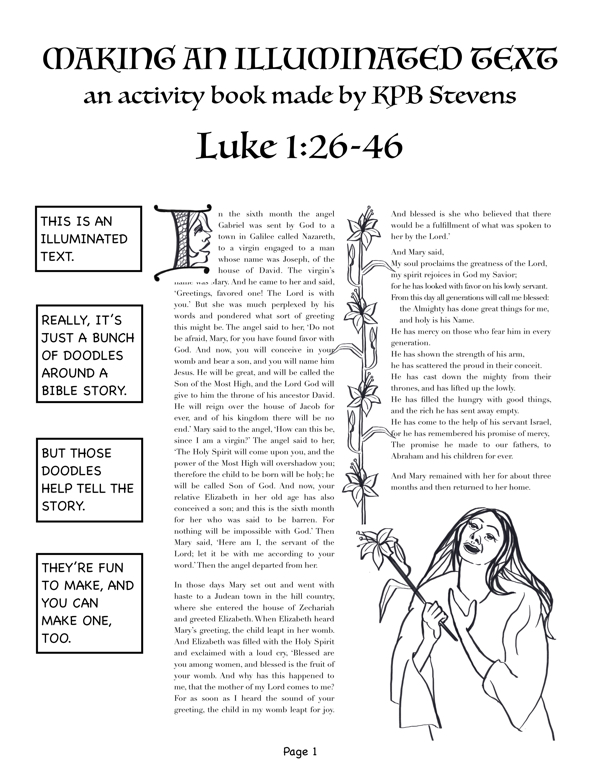
Illuminated Text Workbook for Luke 1:5-25

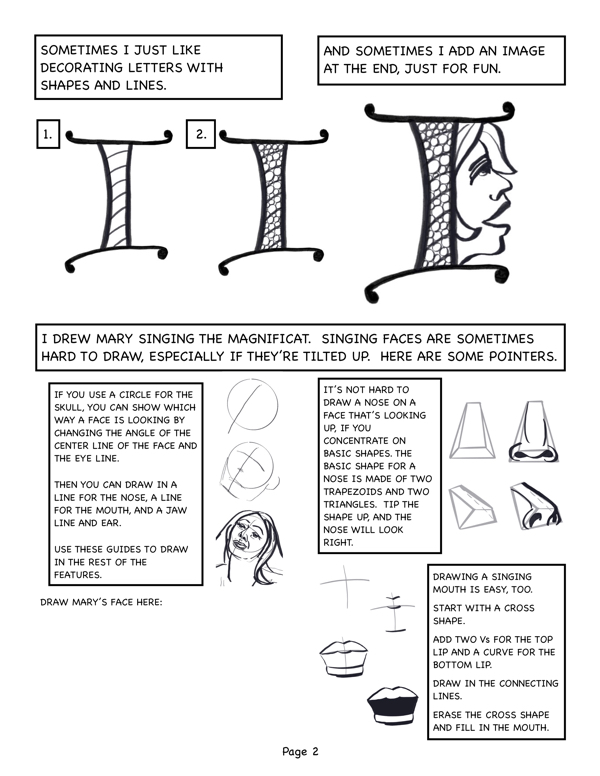
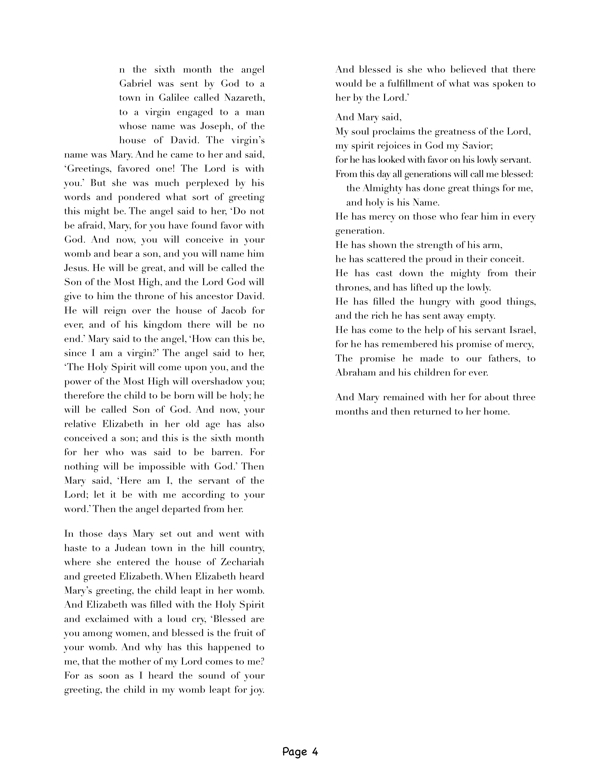
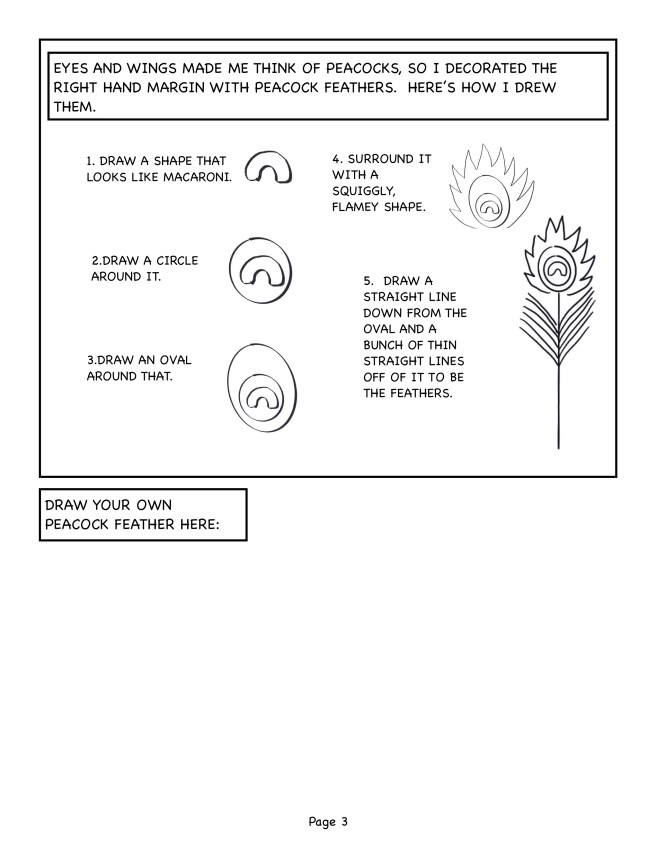
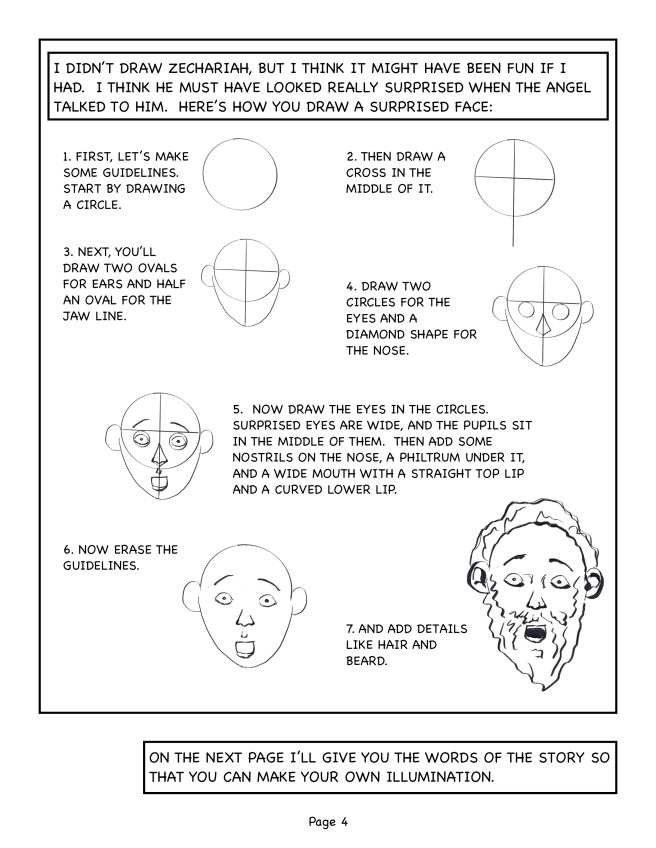
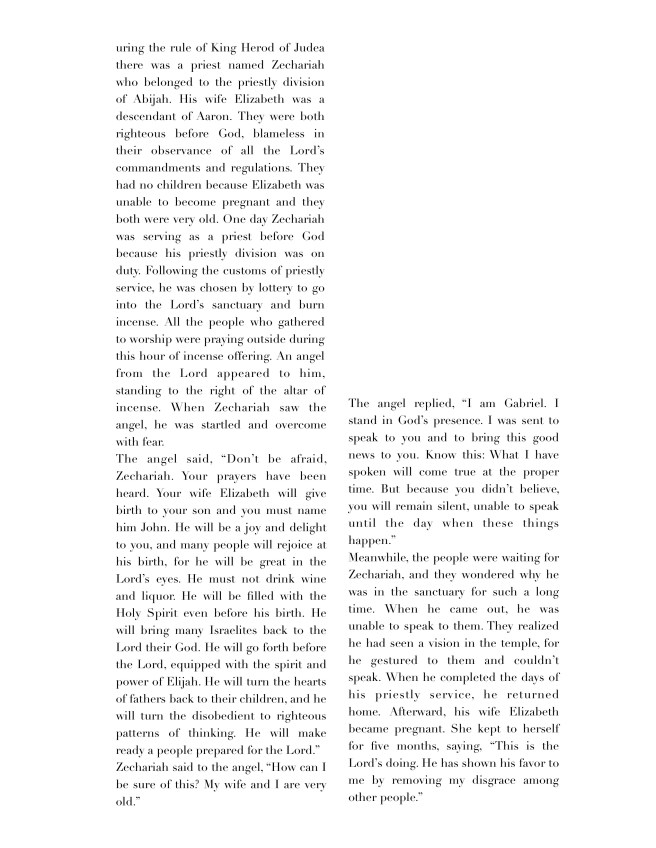
I used to make illuminated text workbooks for kids, and I decided to revive the practice in my work with the kids of St. John’s, Worthington.  Since this is the year of the Diocese of Southern Ohio’s Luke/Acts Big Read, I decided to make one for the beginning of Luke.  Hopefully I’ll keep up the practice in the weeks to come, although I’m sometimes inconsistent.  The separate pages are below, and there’s a link to the entire workbook at the end of this post.

Illumination Text workbook for Luke 1.5-25 page 1

Illumination Text workbook for Luke 1.5-25 page 2

Illumination Text workbook for Luke 1.5-25 page 3

Illumination Text workbook for Luke 1.5-25 page 4

Illumination Text workbook for Luke 1.5-25 page 5

Here’s the .pdf version, if you want to download it and use it with your church or family.

Illumination Text workbook for Luke 1.5-25