A Poem for the OSU Memorial Service tonight

I’ve been asked to lead the OSU Memorial Service tonight, and to come up with some opening remarks.  While I was at Kenyon, I got in the habit of writing poems to serve as invocations and benedictions.  Here’s what I’ve written for tonight:

There can be loneliness in grief.
People pass us on the street
never knowing how closely we
hold to all our memories.
The past means more to us then them;
the past is where our loved ones lived.

We remember how hair smelled
on a child’s head after a bath,
or how a whole small body shook
with laughter, and we shook too,
our bodies moving with their joy.

Now the rooms in which they lived
are transformed by emptiness,
the children who decorated
the walls, who filled the empty air
with their sounds, their smells, are gone.

They outgrew their child selves, and we
follow them on pilgrimage,
to the places they went without us,
and seek sympathy from faces
that were familiar to them,

though not to us.  If each person
is made by the people they know,
then remembrance must include
the world they knew without us.
Their lives gave us to each other.
Let our memories be released
and, set free, release our loneliness.

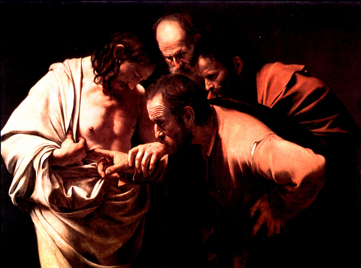
Two Images of the Wounds of Christ

church born from the wounds of Christcaravaggio

The first image is from a moralized Bible from the 13th century.  The cosmic Christ acts as midwife for himself, the Jesus on the cross, who gives birth to the church through the spear wound in his side.  The second image is Caravaggio’s painting of Saint Thomas, who was absent when the resurrected Jesus first appeared to his disciples, and who insisted that he wouldn’t believe their story until he touched Christ’s wounds himself.

I love both of these images.  I had never heard of nor conceived of the idea that the church was born from the wounds of Christ until I saw this illustration in an art history class, and I’ve been trying to understand what it means for the last week.  I’ve been familiar with images that show Christ as a mother, but a dual image, where he’s both mother and midwife, where the cosmic Christ is standing beside the incarnate Christ, is new to  me.  But I like the theological implication – that Christ plays many roles in the cosmos, and all at once.  I like, too, the idea that the church was born from Christ’s wounds, although I don’t know why I should.  It is, on its surface, a depressing idea.  We’re born from pain and suffering.  But of course, pain and suffering isn’t the real meaning of the cross.  The cross is a symbol of self-sacrificing love.  We are the children of self-sacrificing love.  Doesn’t that mean that such love is hereditary to us?

The second image is much more familiar to me.  Thomas inserts his finger into Christ’s wound up to the fore knuckle.  Christ seems very calm and unconcerned about this prodding and probing.  The flap of skin seems sanitized – this isn’t the bloody wound of the late medieval period, but a wound that seems to absorb the aesthetic of light in Caravaggio’s painting.  The wound seems too small for anything to be born through it.  In many ways, this painting is the reverse of the first image.  The church isn’t born out of the wound.  The disciple, a stand-in for the church, inserts himself into the wound.  There’s something clinical about this, and perhaps it reflects a desire to climb back into the body of Christ.  To remove the church from the messy, dirty, distrusted world and retreat into a place of sanitized safety.

The church is always struggling between the two poles that these images represent.  Should we entirely enter the world, be born into it, and learn to walk and live in it?  Or should we stay within the body of Christ, isolated from the world by the skin and muscle and viscera of our Savior?  Is it our doubt that makes us want to crawl inside Christ’s body, where doubt can be overcome by the insistent reality of a beating heart?

In my meditation on these images, I’ve come to prefer the first, and not only because I’m drawn to the aesthetics of 13th century manuscript painting.  It is the figure of Christ as midwife that I prefer.  The reassurance that, if the church is to leave the warm and nurturing body of Christ, and act with sacrificial love within the world, we will do so with the swaddling arms of the midwife Christ around us.

Maundy Thursday

My parents moved to Malaysia at the start of my sophomore year of college, and our connection to the small Wisconsin town where I’d gone to high school was severed.  I had never made connections to any place for long.  My dad was a United Methodist minister, and we moved every six or seven years.  But the friendships I made in high school were some of the most important in my life, and although I haven’t retained close contact to the people I knew then, I can’t think of them without happiness and gratitude.  I remember especially one summer afternoon, after I’d just gotten back from a family trip to California.  I’d encountered God on that trip.  I’d had an epiphany in the John Muir woods, an indescribable experience of ferns and tall trees and clear light.  When I arrived back home, I wanted to tell my friends about it, and we walked together to a grassy hill behind the high school.  They weren’t religious, and I hadn’t been up until that point in my life, but there was no judgement when I told them about my epiphany.  They were open to anything.  They accepted my experience as valid, because I had experienced it, and we didn’t try to assess or control each other’s experiences.

But by the beginning of my sophomore year, I had new college friends.  My girlfriend was my one remaining link to the home of my high school years, and that only tangentially, since she’d gone away to college as well, and we’d spent the summer together in Madison, detached from the place where we’d grown up.  When I thought of home, I thought of her.  So when my parents prepared to leave the country, I wasn’t worried.  I was part of a college social group, and had been initiated the previous spring in a rite that was full of joy and weirdness and a kind of grace.  I had places where I thought I belonged.

That October, my girlfriend broke up with me.  It seems amazing that this break-up was one of the most devastating experiences of my life, given that my adult life hasn’t been devoid of devastating experiences, moments that, in any hierarchy of crisis, should have been far more traumatic.  But I was nineteen, and I hadn’t learned how to deal with devastation yet.  It was all new to me, and more anguishing because it was so surprising.  And the most surprising part was that I found that I couldn’t turn to my new friends for help.  Members of my college social group soon got tired of my depression.  While sitting at dinner one night, one of my friends said “I know you loved your girlfriend and everything, but she’s moved on to a new thing, and you need to just accept that.”  To be fair, I must have been a terribly downbeat person to be around.  Whiny and mopey and angry.  But I also realized that the community I belonged to was only about fun, and that when I ceased to be fun, I lost my membership in it.

Maundy Thursday is all about good and bad communities, and the fact that a single community can often be both good and bad.  As we commemorate the day, we start with a vision of a very good community.  Jesus and the disciples gathered together for dinner, for celebration, for the pleasure of being in each other’s company.  As they ate and drank, they could forget, for a moment, that Jesus had told them that everything was going to end in death and dishonor.  He washed their feet, an act of love and vulnerability that it’s still hard for many people to reconcile themselves to.  The sense of closeness in that room must have been profound.  But almost as soon as that sense of closeness was really and truly established, it began to break apart.  Jesus told his disciples that one of them would betray him.  The disciples, alarmed by this prospect, began to quibble about which one of them was the greatest.  Then Jesus told Peter that he would deny him three times.  And all of the darkness in the life of a community was present in the room.

Communities can be places of grace and love, of true acceptance and non-judgement.  They can be composed of people who want nothing more than to journey together towards some barely defined goal, who are more interested in the journey than the goal itself.  People who will support and stand with each other in both good times and bad.  And they can be places of control, betrayal, and indifference, full of people who are all too willing to abandon each other.  Maundy Thursday is about both kinds of community.  It speaks to a fundamental truth about life.  People will fail us.  We will be hurt.

After dinner Jesus and the disciples went to the Garden of Gethsemane.  The disciples fell asleep.  Jesus prayed alone.  This is the final statement that this day has to make about community.  Community can never take the place of God.  In the end, the perfection we are looking for doesn’t exist within human institutions.  It exists only in God, and only very rarely can other people follow us to the moment when we encounter God.  But there is always the chance to return from these lonely sojourns into God’s presence, and find the people who are willing to hear what we’ve encountered.  To hear, and help us make sense of these encounters, not through judgement, but patient listening.  Through summer walks to grassy hills.  Through friendship.

At the Memorial Service

Last night I went to a memorial service at the Newman Center, for Brittany and Courtney, two students who died in a car wreck on their way back to campus at the end of Spring Break.  The Newman Center is a very modern church building, with big abstract stained glass windows and a large video screen positioned above the band.  I sat towards the back and watched a slide show of the girls’ lives while waiting for the service to begin.  The room was full, and people shifted in their chairs, had murmured conversations, tilted their heads up towards the screen.  Music was playing from the speakers in the center of the sanctuary, and the songs that the kids who put the slide show together had chosen were cheerful.  They played Bob Marley’s “Three Little Birds,” a song I love, and while an old, stiff part of my soul wondered about it’s appropriateness, I found myself surrendering to it, to the sentiment it expresses.  Every little thing will be all right, even in the face of death.

The priest continued that theme once the service began.  He lit the Paschal candle and talked about its meaning, a symbol of new life in baptism, a symbol of continued life at burial.  A visual reminder of the hope of the resurrection.  I was aware that not everyone in the room was a Christian.  My life as a college chaplain has been about meeting the spiritual needs of a wide variety of people who are at different places in their lives of faith, or living lives entirely without faith.  But I was glad that the priest took time to explain the meaning of the ritual.  I think that everyone, believers and unbelievers alike, can accept an authentic ritual, and that sincerity of belief is more welcoming than attempts to hide it.

These assumptions were challenged, however, when the priest offered the mike to the people there, inviting them to memorialize Brittany and Courtney.  The first person to get up was a girl who had known one of the students, and the first part of her talk was a true memorial, a list of memories that honored the dead.  But then she began to preach.  She said that she’d come to Christ in the last year, and that everyone should follow her lead if they wanted assurance of heaven.  She said that her faith had “saved her from a gay lifestyle.”  I cringed.  And I felt sorry for her.  This poor child was being taught that she was somehow unacceptable to God, and that God is not loving, but judgmental and cruel, always weighing our actions and all too willing to send us to hell.  But she didn’t make me angry.  This was how she was dealing with her grief, and people who are sorrowful cast about for certainties.

The next speaker made me angry.  This was a tall young man, who had been sitting next to the first speaker.  He got up and came forward and told us that he didn’t know either of the dead girls.  He said that we couldn’t honestly know if they were in heaven and hell.  They may have claimed to be Christian, and members of their Catholic and Methodist churches, but that didn’t mean they’d really “come to Christ.”  Nor, in his mind, did it mean that Christ would have any inclination to save them.  He threatened us.  Come to Christ or you’ll go to hell.

Fortunately, the priest stopped him before he went any further.  “This is about Courtney and Brittany,” he said.  “This isn’t an altar call.”  The young man returned to his seat.  I watched him.  He was obviously angry at having been stopped in the middle of his tirade.  His friends tried to reassure him.  The memorial service went on.  Real friends of Courtney and Brittany got up.  They talked about the specific truths of the girls’ lives, how Brittany was always singing, how Courtney’s smile could give solace at the end of a hard day.  They honored the specificity of the girls’ lives, and I honored them for it.

This morning I woke up thinking about that tall, angry young man, and the girl who proceeded him.  Did they think they were being loving?  How is it that they could be so indifferent to grief, so hopelessly callous towards the wounded souls in the room, so ignorant of God’s true love for the world?  I began wondering, and I wonder now, if they haven’t been abused in some way, at some point in their lives.  Maybe they’ve chosen a form of Christianity with an abusive ethic because abuse is familiar to them, so familiar that it’s almost comfortable.  Maybe they’ve been told that they, as individuals, don’t matter, and so they assume that individuals don’t matter to God.  Maybe they’ve been taught to run away from the specificity of their own lives, and therefore can’t imagine that God would care that both Courtney and Brittany liked to wear bathrobes in the morning, that Courtney always made Brittany’s coffee, that they were kind and loving people, and full of joy.

My perfect church would be a community of people who supported each other in their lives with God, and didn’t try to control the direction in which anyone’s faith led them.  A community of saints, that was concentrated on God’s love for the world, and therefore tried to imitate that love.  Jesus tells us that God knows every hair on our heads.  Because God loves us so much, the specificity of our hair matters.  The specificity of our bodies matter.  We matter to God, in all of our moments – at a bar, drinking coffee on the sofa in the morning, when we’re with our loved ones, whoever they may be.  That’s how one remembers the dead.  By trying to see them through God’s eyes, in all of their glorious and wonderful variety.  The truer Christians were the friends who got up with no purpose other than to tell stories about Brittany and Courtney.  Truer, because they acted more like Christ, whatever their faith may be.

Sketch of a poem, written at Procter Center while looking out the chapel window at the lake

Winter white on the moving water,
reflected not only from the snow,
but the trees, the day, the surrounding weeks –
the world is bleached.

My grandmother made everything clean.
She ate wall paper paste when a refugee
with two small children in tow,
and everywhere was trampled snow.
Later her hands always smelled of bleach,
her skin was tight, it shone,
looked breathed on and polished,
incomplete in dampened light –

not scarred, but something far beyond
my knowledge was reflected in her skin.

And now the cold lake, moving winter
that knows everything it knows,
water that goes and goes
within its own flat glaze,
the colors almost fade,
the tints lay rigid and subdued –
yet the world is too much,
too true.