
Under the Covers

“Why didn’t Jesus have sex?”  One of my students asked me this some years ago.  We were in the middle of cooking dinner for our weekly campus ministry meal, and my thoughts were on the onions simmering in a pan and on gathering the ingredients to make dessert.  I was distracted and the answer I gave her wasn’t well thought out.

“Because Jesus’s love is for everybody,” I said.  “There’s something about sex that creates a really deep intimacy between just two people, and Jesus’s intimacy is for everyone.  He either had to have sex with no one or everyone.”

I don’t think my student was satisfied with this answer.  I think she was probably asking a more specific question, “Is sex related to God,” or “does having sex take me out of my relationship with Jesus?”  If I had been able to hear these real concerns beneath the question that she did ask, I would have answered differently.

There’s a lovely illumination in the Rothschild Canticles that shows a nun, meditating upon her bed.  The Godhead appears above her in the shape of a sun, and one ray of that sun is reaching under the sheets.  It’s an image that reflects a late medieval spirituality that sought mystical union with God through erotic imagery.  I like it very much, because I think that it has something to teach us.  That teaching can be simplified to this – Jesus is with us under the covers.  He’s engaged in our intimacy, not absent from it.
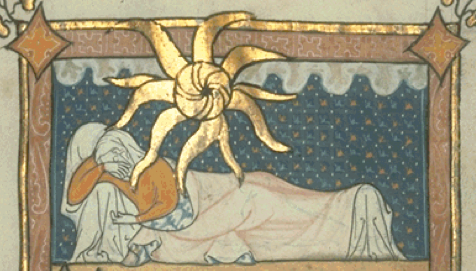
rothschild

My friend Laurie and her friends used to open the hymnal when they were bored in church and add the words “under the covers” to the ends of hymn verses.  They giggled at phrases such as “Lo how a rose ever blooming, under the covers,” or “Come thou font of every blessing, under the covers.”  But this game was unexpectedly theological, even though they may not have intended it to be.  It was probably the only acknowledgement they ever heard in church of the idea that God is present with us in our intimacy.  Why is this idea so unnerving that preachers can’t preach on it, and it only gets expressed in the titillation of giggling children?

Imagine the gift that the church could give to people if it only dared to talk about the ways in which God can be present in our intimacy.  One of the paradoxes of sex is that it’s bodily, but also out-of-body at the same time.  The accumulation of physical sensations leads us into a kind of physicality that we don’t experience in any other way – the scent of a lover, the caress of a hand, the movement of a gaze across the body of a beloved, these things create a kind of altered state, a holistic sense of being present in the body so thoroughly that we transcend it.  There is a deep spirituality in sex, and Christians are always called to make Christ part of our spirituality.  Sex is intensified when we acknowledge that spirituality and invite Christ’s participation in it.  We could begin to define a Christian sensuality, one that acknowledges the godhead as a ray of light that’s with us under the sheets, and then offer this definition to others.  Our relatively shallow American conversation about sex could be deepened by this in a way that would help individual lives.

The Episcopal church, like many mainline denominations, has gone through a decade of pain and contention over issues of sexuality.  One of the things that make these disagreements so hard is that we lack a language for talking about sex at all, let alone about sexual orientation.  But such language hasn’t always been missing from Christianity, as the Rothschild Canticles and other medieval texts show.  Perhaps one of the fruits of the debate about sexual orientation is that it’s allowed us to talk about sex more generally, and start articulating real answers to people who ask us simple questions, such as “Why didn’t Jesus have sex?”  Jesus the man may not have had sex, but Jesus our Lord and Savior is surely with us under the covers.

Genesis 26:6-11

There is a wall, and beyond it, the sea.  The heat is heavier, here.  It strikes the houses’ red roofs and the tops of the green trees.  There is quiet – a deep quiet that stills even the sound of the water, lapping against the shore at the city’s edge.  Everyone is sleeping through the heat of the day.

They have been taken to a room on the second story of a small house.  There’s a temple to the household god on the floor below, and a bath in the room next to it.  But the god is neglected and the bath is empty.  The house’s owner is dead, and Abimelech, the King of Gerar, uses it now as a waiting place for his guests, for the wandering peoples who have been coming into the city because drought is on the land.

Their herds, their men, their wealth is beyond the city gates.  Isaac has left Rebecca there, and the other women.  He has come only with his sons, quietly, and the king will greet them, and look at them with boredom, because he has seen their kind before.

They’re allowed pasturage outside the city walls.  They provide the city with meat from the goats, and trade from their wanderings.  But there are men who walk among them, Philistines, soldiers who come into the camps to barter and haggle, and look at the women.

In the morning, Jacob wakes early and goes and stands by an old, dried up well with a few knotted trees providing him a small piece of shade.  He is looking at the city, at the walls and the road that leads into it.  He is wondering if there are more people outside the city walls than there are people inside them.  He has the sense of being part of a large and living thing, of breathing in and out with the goats, and the men who tend them, and the women who are still sleeping with their children.  He has never thought of himself as belonging to a people before, but now he understands that his people don’t live under red roofs, or bring water into houses for baths, that they don’t go to sleep at night to the sound of the sea, or expect their gods to stay in a house.  He turns and looks back at the tents of his father’s people, and frowns, because a Philistine man has come out of one of the tents and looks like he spent the night there.

The man comes up the incline to the trees and the abandoned well.  He stops and rests there, squinting his eyes at the morning sun.  He doesn’t seem to see Jacob, although they could reach out and touch each other.  He is wearing the short skirt and breast plate of a member of King Abimelech’s guard.  He turns and looks down the incline towards the tents, where the women are emerging to light the cook fires.  Jacob sees his mother come out of her tent.  She is wearing red cloth, and it hangs against her dark hair.  The man is looking at her as well.  Jacob shifts his gaze and watches him.  The man has swollen lips, and gray stubble along his lip and chin.  He raises a hand and scratches his cheek, then draws his fingers across his mouth and down, playing with his bottom lip.  His eyes are narrow and wet as he watches Rebecca.

“You have a very beautiful wife, I hear,” King Abimelech says to Isaac.  They are seated in his reception room, and Jacob is chewing a sweet date.  The men of King Abimelech’s guard are all around them, and the light slants in from the open windows, and wreathes their hair with gold, so that each of them looks as if he’s been crowned.  They seem very big to Jacob, and he glances at his father and sees the same thought in his father’s eyes.

“She is my sister,” Isaac says, and reaches for a piece of bread.

Jacob has heard this story before, told about his grandfather.  That when Abraham and Sarah were in Egypt, Abraham told Pharaoh that Sarah was his sister.  When Pharaoh realized the truth, he gave Abraham gifts because he was afraid of the Lord, that the Lord might strike him down for coveting another man’s wife.  But these men of the Philistines are different.  Jacob doesn’t think that they care much about other men’s wives.

Rebecca hides inside her tent.  Still, the men of the Philistines come to the dried well under the trees and stand there, to catch a glimpse of her.  Jacob has never thought that his mother was beautiful, but now he sees that she is, that there is a lightness to her face and a mischief in her eyes, and a slow languor in the way she moves her arms.  His brother is often with the Philistines, gambling with them, drinking their spirits.  His brother has gone down to the sea with them, and gotten on a boat.  But Jacob is staying close to the camp, somehow hidden by the shade from the trees beside the well.  He is watching the Philistines, and thinking how he could take one of their swords and kill them.

It is night, and his brother is snoring, but Jacob is awake.  There is a breath against the wall of the tent.  He reaches his hand up and holds it against the fabric, and feels the breath resist his fingers.  He lifts his head and presses his lips to the fabric and tries to breathe the breath into himself.  Then he gets up and goes outside, where the stars are tall in the sky and the sea sounds deep beyond the city.  There are men by the dried well.  They’d don’t see him as he slips up the incline and into the shadows of the trees.  They smell of wine, and seared meat, and they’re in the skirts and breastplates of the guard.  A large figure sits on the rim of the dried-up well, and Jacob waits until the wind blows through the trees and moves the shadows off of him.  It is Abimelech himself.  They are watching the camp.  And as they watch, Isaac comes walking past the damped down cooking fires, stepping over the men who sleep beside them, and slips inside Rebecca’s tent.  The men by the well go very still.  Jacob feels their anger.  They are all wearing their swords.

After awhile Jacob’s father comes out of his mother’s tent.  He turns his head towards the well, as if he senses that someone is there, but he doesn’t seem to see the men.  He crosses the camp to his own tent.  Jacob’s mother emerges.  She goes to the cistern where the rain water is kept and fills a water jug.  Jacob can see the sheen of her hair in the moonlight.  “She is as you said,” Abimelech says to one of his men.  “Very beautiful.”  And the men laugh, and relax, and loosen their swords.

“Do you want her?” a playful voice asks the king.

“The man is her husband.”

“That can be ended.  Say the word, and we will procure her for you, my king.”

The king is about to answer, when Jacob releases the breath he’s been holding inside of him, the deep breath that played on the tent walls and that he’s hidden beneath his regular breathing.  He can feel its power and the trees seem to feel it.  They shake with it.  The shadows move rapidly across the king’s face, and he looks up, surprised, his face open to the wide sky.  All the men seem to feel it, too, because they go still again, and wait.  And Jacob can sense it, what he felt when his father sacrificed the goat.  A tremor in the air, a beating in the earth.  The heavy smell of blood rises up around him.  Abimelech draws back into the shadows, afraid.  He doesn’t say anything to his men.  He is very still, and then he stands up from the well and turns, and walks quickly as they follow him, back to the walls of the city.

Genesis 26:1-5

The quality of the wind changes.  It doesn’t breathe against the tent sides, but is sharp and thin.  It lifts dirt from the ground and scours their faces.  It seems to shrink the rivers, and there’s no rain.  The sun is heavy in the sky.  Jacob and Esau follow their father as he walks through the herd, his palm skimming over the backs of the goats.  Jacob reaches out his own hand, feels the rasp of wool against his fingers.  A rope dangles from his father’s other hand, with a loop tied at the end of it.

They lead a white goat out of the flock and along a steep path to an old well.  There’s an altar there, built of stones.  The goat goes to chew some sparse grass that’s still growing in the shade of the altar.  Isaac watches it, and there’s a kind of kindness on his face.  Then he throws his body down over it.  The goat splays against the dry earth.  It scrambles and bleats, but Isaac draws its legs together and lashes them, his hands fast and competent.  When he stands the goat is trussed in the dirt.  Isaac wipes sweat from his forehead and holds out a hand so that Esau can give him the water jug.  He drinks, and both boys watch the precious water.  It courses down his beard, and Esau, laughing, goes and stands in front of him, and cups his hands, and catches the rivulets.  But Jacob is watching the goat.  It’s side expands and contracts and the sharp sunlight seems to move with it.

After Isaac kills it on the altar he stands with his eyes closed for a long time, and Jacob closes his own eyes.  In his mind he sees the sides of the tent moving, and listens for the voice that spoke to his grandfather Abraham.  The day has gone very still.  The wind has dropped away, and he can feel the thin layer of grit that it’s left against his skin.  His father stands, and he wonders how long he can stand there, his hands raised, the smell of new blood sharp in the air.  He hears his brother scuffing the dirt with the toe of his sandal, and then stealthy footsteps as Esau slips away.  But Jacob keeps his eyes closed, waiting.

Night, and his father is talking, addressing the men around the campfire.  Jacob and Esau are sharing a tent now.  Esau’s scent fills the air.  He smells like dirt and wood smoke and blood.  He is asleep, snoring softly, but Jacob is sitting by the tent flap, listening.

“The Lord says to go to Gerar,” Isaac says.  “Not to Egypt, as my father Abraham did.”

“To the Philistines?” one of the men asks.

Isaac is quiet for a moment.  Then he says, “The Lord told me to reside in their land, as an alien.  We have nothing to fear.  The Lord will be with us, and he’ll give the lands to me, and to my descendants, just as He told my father.  He will…”  Isaac pauses, and when he speaks again, there’s a fullness to his voice, “He will make my descendants as numerous as the stars, and they’ll inherit the lands of the Philistines, and all of Canaan, and they’ll be a blessing to all the nations.  Because my father obeyed the Lord’s commands, and kept His statues, and His commands, and His laws.”

Jacob slips out of the tent and creeps along through the shadows.  The wind is large and sharp again, and the night is hot.  He can feel it desiccating the land.  He slips closer to the fire, to a place where he can see across it, to the women’s tents.  His mother Rebecca is there, sitting cross legged in the opening of her tent.  She is looking at the sky but she is listening, and she seems to sense him watching her.  She lowers her face and looks at him, then looks back up at the sky.  He follows her gaze and sees the stars, numerous and quiet above the dry, heavy earth.

Genesis 25

The fabric of the tent moves as if its a veil pulled across a face, in and out with the breath of wind.  She watches it, prone among red blankets.  They’re musty with her sweat, and smell like the goats that the wool was sheared from.  In the center of her body, there is pain.  A full, struggling pain.  She cries, but there’s no one to see her, no one to complain to.  Isaac is out by the cook fire.  She can hear his voice as he talks to the men.  She can smell the seared flesh on the spit.  Alone, she talks to God, rattles out her complaint in the same wheedling voice she’d use with her husband.  “If it is to be this way, why do I live?”  She feels the struggle in her womb, places her hands over her stomach.    A smooth, hard shape moves beneath her skin.  She feels with her fingers, and her voice falls away.  She neglects the tears in her eyes, and gazes up at the side of the tent, the fabric breathing in and out.  She feels another arm, or another leg, with her hands on her womb, and understands.  This is a different child.  There are two in her womb, and they’re wrestling.

The second baby is born clinging to the first baby’s heel.  She nurses them both.  The first baby, the red one, covered with soft down, is stronger, more vital, and less interested in taking the breast.  It is the second infant, who is slight and smooth, who wants to cling to her, who’s little mouth is always clutching at her nipple.  He walks later but speaks first.  He lies with her in the nest of blankets and she teaches him words.  The day is bright outside the tent, and shadows move across it, voices drift in.  They watch together as Esau, her red son, toddles past the screen of fabric.  The men take Esau to the fields, up onto the hills with the flocks, into the wilderness, and he clutches their shins as they shoot their bows.  He has come home from the hunt even redder, with the blood of a gazelle smeared across his cheek.  But when the men are gone, she and Jacob, the heel grabber, watch the side of the tent and see it breathe in and out, and she whispers to him about the voice that told her “Two nations are in your womb, and two peoples born of you shall be divided; the one shall be stronger than the other, the elder shall serve the younger.”

“My brother is greedy,” Jacob says.  He’s nine now, and will often go and wander by himself across the land, from the well to the pasturage, his toes scraped by the grit that kicks up into his sandals.  But he comes back to spend the soft part of the afternoon with his mother, laying on the blankets still, listening with her to the voices of the camp.  He likes to go to the well with her in the morning, and carry the water back for her, and to sit with her beside the fire as she cooks, staring into the embers and letting the smoke tease his eyes and nostrils, resisting the urge to turn away from it.

Outside, the men have come back from the hunt.  They’ve spitted a gazelle, and are laughing.  Mother and son don’t know what they’re laughing at, until they hear Isaac say, “It won’t cook any faster, with you turning the spit so much.”  Jacob sits up and feels the blood rush to his head.  He peers out through the slit of the tent’s entrance, and there’s his brother, beside the fire, his hands on the handle of the spit, his head tilted towards the searing meat, and Jacob can see the greed in his eyes.  He feels his mother sit up behind him.  She’s staring, too, and he can feel the slow working of her mind.  He steadies his own mind into a similar readiness, and they wait for the idea to come.

There are lentils in his hand.  It’s evening, and the sunlight slices into them, and follows them as they drop from his palm into the heart of a kettle.  They are so smooth and dry, and he regrets their dribbling away from him, and lays his palm against the skin of his own shoulder, so that he can feel a similar hard smoothness.  His mother is whispering to him, showing him how much water to pour in, and her hands are dusted with red spices.  Away in the hills they can hear the goats, and she bends to add fuel to the fire.  He’s content to sit, to watch the water boil in the kettle, to see the scum rise on it and then dissipate, and then to wait, observing how the lentils, beneath the tinted, simmering water, slowly, slowly begin to thicken and surrender their smooth form.

“Give me some of that.”  It is his brother, lurking over him.  The smell of goat wafts from his clothing.  His eyes are wide and dark with hunger.

Jacob looks into the pot.  He wants to raise his head, to see where his mother has gone, but he doesn’t.  The men are still coming in from the hills, his father is striding among them, making sure the day’s work is done.  For the moment, he and his brother are alone.  He mutters, his voice no louder than the voice of the stew as it simmers.  “First sell me your birthright.”

His brother leans in to hear him.  There’s a pause, and Jacob wonders if he’s understood.  Esau squats down, jabs his fingers into the stew, licks them.  “I’m dying of hunger.  What’s the use of a birthright to me?”

“Swear to me first.”

A crooked smile on Esau’s red face.  “I swear.  Let me eat.”

Jacob spoons stew into a bowl.  He gives bread to his brother.  He can see that Esau thinks they’re playing, that he doesn’t believe in the transaction that’s just occurred.  He will tell his mother this later, when they’re alone, and she’ll say “He’ll come to believe it.”  But for now, they’re peaceful together, Esau eating and Jacob watching the thick stew bubble and gasp.  A wind picks up.  It’s large and billowing.  It feels like a hand in his hair.

What should we do with our pasts?

I’ve been watching Girls on HBO lately.  Amy and I curl up in bed, watch, and cringe.  The characters treat each other so horribly.  Watching the show makes me remember what I was like at that age, and realize that I didn’t treat people any better.  My cringing is as much about my own shame as it is about anything the characters do.

I spent last week revisiting that shame, but while I was thinking about my youth, I happened to read a passage written by Bernard of Clairvaux.  Bernard was twenty-two years old when he decided to enter the Cistercian abbey at Citeaux.   He convinced his brother and twenty-five of their closest friends to join him.  It’s hard to imagine that Bernard had much to feel guilty about in his previous life.  But apparently he was assailed by the same guilty memories as the rest of us.  Still, he didn’t think that these memories should or even could be ignored.  “In what way will my life be displaced from my memory?” he wrote.  And then went on to write that it wouldn’t be – that his life, all of the things he’d done, good or bad, could not be forgotten.  But he could be forgiven.  “God’s forgiveness blots out sin, not in causing it to be lost from my memory but in causing something which before used to be both in my mind and dyed into it by my moral habits to still be in my memory but no longer to stain it in any way.”

I wish that I could just push that past self away, and forget the things it did. But memory doesn’t work like that – it can’t be abandoned.  But it can be forgiven.  I once described my past to a mentor, and he asked me, “Who loved you, then?”  I thought back to that time when I was being so reckless and indifferent to the damage I caused.  I was able to name quite a few people who loved me.  “Were they fools?” he asked me.  No.  They must have found something lovable in me, even when I couldn’t see it in myself.

So, says Bernard, does God.  If we can face our pasts with the awareness of God’s forgiveness, the story changes.  We no longer live within stories of our shame, but within stories of God’s forgiveness.  God isn’t interested in knowing only half of us, the half we’re proud of and choose to show to the world.  God wants to know all of us, and is willing to forgive and absolve us in order to be part of our wholeness.