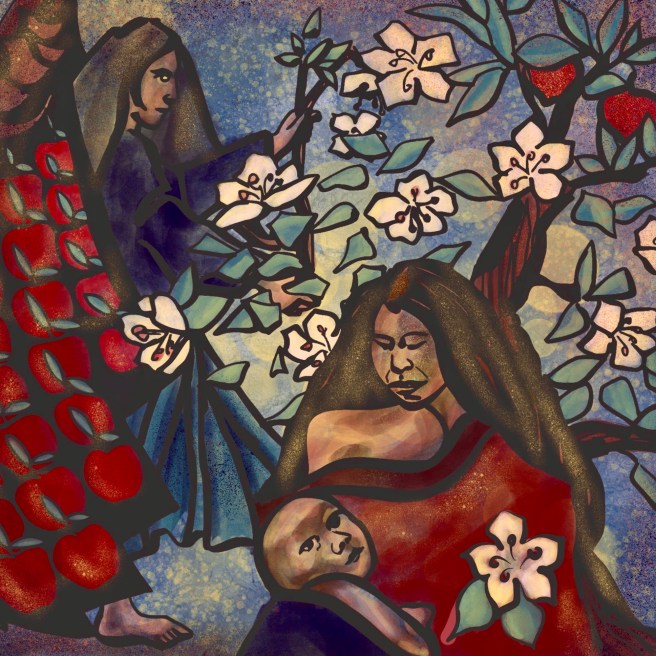
In the 18th chapter of Genesis, Sarah laughs, and I think that her laughter is of prime spiritual importance. It’s proceeded by three mysterious strangers appearing to her and Abraham while they’re camping by the Oaks of Mamre. These strangers tell Abraham that Sarah, who is ninety years old, is going to have a baby. She’s listening to this exchange from inside of her tent, and her response is a giant guffaw (or maybe a snigger, the type of laughter isn’t really specified). Let’s take a minute to briefly recount what’s happened to Sarah so far in the Book of Genesis, so that we can decide whether her laughter is justified. In Chapter 11, we learn that Sarah, although very beautiful, is barren. Regardless, God tells Abraham that Sarah’s offspring will become a great nation. Abraham doesn’t seem to be paying very close attention to this, because in the very same chapter he and Sarah go down to Egypt in order to avoid a famine, and Abraham says to Sarah, “Hey, you’re really beautiful,” which seems like a compliment, but then he says, “because of your beauty, Pharaoh is going to want to kill me so that he can take you as his wife. So when we get to Egypt, lie and say you’re my sister.” This plan works out, in that Abraham isn’t killed, but Pharaoh, who does think that Sarah is really beautiful, says, “Great, she’s your sister? Then she can marry me, no problem.” Good thing she’s barren, or her progeny might have ended up being Egyptian rather than Hebrew. But then God sends some plagues on Pharaoh’s household, and Pharaoh figures out that it’s because of Sarah, and he kicks both her and Abraham out of Egypt, after loading them up with gifts so that God will stop being mad and the plagues will go away. Then poor Sarah is dragged back up to the land of Cana, where her husband decides that he wants to fight in a war against King Chedorlaomer of Elam, and off he goes to battle, and Sarah must be thinking, “if he dies, there goes the great nation that God’s supposed to produce from my offspring.” But he wins and comes back with all the spoils of war, so everything is fine. But still no baby. So Sarah thinks, “maybe this really isn’t about me,” and she says to Abraham, “sleep with my slave girl, Hagar, and she’ll give you a son.” So Abraham does and sure enough Hagar has a baby, who she names Ishmael, although he never goes off with Captain Ahab to hunt white whales. Now everything seems fine, but in Genesis 17 God says, “Nope. I said that Sarah would give rise to nations, not Hagar (although Ishmael’s going to be the father of some pretty great nations, too).” So we come to today’s reading, Abraham and Sarah at the Oaks of Mamre, and Sarah is ninety years old and has been waiting a long time to have a son and see God’s promise fulfilled. And when three mysterious strangers show up and tell her and Abraham that it’s about to happen, she laughs.
But why dos she laugh? Why do any of us ever laugh? What is laughter all about? Well, according to humorologist Salvatore Attardo, laughter is all about breaking Paul Grice’s rules of conversation. Grice didn’t set the rules of conversation, of course. Those have been there from the very beginning. But in the nineteen-seventies he came up with an influential theory to explain how conversations work, and he created four maxims to describe what we’re doing when we talk to each other. His big idea, which these maxims expand on, is that conversation is all about cooperation. We assume that the people we’re talking to will cooperate in the conversation that we’re having with them. We assume that in conversation two or more people are building something together, even if they’re having an argument. When someone breaks the rules and the conversation is in danger of falling apart, we laugh, at least according to Salvatore Attardo. So laughter is a sign that the conversational contract has broken down. Sarah’s laugh seems to indicate that communication between her and God has broken down.
Here are Grice’s four maxims, with commentary and jokes:
The Maxim of Quantity – When we talk to each other, we expect our conversation partners to give us just the right amount of information, neither too much, nor too little. This is why we find mansplaining so annoying. We don’t need a dissertation on the process of carbonation when we ask for a soda. But giving too little information also violates the maxim on quantity. Attardo’s illustrating joke is this: Question – “Do you know what time it is?” Answer – “Yes.” I have to admit that when this type of joke has been directed at me, I’ve found it more irritating than amusing. And we might ask, is it enough for the three mysterious strangers to simply tell Sarah that she’s going to have a baby? Are they giving her enough information?
The Maxim of Relation – Say only what is relevant for the current purposes of the conversation. In other words, don’t digress. Attardo uses this joke to illustrate: Question – “How many surrealists does it take to screw in a light bulb?” Answer – “Fish!” In Sarah’s case, is it relevant to tell a ninety year old that she’s going to have a baby? Seemingly impossible things seldom seem relevant.
The Maxim of Manner – Be brief, but avoid ambiguity and obscurity of expression. Breaking this rule leads to Abbott and Costello’s old “who’s on first” routine. Groucho Marx also made good use of it when he said that “outside of a dog, a book is a man’s best friend. Inside of a dog it’s too dark to read.” The three strangers’ announcement to Sarah seems equally bizarre and obscure.
The Maxim of Quality – Don’t say things that you know are false, or that you don’t have enough evidence to support. In other words, don’t lie. Mark Twain was guilty of breaking the maxim of quality in his joke about Cincinnati. He said, “When the end of the world comes, I want to be in Cincinnati because it’s always twenty years behind the times.” Funny, but obviously untrue. This is the one rule that the strangers’ proclamation doesn’t seem to break.
So Sarah laughed because the three messengers of God who visit her and Abraham at the Oaks of Mamre broke Grice’s conversational maxims, at least the first three. The only maxim that the heavenly messengers don’t seem to break is the Maxim of Manner. They’re brief, unambiguous, and the opposite of obscure. “You will have a son.” Full stop. But God is expansive, mysterious, and ineffable. Doesn’t communication with God always break Grice’s Maxim of Manner, just because God’s very nature is beyond what we’d consider mannerly?
Sarah laughed because her communication with God had broken down. God had broken the conversational rules. And God always breaks the conversational rules, just because God is God, and will never adhere to the Maxim of Manner, and doesn’t seem to have much use for the other three maxims, either. If this is true, isn’t all of our communication with God primarily marked by laughter? Or shouldn’t it be? Not because we find God funny, not because we’re mocking God, but because we find the communication itself to be so weird and abnormal that it amuses us. The communication breakdown is all on our end, not God’s. We fail to truly hear and to understand God, so we laugh. But God hears and understands us, even our laughter. And as the scripture says, Sarah gets this. She says, “God gave me laughter.” Laughter is a gift from God.
And yet, despite everything I just said, the real question isn’t why Sarah laughed, but how does the fact of her laughter help us?
Well, mostly it helps us with our internal transformations. I’ll go so far to say that there’s no transformation without comedy. When something truly life-altering and transformative happens, it breaks all of Grice’s maxims, shatters the rules of normal behavior, and leaves us feeling lost and confused. Even if it’s a good thing. Any young parent can tell you that the birth of their baby has altered their life in surprising ways. They have to adjust to new versions of themselves. And although there’s a never ending series of books to tell them how to do that, and even though they’ve taken countless birthing classes and received the unasked for advice of many older relatives, they still find themselves confused and perplexed and not knowing how to live into their new role as parents. Fights about getting up in the night to see to the baby aren’t fights about that at all. New parents are wondering whether the person they made the baby with, whom they were pretty sure loved them and had their best interests at heart, will really choose sleep over them. It all gets very tough and complicated, and if you can’t laugh about it together, things aren’t going to go very well. I say it here and I’ll say it again – there’s no transformation without comedy.
But don’t just take my word for it, take Richard Sewall’s. In his book A Vision of Tragedy, Sewall suggests that tragedy is tragic because it disorders the world. When you experience a tragedy, all the day to day assumptions that you’ve built your life around are called into question or disappear entirely, and you find yourself out on the moors with a deranged parent who’s just gouged his own eyes out, like in King Leer. Or you gouge your eyes out because you find you’ve been sleeping with your mother accidentally, like Oedipus does. There’s a lot of eye-gouging in tragedy, and very little in comedy, because tragedy leaves you feeling blind. You can no longer see the order that you thought was implicit in the universe.
Comedy seems to make fun of order, even seems to undercut order, but it secretly rebuilds it. Sewall says that comedy relies on a vision of ultimate harmony, and I think he’s right. It’s never satisfying unless the order that it makes fun of is replaced by a new sense of order – in romantic comedies, this new order is usually symbolized by a wedding.
Comedy redeems the pain of transformation. Transformation always has its portion of suffering, and no transformation is quick and easy. One of my favorite quotes from Saint Anselm comes from his poem on baptism. “After I lost the joy of my baptism,” he wrote, “I wallowed in manifold sins.” It’s hard to imagine what sins the kindly old saint was wallowing in, but I’m grateful to have him affirm that baptism doesn’t just clear away all of the tragedy from a Christian’s life. People of all faiths, and probably of no faith, have had similar experiences. You undergo a conversion, or a rite of passage, or some world-shattering life event, and then you sit there wondering, “now what?” And you find that you’ve dragged your old self kicking and screaming into the life of your new self, and the old self isn’t happy about it, and is still pretty persuasive about going back to all of your old bad habits. And because we’re susceptible to that old self’s arguments, we slip back into old, destructive ways of being, and regret it, and stew in a sense of our own horribleness and hypocrisy. So, no matter how much we wish it was otherwise, transformation involves suffering.
Comedy, with its wry, sassy approach to suffering, acts as a kind of hangover cure. Sure we messed up, but it’s not the end of the world, and we probably learned something. But we won’t really be able to accept what we learned until we can laugh about it. Once you find that you can tell a story about yourself, a story in which you look ridiculous, you know that the story has lost its shame. Yes, it’s a story of failure, but the failure has taught you something, and the new self you’re becoming delights in self-knowledge, even values it more than looking cool or being perfect.
In order to get there, you have to embrace humility, accept your foibles and failures, and shrug off the pride of perfectionism. Hard stuff, I know. But many, many mystics are agreed that without humility, the human soul can never really know God. Humility is of prime spiritual importance, and most of our transformations are, at root, about learning to be humble. Comedy is all about humility – the humbling of the great as their ridiculousness is exposed, the exalting of the humble, who are shown to be cleverer and wiser than anyone suspects, and the humbling of our social contracts, which are revealed to be nothing more than a set of rules or maxims that, granted, have their usefulness, but often deliberately block beauty and cage grace. Can laughter help us learn how to be humble and navigate the many vicissitudes of transformation, so that we can discover a new order, a new harmony, and be delighted by it?
I think it can, but only if we learn how to surrender control. And control is a hard pattern to break. We often think that control is the antidote to fear. I’m afraid that people won’t do what they said they’d do, that no one will show up, that everything will go horribly wrong and I’ll look like an idiot. So I rush around trying to control everything, which just means that if everything does go horribly wrong, all of the blame is going to devolve on me. A vicious cycle.
But in the spiritual life, you can’t control grace. For me, the Kingdom of Heaven is a place where we all help each other to overcome our fear and let go of our need for control. Where the Holy Spirit moves through us and makes each of us a leader when we need to lead, and let’s each of us be a follower when we need to follow. It’s a place where failure is acceptable and transformation is real. It’s a place where laughter harmonizes our lives and gives us back the order that tragedy takes away. Sarah laughs in the Kingdom of Heaven because she’s surprised by a miracle and humble about her own understanding of it, and because God has overwhelmed her with information and gestured towards the intense transformation that’s about to swamp her life. And her laughter has something to teach us – how to be humble, how to accept transformation, how to see things as they really are, how to live in real community, and, most importantly, how to respond to God with surprised joy.