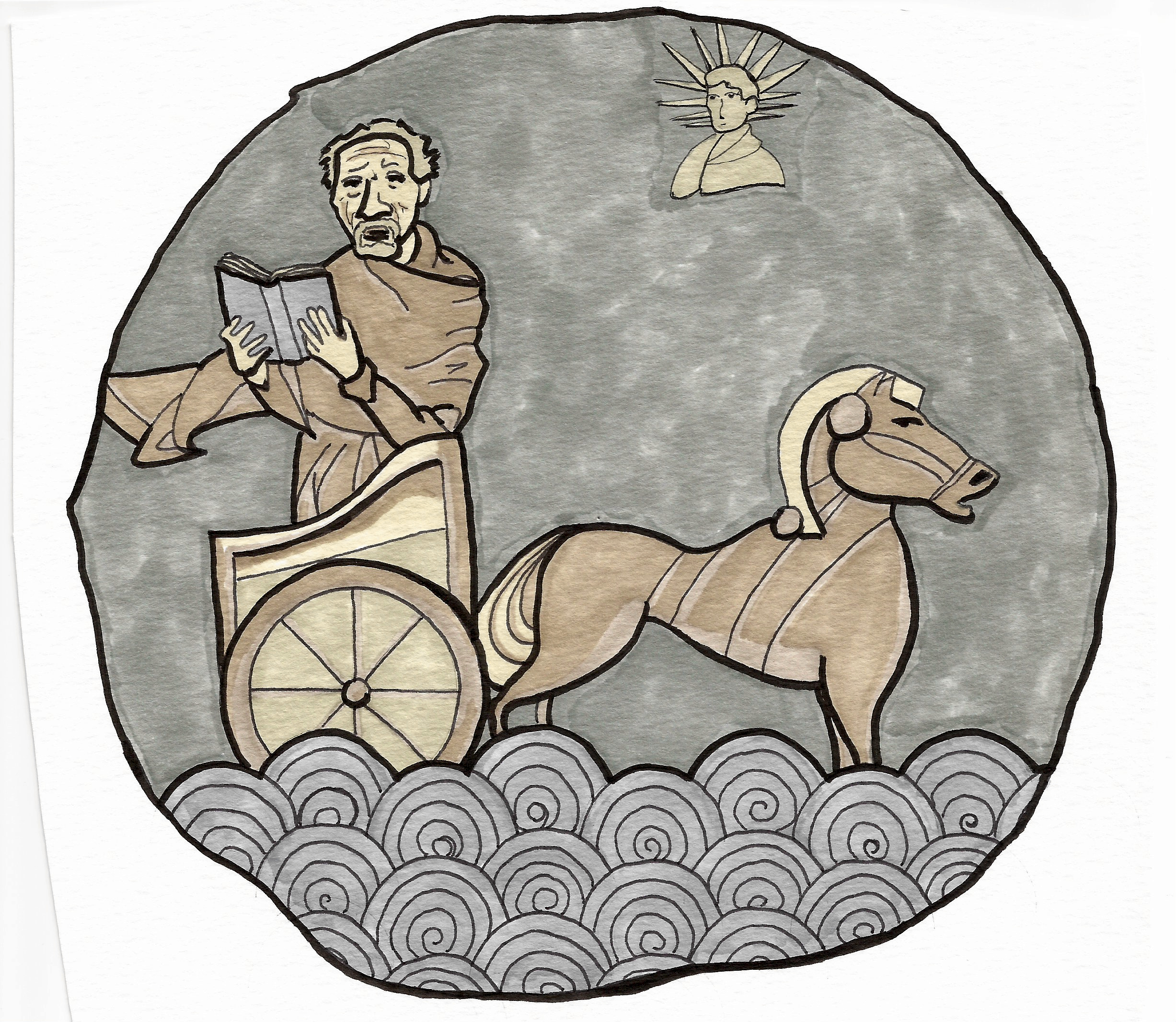
Mary Magdalene

Magdala was a town of almost forty-thousand.  It was a town of white pigeons hatched from three hundred shops, birds for sacrifice that sometimes escaped to roost in eves and on rooftops and descend in flocks on a piece of dropped fish.  Magdala was a town of fish.  Mary watched the fishermen heave them from the sea in shaking nets and deposit them in the midgals, the little stone towers in which layer upon layer of fish flopped and died.

Mary hated the arrogant purity of the pigeons.  They were supposed to be without blemish, but light itself blemished them, catching out the iridescent colors in the fibers of a wing.  The same colors she saw on the enamel of the seashells she picked up on the shore.  But seashells never claimed that they were clean.  Seashells were allies of fish, whose scales caught those colors also, the oily blues and greens that looked like bruises turned to water.

Mary left Magdala like she always did.  One moment she was squatting beside the boats, a small, disquieting figure with her long face and chewed over lips.  The next moment she was gone.  The fishermen shrugged.  She was unclean.  She belonged to no one.  No Jew would touch her, and no Greek either, unless he was insane, unless he heard her babbling out the voices of her seven demons and found it, somehow, exciting.  Who could know.  Since Herod Antipas had built the city of Tiberias, with its pagan gods and Roman baths, many unclean things came down the road.

It was summer.  The hot winds had already come and killed the blue and red anemones.  The plain of Gennesaret had turned gray, dead with too much light.  Mary carried this seer landscape within her, even though the land had rebounded, even though figs and olives hung on green trees.  The memory of the dead ground was like a veil that the demons had settled over her.  A long veil that fell past her face and then blew outward, draping the landscape.  She laughed at it as she walked, held up her hands to shake it, tried to bite it.  People ran away from her, except for a group of children who followed, daring each other to run up to her and try to step on her shadow.  They were called away by their fathers, who told them that she was unclean.  Everything she saw had too much light.  Not gentle light, but imposed light, light that denied the colors that it touched.

She came to Capernaum without noticing it, without noticing the huts on the outskirts, the goats and sheep that spread across the road.  She didn’t even notice the others who were like her.  Bedraggled, slouching shapes.  Women and children.  A man, tied to a litter, was carried past her.  A wan girl fell to the ground and shook against the dirt.  Mary’s demons didn’t leap to see the demons within these others.  Her demons lay still, and that is what she noticed.  And because they were still, she suddenly noticed the town around her, the small basalt houses, the returning smell of fish.  But no pigeons.  The bleating of goats, but something more.  Something the demons had blinded her to.  Small glittering pebbles in the road.  The fleece of a passing sheep, its dirty gray nap, the small resilient curls of its wool.  She saw the exact lines in the weave of the shepherd’s cloak.  She saw a surprising number of faces, too many for a town this size.  Too many people, and yet her demons lay silent.  Cowed.

She remembered why she had left Magdala and walked through the orchards.  She remembered a name.  They said that a man had been lowered to him through the roof of a house.  She turned to study the roofs.  She kept turning, her eyes seeking, unaware of the circumference of her steps.  A body brushed past her, then another.  She was borne along, still turning, her eyes trying to take in every angle of roof, looking for a pile of masonry, a slab of broken stone.

The crowd slowed.  There were others before them, and there was nothing they could do but stop.  The sun beat down on them.  Mary lowered her eyes from the roofs and looked at the coarse grain of a nearby man’s cheek, the varying colors in a nearby girl’s hair.  She wanted her veil back.  She wanted these details to be bleached and neutered by light.  But the demons were not only quiet, they were crawling away.  She hissed at them, trying to get them back.  A woman standing next to her began singing in a high, soft voice.

She didn’t see him that night.  She let the crowd move past her and stood alone in the growing cold of the darkening street.  Someone gave her bread, which surprised her.  It was in her hand and the man was moving away before she could see his face.  She ate it, and then thought how easy it would be to do what she had always done.  She hunched her shoulders, drew her face down and stared out, darkly, from under her brows.  She chewed her lips.  No one noticed.

She saw him the next day.  She shuffled into the house where he was staying, one in a line of many others, but he looked at her and saw her.  “Seven demons,” he said.  She stopped and stared at him.  “They’re gone now,” he said, “but it isn’t enough.”

“Rabbi?”

“Your house has been swept clean, but they’ll only find that more inviting when they come back.”

“Rabbi.”

“You need something else.  Something else has to happen.  A singing breath entered Adam.”

“Rabbi!”

“A singing breath entered Adam.  Let me breathe on you.”

But really, he was already breathing on her.  As he spoke the whole room became breath.

It is not enough to merely lose our demons.  We must experience resurrection, be filled with the Holy Spirit.  Joy.  Joy is at the root of it.  The great carved places inside of Mary were filled with joy.

She followed him up the mountain and sat in the diminishing evening light with the other disciples.  They were silent for a long while, listening to the voices from the lower slopes, the people who had come out the cities to see him.  At last he spoke.  “Blessed are the poor in spirit, for theirs is the Kingdom of Heaven.  Blessed are those who mourn, for they will be comforted.  Blessed are the meek, for they will inherit the earth.”  Every word he spoke terrified her.  He spoke of light and she knew that light, but she also knew that she had been Mary the Skulker, Mary the Unclean, and she feared for the light inside of her.  In the dusk, as his voice continued and the profiles of the seated disciples became blurred with shadow, she feared that there was something in the world that could take her joy from her.

He wasn’t speaking to her alone, but she knew that he meant her to hear him.  His face turned towards her and she lifted her head to look at him in the semi-gloom.  She clutched her knees to her chest.  “Love your enemies and pray for those who persecute you, so that you may be children of your Father in Heaven.”

“Lord,” she mumbled in her rough voice.  “Lord, I pray for my seven demons.”  And she felt surprising pity for them.  They were wandering over the plain of Gennesaret, looking for a home.  They were shaking the long black veil out to cover the trees, insisting on the insulting light that had no interest in the sheen of green olive skins.  They would be despised beside the fishing boats, and pecked about by holy pigeons.  She began to laugh, but not maliciously.  She began to laugh because she knew, in her pity for them, that she was free of them.  They could never pity themselves.

And when he told her and the other disciples not to worry about their lives, she laughed again.  She had never worried about her life.  The demons had never allowed her fine clothes, or the taste of good food.  And now that they had left her she was a lilly of the field, a bird of the air, trained by desolation not to care for vanities and suddenly given into the keeping of God.

As they walked towards Jerusalem, she noticed patterns on the ground.  The scuffed over prints of many feet, the calligraphy of mule droppings.  There were grasshoppers in the grain fields.  She paid attention to the way the husks of wheat rasped against her fingers when she picked them.  There was a slow design to the way the disciples walked.  Matthew held his slight wrists at his side and swayed them back and forth like the beads of an abacus.  Philip pushed his face slightly forward.  Joanna, dressed in plain clothes that she’d bought to be plain in, was still aware of her neck’s length and softness.  Her hands still gestured to show their beauty.  “We are so small,” Mary thought.  “Every one of us.  We are like heads of grain, or ripe olives, or the rain.  And God knows every hair on our heads.”  She thought of God’s attentiveness.  She thought of her mother, who surely hadn’t remembered every loaf of bread she’d shaped with her hands, and her father, who couldn’t have remembered each net he’d woven.  She looked at the sky, and it was as if it was speaking to her.  She knew the sense of the words, but not their phrasing.  God was in His creation, complete.  Human beings might create, but no one created like God.

Jesus began to say that he would suffer when they got to Jerusalem.  Mary was not afraid.  When Peter argued, and when the Sons of Thunder tried to settle their place in the hierarchy, she walked calmly beside them.  She measured her stride to Jesus’ own.  She would have taken his hand if she could.  Would have stood on her toes so that she could whisper in his ear, “I know what it’s like.  There is a great hollowness, but then there’s breath.”  Wherever they buried him, she’d go there to wait.  No one should be alone in that hollowness.  She’d wait beside his body until he rose.

But when they came to arrest him she ran like the others.  She hadn’t expected the soldiers or the jeering priests.  She hadn’t expected this evil to be accomplished by men.  Maybe she had never known that men could be evil like this.  The veil of her demons had protected her.  It had turned the details of each day to chaff, had allowed the words and touch of men to blow away.  She watched a soldier strike him and she wanted her veil back.  She crept away.  Maybe the other disciples hid together.  She wandered away from the city, alone.

She moved across scarred ground, the seared slopes of the land around Jerusalem, and she tried not to look at anything.  She wanted her eyes to fill with blank light that would deny the russet stone, the green scrub.  She muttered to herself.  “Unclean!  Unclean!”  But these words had no meaning.  She wanted them to chisel her flesh, to create places for the demons to return to.  But they were dull words, and she saw the world despite them, the white hairs of a donkey’s muzzle, the slim arms of the boy who waited, so patiently, for the animal to drink.  The vision that Jesus had given her wouldn’t leave her.  It drew her back to the city.  It is impossible for us to ignore our resurrections.

She learned of his sentencing and was there at his death.  She stood beside Joanna and the other women.  She watched his mother, and was curious to know if the light could subsist even now, if she could see its varying shades settle across Mary’s anguished face.  She turned to watch him as he died on the cross, and felt the smallest touch of his breath reach her.  Was it possible that God was creating even now?  She studied him and saw an iridescent sheen, his sweat laid across the bruises of his skin.  A fish, a shell, a bird of sacrifice.  But it wasn’t her who was sacrificing him.  It was the men standing near the cross, the soldiers and the priests.  How could God, who was aware of each husk of grain, each movement of her breath, demand the death of living things?  She looked at the soldiers and the priests, and she said what he said.  “Father, forgive them, for they know not what they do.”

The women wept, but she remained quiet, watching with lifted gaze.  When they took him down there was a commotion, argument over his body, the flashing of coins that moved from hand to hand.  Somebody’s servants were carrying him away.  The women gasped with consternation.  They followed, walking quickly, pushing through the crowds, afraid of losing sight of him.  Mary was swept along with them, her legs moving briskly, her eyes looking everywhere.  She felt anger, and it was the first time that she remembered feeling anger.  Her demons had kept her from being aware of other people, but now she saw that other people were blind, indifferent, lost within the empty light of their many errands.  She wanted to grip them, to hold them to her and breathe on them.  She remembered the young man who had come to Jesus in his clean robes and oiled hair, his slaves standing a little way off, and who had gone away weeping, and she remembered Jesus’ sorrow, and understood that now that he had left them she could finally see with his clear eyes.

They laid him in a tomb and she sat beside it until sundown.  Sabbath, and the other women bade her come away.  She couldn’t tell them how little it mattered, how no one could convince her that she was unclean even if she spent the night resting with the dead.  She went with them out of pity for them.  They needed her peace.  And as they spent the long day in a dusty room, she tried to send her peace out to them, so that it could rest on them.  She prayed for each, staring at every face, at Joanna, and Peter, and James, and Mark, and Mary, Jesus’ mother.  And on the morning after the sabbath, she arose and went to the grave.

Can we be surprised by resurrection when each of us has known it?  When, at some moment in our lives, we each have noticed the depth of light, familiar objects suddenly suffused with intricacies, with shapes and patterns we never knew were there?  Can we be surprised by resurrection when we have felt the breath of grace arrive at unexpected moments, when we’ve done nothing to bring it and don’t deserve it, and yet its there?  When we feel it enter into us and blow past the filaments of chatter, of every day life to show us something waiting beneath the world’s skin?

We have all known little deaths.  The ends of relationships, of eras of our lives, of long-held dreams that we’ve finally put to rest.  Or stranger, more subtle deaths.  Incisions made in our souls to remove some tumor of doubt or anger.  The exorcism of some preference for self-destruction that we’ve clung to because we’ve been afraid of what redemption might demand of us.

And yet we are all here.  Resurrected at some moment or another, brought together to witness and celebrate the one resurrection with Mary and the other disciples.  We are here because we know that, despite death and doubt, despite our desires to hide with our familiar demons, God’s favor is life, and joy cometh in the morning.

She met him in the garden.  She was weeping because the resurrection had already happened when she arrived, because the tomb was empty and there were two men there.  Or maybe his body had simply been moved, and she didn’t know where to go to witness the resurrection, to feel the breath of God, as she had felt it when he healed her and cast out her seven demons.  When she saw him, she thought that he was a gardener.  But she should have known, from the way that the morning light cast a shadow on the tomb’s wall behind him, a round shadow that circled his head, a halo, that this was her risen Lord.  From then on she saw that halo everywhere, appearing on the walls behind the apostles as they ate and spoke and healed.  Surrounding the heads of the people as they gathered together and prayed.  She saw it on new converts as the apostles went out from Jerusalem, and the light spread, and the world’s cold, pitiable demons fled to wander in the barren places.  The world was haloed with new light.  Our world is haloed with new light.  May it help us see and understand and love.

Simon Peter

He and Andrew had just begun their night’s work.  They had just heaved the dense, wet net out of the bottom of the boat and cast it out over the water.  It struck the surface and sank.  They were silent after the sound of the net going in, and then a voice called them from the shore.  They were unused to hearing voices that called to them.  They were unused to any sound but the small lap of the water against the side of the boat and the rustle of the wind against the sail.  “Follow me, and I will make you fish for people,” the voice said.  Perhaps it was the fact that they could hear the voice, that it carried to them from the shore, that made them pay attention to it.  Perhaps it was the words themselves, the idea that people were like fish, as simple and flopping and elusive as the schools who swam beneath the boat.  Or perhaps it was that Simon was already a rock, and he knew it.  Rocks have no business in boats at night, floating in open water.  Rocks sink.  They’re stubborn and still.  They don’t move through water.  They make water run around them.

A rock, that’s what Jesus told him that he was.  A rock who fishes for people.  Rocks are not known for their ability to understand people.  And sometimes it felt like understanding could only come through a process of erosion.  He would only understand when he had been worn down, when deep grooves of understanding had been carved from him by the experiences that pressed against him and swirled around him like water.

Before Jesus called him, life had been simple.  At night he sailed out onto the Sea of Galilee with his brother Andrew and their friends James and John.  The wind blew and they listened to it.  They watched it ruffle the top of the water.  The weather could change suddenly.  The wind could come rushing out of the surrounding hills, troubling the waters.  All night long they lowered their nets and waited for the fish to swim into them.  He lived with his wife and his mother-in-law in a one-room house made of mud bricks.  Mud-covered reed mats served as a roof, and they would shift and rustle in the strong winds.  In the morning the fishermen would send their catch to Magdala, where it would be salted and sold.  In the afternoons, Simon, who would be called Peter, the rock, would sleep.  Then, at evening, he and Andrew would meet James and John by the seashore, and they would squat above their nets, running their hands over the sodden ropes and finding breaks which they tied back together.

On the Sabbath he went to the synagogue, where he sat with the other fishermen, with the plowmen and traders, the carpenters and merchants.  They all listened together to the readings from the prophets.  They knew that their present world could never last.  They had been promised a new world, a Kingdom that would be ruled by God.  During the high feast days, Simon went to Jerusalem.  He had been there many times, walking past the dried-fish dealers at the Fish Gate and looking at their wares, wondering which of these fish he had caught himself.  The people in Jerusalem thought that he was a country bumpkin.  They mocked him and his friends for their accents, even though Galilee was rich and fertile while Jerusalem was hard, dry, and dependent on the farmers and fishermen in the countryside.  Simon’s labor allowed these people to live in their stone houses and speak in their posh accents.  They made him impatient, these Jerusalem-dwellers.  He disliked their rules and their fine sense of religion.  He remembered the pharisee who had visited Capernaum and who had spoken in the synagogue.  Someone had asked him if you were allowed to turn over a pot onto a scorpion on the Sabbath day, to prevent yourself from being stung.  No, the man said, that was too much like hunting.  Hunting!  When had that pharisee ever hunted?  What did he know about making a living and protecting your family?  In the Kingdom of God, the wisdom of such men would be shown to be foolishness, and his wisdom, the wisdom of the sea and the salt air and the winds that rustled through the olive groves, would be admired.

But he didn’t know how to express that wisdom to people, at least not yet.  He didn’t really understand people.  They acted so strangely, clustering around Jesus, reaching out to him, touching him, calling his name, begging him for healing.  Then, the next minute, they would be turning against him, furious at him, trying to drive him away.  They were motivated by desires that Simon could not understand.  They flopped like fish, they swam in shimmering schools, they were chased up from the deep by some sense of danger or some shift in the waves, and yet Simon could not think of how to devise a net that would catch them.  Whenever he made a net and showed it to Jesus, Jesus would feel along its cords and find its tears and snags.  Simon thought that if Jesus would just show people that he was God, if he would just allow his face to shine and his clothes to become a dazzling white, as they had on that mountain when Moses and Elijah appeared, then they would all swim into the net of his truth.  But he wouldn’t do it.  People had to understand the message without the miracle.  It was the message that was important.  The message was the true net.  Jesus wouldn’t let Simon try to make a net out of miracles.

The message was that everyone, even the samaritans, even the gentiles, were Simon’s neighbors.  Even the Romans.  Even the Germanic mercenaries whom Herod Antipas hired to police Galilee and bully its citizens.  He had never believed this before.  He had always thought that his neighbors were his fellow Jews.  Galilean Jews, people who knew him, who felt as he felt, who saw the world in the same way that he saw it.  But Jesus caught Simon in his own net, in a greater understanding of neighborliness.  “Your neighbor is the person who does good even though it doesn’t benefit him in any way.”  Sometimes doing good had a cost.  Sometimes, you had to die for your neighbors.  Simon couldn’t accept this at first.  Jesus said that he would go to Jerusalem and suffer, and die.  He said this as if it were the price for neighborliness, the thing that you had to do in order to love your neighbor as yourself.  Simon  couldn’t stand it.  “God forbid it, Lord!” he said.  “This must never happen to you.”

Jesus’s response was hard.  It slapped against him like water.  “Get behind me, Satan!  You are a stumbling block to me; for you are setting your mind not on divine things but on human things.”

A stumbling block.  Well, yes, that’s what a rock was, wasn’t it?  Sometimes.  An anchor, a weight, a stumbling block.  But why did one have to die for one’s neighbors?  A fisherman didn’t die when he brought in his catch, did he?  Well, sometimes.  Sometimes when the wind rose and blew from the west, and the water roared up all around the boat, and the sail came loose, and the mast snapped, and the boat capsized and the fishermen, like rocks, sunk to the bottom.  If men were like fish then there was danger in trying to bring in a net full of them.  There was danger even on the nights when the water was still and the nets were empty.  There was always risk.  There was always the possibility of disaster.

They went to Jerusalem for the Passover.  The Paschal feast had always taught the Jews who their neighbors were.  Their neighbors were their fellow Jews, the people whom Moses had brought out of bondage in Egypt, the people who had settled in the promised land, the people whom the prophets had come to, promising that one day they would all live in the Kingdom of God.  Jerusalem was crowded during the Feast of the Passover, so crowded that the boundaries of the city itself were extended so that all of the pilgrims staying in the suburbs and the neighboring towns could say that they were in the Holy City for the feast.  All the pilgrims were crammed in with their friends and relatives, sleeping side by side in the small houses.  All of them were gathering their money together and buying sheep.  In the morning, they would take their sheep to the temple, where the priests would sacrifice them and burn the entrails on the pyre.  Then they would bring the lamb home and prepare it for their meal.  Throughout the day, the wind would blow from the east, from the temple, and carry with it the scent of blood and incense and burning fat.

Peter sat at supper, there in the upper room, and the city, its scent and sounds, came through the open window and washed against him like a wave.  He was paying attention, noting and analyzing everything, trying to understand the message, trying to piece together the net with which he would become a fisher of men.  Jesus stood up and took off his outer garment and tied a towel around himself.  He began to wash the disciples’ feet.  And Simon Peter knew that their roles were wrong, reversed.  He was supposed to be honoring Jesus.  He was supposed to be washing Jesus’ feet.  But Jesus wouldn’t let him.  The water had to be poured against Simon the Rock one more time.  It had to work at him, to erode his understanding.  No, Jesus said, no, I am showing you how to treat your neighbor.  Wash their feet.  Be their servant.

The water rushed against Simon’s feet and he felt grit and grime wash away.  The world was a different thing than he had thought it was.  It wasn’t composed of Jews and Greeks and Samaritans and Romans and German mercenaries.  It was composed of people.  Longing people.  Flopping people.  Failing people.  They swam in schools, silver through the water, frantic and lost and mindless.  And Peter understood that Jesus had compassion on them.  That he pitied them, even in their small, silver, darting violence.  That he wanted to draw them up from the depth of the water.  That he wanted to draw them into light.  And Peter, in this sudden moment of insight, felt himself close to understanding everything.  Everything that Jesus had done or said or predicted.  He just needed some more washing, some more erosion.  He just needed the water to rush against the uneven surface of his soul, to make it smooth and shaped so that he could become a perfect vessel to do God’s will.  “Lord,” he said, “not my feet only but also my hands and head!”  But Jesus said no.  “You are entirely clean,” he said.  Already shaped.  Already in possession of the message that would make him a fisher of men.  “Love one another,” Jesus said.  “Just as I have loved you, you also should love one another.  By this everyone will know that you are my disciples, if you have love for one another.”

Far away to the north, schools of fish swam through the dark waters of the Sea of Galilee.  On the shore, in the hills, in the dry valleys and the verdant farm land, by the river Jordan and in the small towns and cities, and in the great city of Jerusalem itself, the people swam dimly, moving in darkness, as the fishermen in the upper room were taught how to make the nets that would pull them out of the depths and into the light.  “Love one another,” they were told, and with cautious, uncertain gestures, they began to weave a net of that love.

Life and Ideals

Not everyone was happy about the resurrection of Lazarus.  According to John’s Gospel, the fact of that miracle caused great crowds to flock around Jesus, and the chief priests grew jealous and afraid.  They plotted to kill Lazarus, thinking that this would make the crowds go away.  They didn’t just want to ignore his resurrection.  They wanted to undo it.  But they plotted impotently.  The very next day Jesus entered Jerusalem, and those crowds that had been following him because of Lazarus lined the streets.  More crowds gathered, and learned about the raising of Lazarus.  And the plotters looked at each other and said “You see, you can do nothing.  Look, the world has gone after him!”

Included in that “world” that was chasing after him were some Greeks.  They went to Philip and asked him to get them an interview.  But when Philip and Andrew approached Jesus with the Greeks’ request, he launched into a short monologue about his glorification and his death.  He ended by saying that “I, when I am lifted up from the earth, will draw all people to myself.”  Including, presumably, the Greeks.  But they never got to see him.  Instead of granting them the interview they requested, he went away and hid from the crowds.

It’s clear that this story is all about the resurrection.  Lazarus’ resurrection is the event that gets the story moving, that keeps the crowds engaged and terrifies the chief priests.  But I think it is also a story about idealism.  The crowds flocked to Jesus because they thought he could teach them how to escape death.  In essence, they were right, but not in the way that they thought.  Jesus didn’t become a renowned resurrection man, traveling from place to place, raising the dead.  He taught people how to escape death by emulating his example – by presenting himself as an ideal for them to subscribe to, the ideal of the human being who truly is human, living a life that truly is life.  In other words, he invited them into idealism.

Idealism is a powerful force.  Robert Jay Lifton tells a story about a series of interviews he conducted with a young soldier in 1969.  This soldier had been present at the My Lai massacre, that morning of terror in a small village in Vietnam when American soldiers killed more than five hundred innocent people, grandmothers and babies.  The soldier whom Lifton interviewed had refused to fire, refused to participate in the slaughter.  He didn’t think that this absolved him of the guilt of the event.  “There’s no way I can feel that I was separate from the whole thing,” he said, “especially when I didn’t do anything to stop it myself.”  But unlike the soldiers around him, his comrades and friends, he couldn’t bring himself to shoot.  Lifton wanted to know why.

He discovered that the young man was a lapsed Catholic.  He had drifted away from the church, but his childhood religious training had convinced him of the sacredness of life.  He was a man who felt comfortable in his own company, and didn’t have much need for the approval of others.  But most of all, he was a man who truly believed in the Army.  He had joined the Army after flunking out of college, during a time when his life was falling apart.  He loved it.  He excelled at being a soldier, and was quickly promoted.  He wanted to make the army his career.  He had completely bought into the idealistic image of a soldier that the army presented to him.  He believed in it.  He believed what he had been told about what a true soldier would and would not do.  And it was this sense of military honor that kept him from killing old men and women and small children in the tiny, innocent village of My Lai.  He was saved from becoming a murderer by the fact that he was an idealist.

Christian idealism has the same scope and power.  It can help us reach for life even when we’re surrounded by death.  I heard a story this week about a man whose wife recently died.  She was fairly young, in her late forties.  They were a very loving couple, and she was an exceptionally good woman.  A social worker for many years, she and her husband had adopted numerous children and taken in foster children.  She knew she was dying, and she did her best to prepare her husband for this fact.  He would come and visit her in the hospital, and she would try to send him away.  “Don’t you want me here?” he’d ask her, and she’d say, “Yes, but I want you here,” gesturing widely with her hands.  Meaning that she wanted him to go outside the hospital room and act widely in the world, attending to all of the responsibilities that they’d taken on together, fostering all of the relationships that they’d formed together.  After she died, he grieved deeply.  But he was also able to say that she had won.  All that time when she was in the hospital, he thought that she was losing.  Losing the battle for life, and maybe even losing all of the potential in her life, all of those possibilities that her disease was taking away.  But after she was gone, he realized that she had won.  Because she wasn’t afraid to die.  Because she died so gracefully and beautifully.  And because she was an idealist.  She believed in living her life according to the idealism of Christ.  Taking care of people, treating the world with love, worrying as much about the good of others as about her own good.  And she believed in the resurrection.  Her idealism went so far as to even deny the power of death.

Christ came to teach us profound idealism.  But idealism is a funny thing.  We rarely succeed in living out our ideals.  The man whose wife died couldn’t fully accept, as she was dying, that she was moving into the resurrection, even though he shared her ideals.  The soldier in My Lai couldn’t figure out how to make others act according to his ideals during those hours of terror and grief.  Like Jesus, our ideals are always slightly elusive, slipping away to hide from the crowds.  But that doesn’t invalidate them.  An ideal doesn’t lose its power just because it can’t be fully lived up to.  An ideal’s power come from being, well, an ideal.  Always just a little beyond our grasp.  Always the focus of our aspiration, even if it remains hard to accomplish.  But we move forward, chasing the ideal, and we get a little better at it all the time.  More than that, we’re protected from people and events who are anti-idealistic.  From the chief priests.  From screwed up judgment and false orders.  From a world that would tell us that death is simply death, and that there is no possible response to it other than grief.  We strive towards our ideals because, by doing so, we become the people who we are now and, step by slow step, the people who we hope, someday, to be.

Snakes on a Stick

The problem with the story about the snakes in Numbers 21:4-9 is that it seems to be about magic.  And the problem with Jesus’s conversation with Nicodemus in  John 3 is that Jesus’s use of the Numbers story is completely bizarre.  It would be easy for preachers to dismiss this, to move too quickly to clever theological explanations or, worse, obscure textual analysis, and ignore the fact that the majority of people sitting in the pews are bound to be completely bewildered.  In fact, most people in the pews will be in the position of one of John of Patmos’s first listeners.  They’ve wandered into a kindly space, full of good light tinted by stained glass, and they know from previous visits, or just from observing the behavior of others, that a certain decorum exists in this place, and maybe, hopefully, they appreciate that calm decorum.  And then someone gets up and reads something weird about people looking at a snake on a stick in the wilderness.  And then someone else gets up and reads about Jesus talking about eternal life and connecting it, somehow, to that snake on a stick.  The proper reaction to this is absolute confusion.

As far as the Bible is concerned, we live in a post-literate society.  Even dedicated church goers have rarely dipped into Numbers.  They and their children have, hopefully, heard and understood the main stories: Jacob and his ladder, Joseph and his coat, Moses and the Red Sea, Joshua and Jericho, David and Goliath.  But this is probably the first time they’ve heard about snakes in the wilderness.  Most have spent some time thinking about what it means that Jesus died on the cross for them.  But these are the church-goers.  Only about 40% of the general population.  Which means that the majority of Americans don’t know these stories, even if they claim to be Christian.  Preachers should assume that at least a few people in the pews are hearing even the most popular stories for the first time.  And preachers should avoid the temptation to be erudite or clever.  The person who wanders into church for the first time is looking for something, and it’s probably not an experience of being wowed by the cerebral accomplishments of the person in the pulpit.  They are looking for meaning, for an understanding about themselves and their world. And the proper question to ask of a set of readings such as those kicked up by the Revised Common Lectionary for the fourth Sunday of Lent, is whether they can help answer those questions of meaning.

I think they can.  Nicodemus comes to Jesus at night and pays him a compliment: “Rabbi, we know that you are a teacher who has come from God; for no one can do these signs that you do apart from the presence of God.”  Jesus answers him obscurely, to say the least: “Very truly, I tell you, no one can see the kingdom of God without being born from above.”  Now Nicodemus has problems with this.  How can anyone be born twice?  We can’t crawl back into our mothers’ wombs and insist that she give birth to us a second time.  Jesus tells him that there are, essentially, two births.  One is from the water of one’s mother’s womb.  The second is from the spirit.  We are born from above by being born from the holy spirit.

All right, so far so good.  But what on earth does that mean?  What does it feel like to be born of the spirit?  How do you get it to happen?  What will happen to you if you do get it to happen?  Jesus answers the last question, but not the two previous questions.  When you’re born from the spirit, you’ll know it, because the winds of life, all of those troubles and joys, blow past you without you getting too anxious and upset over them.  To me, this sounds like a beautiful thing – to be born of the spirit is to become skilled at being at peace.  Peacefulness, that’s the spiritual good that is promised to us.  But how we attain it is a question that is left unanswered.

Or, rather, answered in a very obscure way.  Jesus keeps talking.  He talks about himself.  He is God’s son, sent to bring eternal life to the world.  How?  Not by condemning the world, but by trying to show us the light, to lead us into enlightenment.  And if want this enlightenment, we must respond by coming into the light, by seeking it.  This involves action.  Our actions in the world must be open and honest, available for the consideration of anyone.

So those are the elements at play.  Seek enlightenment and act honestly in the light, so that you may know the spirit in your life and be at peace.  But the question remains: what does this have to do with snakes?

I heard a story this week about a woman who had served as a cancer nurse for thirty years.  Thirty years of sorrow and loss as she saw patients worsen and die, and knew that even the moments of hope couldn’t be called cures, but only remissions.  A huge psychic weight of suffering.  And after thirty years, she found that her work place had changed.  She had a new boss who was very demanding.  It wore her down, to the point where she collapsed.  Who could blame her?  She left nursing for awhile and sought help.  And after some months passed she felt better, and was ready to return to nursing.  She wouldn’t be a cancer nurse anymore, but she would be at the same hospital, and with the same demanding boss.  The day before she went back to work, she was terrified.  She told her husband that she didn’t know how she was going to handle being in her boss’s presence again.  Her husband told her “You’ve got to face the snake.”

That’s what the snake is.  It’s that little piece of darkness in anyone’s life that is keeping them from walking in the light.  The shame of feeling that you’ve failed a demanding boss.  The pain of a childhood memory that keeps coming back.  The fact of a rejection, the grief from a loss, the ingrained dissatisfaction from not getting something that we really wanted.

For the Israelites in Numbers 21, the real, physical snakes appear after the people have become impatient and complained about the food.  Their impatience and complaints prompt the Lord to send poisonous, biting snakes among them.  Many of them die.  They recognize their mistake, go to Moses, and ask him to intercede on their behalf.  Moses consults with the Lord, who tells him to “Make a poisonous serpent, and set it on a pole; and everyone who is bitten shall look at it and live.”  It is, unquestionably, a bizarre story, and it doesn’t make the Lord look very good.  But it does have spiritual value.  It suggests that we get over our snakes by facing them.  You have to face the snake.  Whatever little shard of darkness is keeping you from the light, you don’t get over it by ignoring it.  You get over it by facing it and moving through it.

And this is why Jesus compares that snake on a stick to being lifted high on the cross.  For people who aren’t used to the story of the cross, and who hear it for the first time, it sounds like foolishness.  The idea that the world would be saved by a Palestinian peasant being tortured to death doesn’t make much sense.  And for the disciples, the cross represented the end of their hopes and ambitions.  It wasn’t the salvation they were looking for.  But they walked to the cross with Jesus because they couldn’t help themselves.  They loved him too much.  He had taught them how to live.  They watched him die, and if that was the end of the story, they would’ve been sunk.  But they spent two days in hiding, and on the third day, Jesus rose again from the dead.  They had stared at the snake, and moved through the pain of its darkness, and found themselves blinking in new light.

This is what happens to us when we face our darkness.  It hurts to face it.  It leads us into deep grief.  But if we look on it with steadfastness, we move through it, and find ourselves emerging into a new life.  Being born, as it were, from the spirit.