Trespasses

trespasses

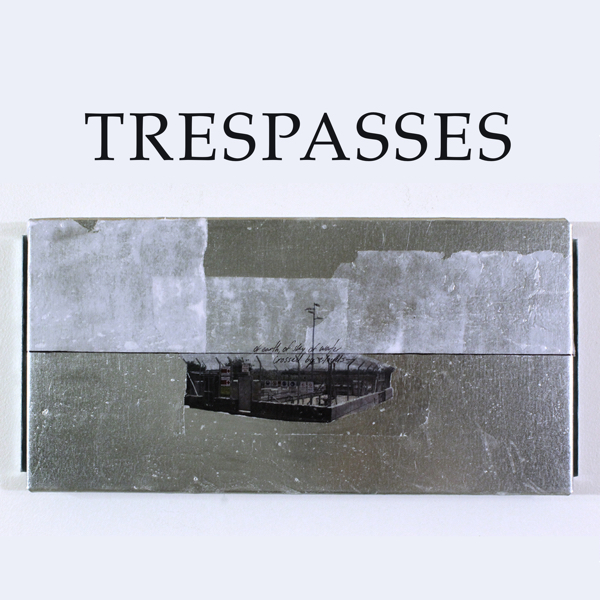
Trespass is a very old idea, and although it’s often seen negatively it can lead to beauty and revolutions in understanding. Sometimes we need other people to trespass into our private preserves of thought and belief, and into our carefully curated ways of doing things. In October of 2014, artists and writers came together in the EASE Gallery to share and talk about their work over dinner. Having met each other, they formed partnerships with each other and set about creating works that address the theme of trespass.

You can view those works by downloading this .pdf file, or you can order a print copy of the book on demand by following this link.  Ordering a print copy will provide a small financial benefit to the EASE Gallery.

How Can We Cultivate a Culture of Reverence?

“Im not interested in longing to live in a world in which I already live.”  Brad Modlin was reading from Maggie Nelson’s Bluets, a book about the color blue.  The Ministerium of Ideas was meeting to examine the question of how we can cultivate a culture of reverence, and Brad was sharing an omnium-gatherum of readings that he’s collected during his studies as a poet and a teacher of literature.  He divided these readings into five sections, and talked to us about Reverence through Rituals, the Reverence of Dropping Silent, Reverence as/by Staring, Reverence as Pause, and Reverence as Real Presence.  Most of the readings were drawn from contemporary poetry, and for many of us this was part of the excitement – to discover the gathered wisdom of a world of artists who are living now and experiencing the same fractured world that we experience.

To talk about ritual, Brad read Marie Howe’s poem, “What the Living Do.”  She wrote it for her dead brother, and Brad’s point was that the reverence of ritual shows up in everyday life, in the wonder at just being alive, even when grocery store bags break and the sink gets clogged up.  The poem conveys the idea that cultivating reverence is not about looking for exceptional moments, but discovering the beauty of the ordinary.

And that beauty can be wonderfully discovered when we fall silent.  Brad showed us a video of Neil Hilborn performing his spoken word piece, “OCD.”  Hilborn suffers from the eponymous condition, and the piece is a spillage of words, starting at a heightened level of intensity and becoming more intense.  But it’s true power comes at the end, when Hilborn falls silent.  All the clutter and confusion of his mind and words is allowed, for a moment, to lapse into quiet, and I couldn’t help thinking of the clutter and confusion of my own life, and those moments of allowed silence that create a sense of reverence.

Brad showed us a video of Marina Abramovic’s amazing performance art piece, “The Artist is Present.”  Abramovic performed the piece at MOMA, and it consisted of nothing more than her sitting, in a red dress, at a table.  When audience members sat down opposite her, she made eye contact with them for as long as they wanted.  Some people would sit for only a few seconds.  Others for long periods of time.  Some would weep.  The piece emphasized the power of the human gaze, but also the paucity of looking in our lives.  And this was Brad’s point, that reverence can be cultivated simply by gifting each other, and the world around us, with our attention.

So what stops us?  Perhaps its the fact that we fall too easily under the sway of what Brad called kronos, an understanding of time as sequential and demanding.  Kronos is the root of the word “chronology,” and holds within it the idea that time is fleeting, and that we must use it to accomplish all that we can before we die.  Brad contrasted this to kairos, which he described as God’s time, time that is eternal and secure, and that we don’t need to feel anxious about.  To engage in the rituals of ordinary life, to fall silent, to look and truly see, we need to let go of chronic anxiety and cultivate kairos.

And we need to understand that the world is full of what Brad (and countless Catholic theologians) called “real presence.”  To illustrate this, he showed us Michael Craig-Martin’s piece, “An Oak Tree.”  The piece consisted of nothing more than a water glass on a shelf, and a dialog between Craig-Martin and an unknown interlocutor, in which Craig-Martin makes the case for the water being an oak tree, in the same way that bread is seen to be the real presence within the Roman Catholic doctrine of transubstantiation.  “An Oak Tree” is an examination of belief.  We need this belief to give meaning to the mechanics of ritual, but, Craig-Martin asserts, it is also only through belief that we can give meaning to art, and life.  Experiencing reverence in the ordinary, in ordinary silences and ordinary seeing, seems to require the mediation of belief.  We believe that we will see something that contains more meaning than the ordinary should allow.

Which brings us back to Maggie Nelson’s Bluets, and her assertion that all the things we long for are already present here, if we could simply look and see them.  They’re present within the color blue, which is Nelson’s great obsession.  They’re also present within moments of realized justice, and in classes that we take about Ohio trees, and when we sit beside people who are dying, and when we witness the power of a sunset.  There is a great and constant transubstantiation going on, brought about by our silences, our looking, and our reverence.

Why is it so hard to help people die?

“If the goal of medicine is to prevent death, then the entire enterprise is a complete and utter failure.”  Dr. Robert Taylor of the Ohio State Medical Center was speaking to us at the Newman Center on a Thursday in early December.  We had gathered to examine the question of why it’s so hard to help people die in America.  Dr. Taylor has spent his career examining the ethics and spirituality of palliative care, and has concluded that the goal of medicine isn’t to prevent death, but to relieve suffering.  He and his colleagues are re-thinking the ethical paradigm for providing medical care to the elderly in an aging world, and he graciously shared their discoveries with us.

People who are seeking a good death help their families prepare for their absence.  One of the frequent questions that patients ask Dr. Taylor is, “how much time do I have?”  In some cases, they are really asking him to try to extend their time on earth.  But in most cases they’re thinking through all of the things they’ll need to do to arrive at a good death.  One of the most important aspects of a good death is called “completion.”  It means a chance to thank those who have been important in our lives, to forgive those who have hurt us, to express love, and to ask for absolution.  People who are seeking a complete end to their lives are willing, in general, to cede medical decisions to their loved ones, because they care more about their loved ones’ well-being than their own autonomy.  Seeking completion is a way of helping those loved ones prepare for the dying person’s absence.

Ceding one’s autonomy can be very counter-cultural, especially among white middle-class people.  Dr. Taylor pointed out that being dependent on others is often the worst thing that white middle-class people can imagine.  Which made me realize that even a healthy person in mid-life, such as myself, can begin preparing for a good death by surrendering my self-reliance daily.  As I listened to Dr. Taylor, and thought about my own eventual death, I realized that I want it to be fearless.  I don’t want to cling to life because I think that I can somehow control it.  I also don’t want to fear death because of a sense that too many things have been left undone.  A good death, it seems to me, is a reflection of a good life.

Hospice is a unique cultural institution, one of the only American institutions that explicitly bless death in a culture that is youth-obsessed and death adverse.  Our faith-communities can sometimes do this, but with less consistency and intentionality.  What if we were to adopt the questions of hospice and ask them of our members?  Dr. Taylor gave us four questions to ask.  What is most important to you?  What gives your life meaning?  What is your greatest fear?  What is your greatest support?  These questions can be asked of anyone, at any time.  They are questions that help us understand our lives as we live them.  And because of that, they are questions that can help us understand, and accept, our deaths.

Social Practice Art and Jeni Hansen Gard’s “Project Share”

project share
photo by Agnes Burris

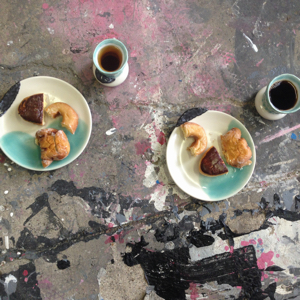
Whenever Agnes used the dishes, someone else washed them for her.  Joe began thinking about what kind of food he would serve on them, exploring new recipes and indulging his creativity.  Jen carried hers into the street and showed them to Melvin, a homeless man, and invited him to share a meal.  My dishes sat on the coffee table in our living room for the month of October, a goad to staying true to my participation in the project and a reminder of the people I had eaten with.

All four of us were participating in Project Share, a social practice art piece that Jeni was creating, and that ran concurrently with the Concurrent show in the EASE Gallery.  Like all of the artists in that show, Jeni is a ceramicist.  A few years ago she went to see a social practice piece in Philadelphia, and was underwhelmed.  The piece was about serving tea to people, but the cups and teapot used were mass produced, and the tea was generic.  She began to wonder about the power of objects, not just whether the specificity of a given object could enhance social practice work, but whether it could be the engine of the work itself.  She’s undertaken many projects to explore this question, one of the most notable being Project NOLA, which took place last Spring.  She was interested in what the men who lived under a bridge in New Orleans ate, so she created more than fifty ceramic plates and passed them out, along with disposable cameras.  She got four of the cameras back, and one of them contained a food journal that one of the men had kept.  Our project, Project Share, was about creating shared meals among strangers.  Jeni gave each of us a set of plates and cups, and asked us each to invite a stranger to share a meal.

Social practice art has thrived in Europe for decades now, and has recently begun to grow in the United States.  It is art that has a social conscience, that is deliberately trying to marry aesthetics with justice.  More than that, it’s art that is intent on creating community, and exploring the questions of community creation during a time in American history when many of our old forms of community are falling apart.  Being a member of one of those declining institutions, the church, I am more than interested in Jeni’s experiments, and what they can teach us.

The project was not a complete success.  Last night we had a final dinner, to which we were asked to invite the strangers whom we’d eaten with throughout the course of the month.  Neither of the people I’d met could come, and I wasn’t alone in this.  Only two of the dozen or so guests at the meals we’d held attended.  The rest were kept away by work and family conflicts, or by the fact that they’d been met, and then eaten with, in other cities, as we traveled throughout the month.  At this point in American life we’re a transient people, and the busyness of our day to day existence means that we look for community within the domains of family and work life, and that any other form of community is a secondary concern at best.

And yet, for those of us who participated, it was a distinctly beautiful experience.  The plates Jeni gave us were glazed white with a crescent of turquoise, and a quarter circle fringe of black, molded clay.  They were wonderful to look at and to touch.  Having them in my living room, and laden with food on the table of a restaurant as I ate with a stranger, made me think of the uniqueness of objects.  I have other unique plates and cups in my house.  But they’re not charged with experience in the same way – I can’t look at them and remember a certain time in my life, and the people with whom I ate off of them.  To use an object for a particular purpose is to gift it with memory, and there is grace in living a life that allows certain memories to remain distinct.

You can visit the Project Share blog by clicking here.