
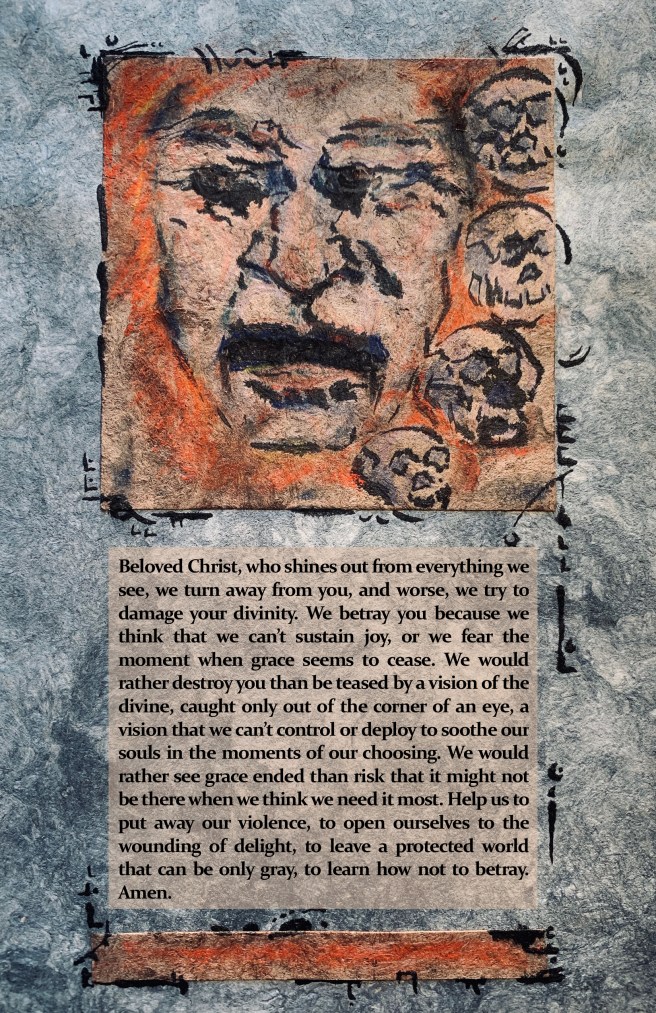
Station Two, The Arrest of Jesus

Station Two by KPB Stevens

THE ARREST OF JESUS

Judas brought a detachment of soldiers together with police from the chief priests and the Pharisees, and they came there with lanterns and torches and weapons. Then Jesus, knowing all that was to happen to him, came forward and asked them, ‘For whom are you looking?’ They answered, ‘Jesus of Nazareth.’ Jesus replied, ‘I am he.’ Judas, who betrayed him, was standing with them. When Jesus said to them, ‘I am he’, they stepped back and fell to the ground. Again he asked them, ‘For whom are you looking?’ And they said, ‘Jesus of Nazareth.’ Jesus answered, ‘I told you that I am he. So if you are looking for me, let these men go.’ This was to fulfil the word that he had spoken, ‘I did not lose a single one of those whom you gave me.’

They saw him and were amazed, but we can be alive to wonder, and still betray, having built rooms within ourselves in which to hide and pretend that we can be unknown to God. When we try to move beyond these rooms, we carry torches and heft weapons, so that we might prove that the force that keeps us small, and our happy consent to our fall, is a power that is greater than God’s. We enact brutality on the beloved, try to put out the eyes that are wide with grace, to prove that the smallness we believe in is really what we believe.

Think of a usual day. The confused tiredness of three in the afternoon, with the long, numb evening still to respond to. Think of the slight, inarticulate fear of leaving the house. Outside we might still be lonely, even in a crowd. And so many of our memories are hampered, somehow, by someone’s sneer or complete ignoring of our lives. Even when wonder is as simple as a line of light, tracing a building in the morning, who can we say this to, who would understand? Even when we pray, if we’re in public, if we extrovert a little gasp of joy, how can we trust it, if everyone around us is gasping to, if it seems to be, simply, the thing to do? Wonder, the low thrum beneath the beat of time, demands too much, demands a trust we may not have. Better to ignore it. Better to betray.

Seven Stations of the Cross – Station One, The Agony in the Garden

Station One The Agony in the Garden

I’ll be leading the Stations of the Cross at St. John’s on April 16th. I plan to do something different then the traditional fourteen stations that start with Jesus’s trial. I feel that this arrangement leaves too much out. And I want to focus more on the disciples and the others who surrounded Jesus, so that I can consider their (and our) reactions side by side with his suffering. Here is the first one. I plan to make a little chapbook of the seven stations I’ll be presenting for those who come to walk the stations with me. The page with the artwork I made and the prayer I wrote to accompany this station is above, and the reading from scripture and meditation is below. I’ll be following this format with the next six posts.


THE AGONY IN THE GARDEN

He came out and went, as was his custom, to the Mount of Olives; and the disciples followed him. When he reached the place, he said to them, ‘Pray that you may not come into the time of trial.’ Then he withdrew from them about a stone’s throw, knelt down, and prayed, ‘Father, if you are willing, remove this cup from me; yet, not my will but yours be done.’ Then an angel from heaven appeared to him and gave him strength. In his anguish he prayed more earnestly, and his sweat became like great drops of blood falling down on the ground. When he got up from prayer, he came to the disciples and found them sleeping because of grief, and he said to them, ‘Why are you sleeping? Get up and pray that you may not come into the time of trial.’ -Luke 22:39-46

It is incredibly hard to stay awake. At this moment, little tragedies are happening all over the world, yet it isn’t these that make me want to sleep. It is the closer suffering, the nearer pains. Some moment when I caused offense, or someone offended me. An ache in the body, a tiredness with being human, the simple desire to restlessly escape. Such sleep, the sleep that runs from trouble, isn’t true rest, but merely misery expressed as a hiding away. And all the while God, who sees everything, and to whom our little sufferings are hardly unique, is awake.

This is the first reason for our sleep – that true wakefulness is divine, and we are ill-equipped for divinity. I am, at least. Teresa speaks of the wound of compassion, the piercing we feel when we glimpse the world through the eyes that looked out from the cross. Because we are limited, we might, when seeing such suffering, believe that all is loss. We cannot see that the bodies that suffer are also held, or see the way that love sustains souls in pain. We cannot see that for every person there is a balance of moments of joy and pain, that the eye of eternity sees everything at once, both one day’s weeping and another day’s play. If we could live, like God, beyond the bounds of time, the joy that keeps the soul awake would not forsake us when we suffer for compassion’s sake, and from the cross we’d survey the empty tomb, the resurrection, the closing of the wound.