
Luke 17:1-10 We Will Find Ourselves in Communities of Forgiveness and Grace

Jesus issues a duo warning in this passage. First, when you fail (and we are all bound to fail), don’t lead anyone after you in your failure. Second, the surest guard against failure is the encouragement and forgiveness of community. If we are to accept the schema of self that I’ve talked about previously in these posts, we must ask what role community plays in our efforts to strip away ego and grow close to God. And it must be admitted that identity is not necessarily bad, just as its not necessarily good. We saw, in the parable of the heavenly banquet, that clinging too strongly to our identities prevents us from joining in the banquet that God is preparing for us. But it isn’t really possible to be part of a community without taking on an identity. As soon as you say “I belong,” you are necessarily claiming an identity in the group that you belong to. Identity cannot be entirely wrong or bad. As long as we hold it lightly, and don’t confuse our identities with our souls, we are helped by it, because we are helped by the communities we belong to.

What a community Jesus is describing! The community of his disciples is very different from many of the other communities we might belong to. To belong to this community is to be raw and exposed. This is a community that requires one to admit fault and abandon the need to be thought well of. In this community love, as the Apostle Paul puts it, does not insist on having its own way. And because one is exposed, faulty, and repentant, it becomes hard to lead other people astray in such a community.

At Youth Group a week ago, I said that I 95% believed in something. My daughter, who knows me well, and who has lived sixteen years listening to my opinions, asked me what I meant. I said that I always try to hold five percent back from any of my political or moral beliefs, because I always want to keep open the possibility that I might be wrong. I stand by that, even though it might make me seem wishy washy. But being one hundred percent certain is insisting on having things our own way, and I don’t want to lead children into this one hundred percent certainty mindset. When we embrace this mindset, it becomes much harder to admit our faults and ask for forgiveness. It also becomes harder to forgive, as forgiveness becomes associated with winning. “Of course I’ll forgive you, once you admit that I’m right.”

Such thinking is at the root of communities of dominance and exclusion, exactly the kinds of communities that create destructive, self-serving identities. But a community that has an ethic of repentance and forgiveness, and doesn’t misuse that ethic or turn it into a form of control, posits a different kind of identity, one that reduces the controlling needs of the ego and cultivates humility in its members. Living in such a community is easy and joyful. Laughter is heard often in such a community, and people feel free to play. It is in this passage that at least two of the main spiritual themes of Luke are realized, and we see how joy and forgiveness lead to beauty and grace.
Luke 14:25-35 Asking for Terms of Peace

I am not a disciple of Jesus. I have not given up family, and home, and possessions, for his sake. It is important to admit this from the outset, to set aside the hypocrisy and vanity of claiming that I’m something that I’m not. The handful of people who followed Jesus were better at this than I am, but not at first. They must have heard Jesus’ words with the same dismay that I feel. We are to hate our mothers and fathers, brothers and sisters, our spouses, and even our lives? Really? Wasn’t it enough that they had already left their homes and livelihoods to follow him? Now they had to give up their relationships and die? They fail in this when Jesus goes to the cross, although some of them do, eventually, live lives of radical renunciation.

I am humbled by my own failure at discipleship, but I think that is the point. Teresa of Avila, the great 16th century Spanish mystic, says that humility is the most important attribute and spiritual gift we can have. She goes even further, and talks about God’s humility. Perfect love, divine love, is humble. It doesn’t insist on having its own way. It casts aside the need to control that causes us to fear. As Christians, we hope to mirror that divine love. But we can’t do it on our own. If we fail to see that, if we believe that we can follow Jesus’ harsh command and still somehow imitate perfect love, we are fooling ourselves.

It is the harshness of the command itself that humbles us. Jesus is setting an impossible standard. He himself doesn’t hate his mother, who stays with him at his death, standing at the foot of the cross. And yet he has been willing to give up everything for love. His humble death teaches us how to love like God loves. Beyond the strengths of our social and political power, beyond the boundaries of our identities, there is a love that encompasses everything, and it is our hope to imitate it. But we will be unsuccessful. Like the king in his parable, we will consider the strength of our forces, find them entirely wanting, and be forced to ask God for terms of peace.

In the end, when faced by the impossibility of perfectly imitating divine love, when brought to see each other as we really are, we will be humbled and, in our humility, come to understand our need for God’s grace. The divine love will keep loving us, no matter what our failures, and we will not be able to control it, or direct it. All we can do is give ourselves to it. In humility, we can worry less about being perfect in the practice of love, and let ourselves be sufficient in the acceptance of love.


Luke 2:1-21 Divinity Entangled with Humanity

The Gospels claim, and Christians believe, that divinity is entangled with humanity.  The evangelists go even further. When Jesus talks about the Kingdom of God, he is saying that creation itself is shot through with divinity.  Divinity is all around us, and it always has been. Poets and mystics alike attempt to see through the veil of ordinary existence to the extraordinary, pulsating life of the world.  This requires a deep spiritual practice. One of my favorite poets, Denise Levertov, describes this beautifully with a line from In Memory: After a Friend’s Sudden Death: “to heedfully walk and sing through dailiness noticing stones and flowers.”  We must be heedful in our noticing if we are to cultivate a spirituality of incarnational wonder.  And once you start practicing this heedful noticing, you find yourself spiritually aligned with the shepherds: accosted by angels, filled with joy and fear, ready to rush off and seek the miraculous.

The most surprising thing about the miraculous in the nativity story in Luke’s Gospel is that it takes the form of a newborn child.  Ephraim of Syria, a fourth century poet and theologian, wants us to dwell within this sense of surprise. “Mary bore a mute Babe though in Him were hidden all our tongues.”  Jesus, the miracle, the Word that dwelled before time and was active in creation, becomes human as someone who cannot speak. You might say, “well of course, that’s how all of us become human.”  But if all things are possible with God, then Jesus’ could have just shown up as an adult. His incarnation as a wordless, squalling baby is meant to tell us something. First, that the spiritual practice of noticing and participating in incarnation takes a great deal of care.  We need to attend to it like we would to a newborn. Second, that the spiritual life is a journey, just as physical life is, and that it will have moments of trial and error, success and failure, growth and senescence. We are figurative infants at the beginning of our imitation of Christ, and we would do well to remember that.  Babies lack control of words, of their bodies, of their relationships. They are humbly reliant on the people who surround them. And that’s how we should start. With humility and the acknowledgement that we are not in control.

Spiritual Mastery

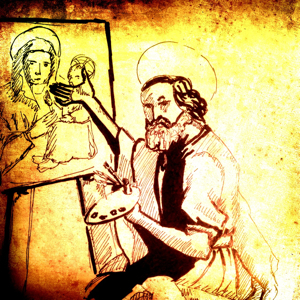
saint luke for postSaint Luke’s feast day was a few Fridays ago.  In additional to writing his Gospel and the Book of Acts, Luke is the patron saint of artists, for the simple reason that he’s believed to have been the very first Christian artist.  The earliest icons, showing Christ and Mary, were thought to have been painted by Luke, and that’s why iconographers are so careful to take themselves and their own artistic vision out of the equation when they write icons.  In their minds, they’re simply copying the original portraits of Our Savior and his mother.

In the middle ages, artists organized into Guilds of Saint Luke.  When an artist wanted to be considered a master, he had to submit a masterwork to the guild.  Often, these masterworks show a scene in which Saint Luke, sitting at an easel, paints the Virgin with the infant Christ sitting in her lap.  The painter himself is sometimes pictured as well, but always in a subordinate role – cleaning Saint Luke’s brushes or performing some other menial task.

Learning about this got me thinking about the idea of mastery.  Obviously, if Christian artists and other craftsmen were trying to attain the status of “master,” the idea of mastery can’t be entirely foreign to the Christian church.  But how often do we think of our spiritual lives as leading to some goal, some master work?  Would it change the way we thought about our faith if we had some distinct purpose in mind when we went to church or prayed privately during the course of our day?

A Christian masterwork could be anything, really.  When I was working in a hospital for a summer I had a friend and mentor who was an elderly Roman Catholic priest.  He and another priest had a spiritual practice of meditative walking, which they did in downtown Chicago.  As they walked, they tried to open themselves to the world around them, the sound of street traffic, sunlight cutting its way across the buildings.  One day, as they were walking through a park, they encountered a man who was assaulting a woman.  Without hesitation or fear for their own safety, they interfered and protected the woman.  I consider this their master work.

The one prerequisite to producing a master work seems to be humility.  Medieval and renaissance artists were often arrogant fellows, but they subordinated themselves in the paintings they made of Saint Luke.  My friend the Roman Catholic priest could only help the woman who was being attacked because he’d been humble enough to try to make himself truly aware of the world around him.

I found myself thinking about humility this past week, when I served as chaplain during the Stand Down for Homeless Veterans in Columbus.  This is a yearly event where agencies and companies and politicians gather in the Veteran’s Memorial to provide gifts and services to vets who are living on the street.  Humility was the prevailing ethic of the day.  Danny, one of the chief organizers, told me what he tells all volunteers, that the men and women who came through the door were veterans first and foremost, and that we wouldn’t dwell on the fact of their homelessness.  Ask them about their service, not about their poverty.  This seemed very humble to me, this willingness to concentrate wholly on the dignity of the people we would meet.

But an even greater humility belonged to the ROTC cadets who lined up by the door.  These were high schoolers in baby blue shirts and neckties.  As the veterans came in, they stepped forward to push shopping carts, carry bags, and guide the men and women through the Memorial Hall.  I watched them and thought about the fact that in five or ten years these kids will be leading troops in combat.  That day in the Veterans Memorial they were engaging in a kind of training in humility.  A good officer has the humility to set their own needs aside in order to look after their troops.  Because of this early training in humility, these young people may, someday, be capable of a masterwork in leadership.  They may, through their attentiveness and caring, be able to save the lives of those who serve under them.

If I were to describe a spiritual path to Christian mastery, the first station would be humility.  No skill can be learned, no human relationship truly established, until we learn humility.  Without humility, we are deaf to the voice of God in our lives, and blind to the needs of those around us.  This, I think, is why Jesus so clearly values the tax collector in Saint Luke’s parable, the one who prays “God, be merciful to me, a sinner.”  It’s not because Jesus wants us to demean ourselves.  Jesus wants us to be like him, a spiritual master.  But the first step on the road to mastery is humility, the ability to set ourselves to the task of cleaning Saint Luke’s brushes and not assuming that we already have the skills to create a masterwork.