
Laments & Praise
Last Sunday, we finished our five-part series on Lament by considering praise. It is rather beautiful that laments, which are so honest and raw about negative emotions, also have plenty of room for thanksgiving and expressions of joy. The ancient Israelites seemed to know that emotive prayer couldn’t be completely honest if it only dwelled on the hard things. Human beings are deeply complex, and moments of distress are often also moments of discovery and uplift. So we end our laments with praise not out of any insistence on false optimism, but from a sense that we can’t be complete people without acknowledging the light as well as the darkness.
Opening Prompt
Here’s the opening prompt that I offered to our study group:
Name something or someone that you love, yet struggle to find words to describe the love you have for them.
People talked about all sorts of things, from the natural world to familial relationships. Since the discussion that followed touched frequently on ineffability, it was good to start by acknowledging that even the things we’re most familiar with escape our powers of description from time to time.
A Teaching About Praise
The Bible describes different understandings of reality and selfhood than those held by most people in the post-industrial Western world. For the ancient Israelites, there was no understanding of self outside of encounters and covenant with God, who is understood to “author” reality. Scripture puts God’s justice at the center of reality and expects God to act in history and to be present in our current struggles. But encounters with God go far beyond any of our imaginings.
Martin Buber famously described our relationship with this present, active God as an “I/Thou” relationship. I/Thou relationships are intimate and lead to transformation, as encounters with a “Thou,” be it a tree, a building, the Godhead, or anything else, are totalizing. Buber writes that
“Nothing conceptual intervenes between I and Thou, no prior knowledge and no imagination: and memory itself is changed as it plunges from particularity into wholeness. No purpose intervenes between I and Thou, no greed and no anticipation, and longing itself is changed as it plunges from the dream into appearance. Only where all means have disintegrated encounters occur.”
When our experience of each other or the things of this world is one of utility, we are not in I/Thou relationships, but are involved in I/It forms of exploitation, as if the stuff of the universe exists only to serve our purposes.
Songs of praise are expressions of I/Thou encounters. They speak of relationship and transformation. Walter Brueggemann writes that “in this practice of praise the human person lives best and well and most freely when all of the self and all of the claims of the self are given over in full, unreserved surrender to God.” According to Bruggememann (all the following quotes are his), praise has these qualities:
- It is unrestrained address to God in extremes of need and joy.
- It is not transactional – not giving thanks for gifts received or services rendered, but “a lyrical expression of amazement, astonishment, and gratitude towards the Holy One who lies beyond everything the human persons can generate.”
- It contains awed recognition of the wonders of creation, of God’s ongoing “birthing” of the cosmos, and sees creation as a form of generous extravagance that cannot be hoarded or even possessed by human beings. It asserts that there is a “limitless generosity at the root of reality.”
Psalm 63:1-8
We can see this sense of praise at work in Psalm 63, called, in the tradition Deus, Deus Meus which means “God, my God.” Here’s the text of the psalm:
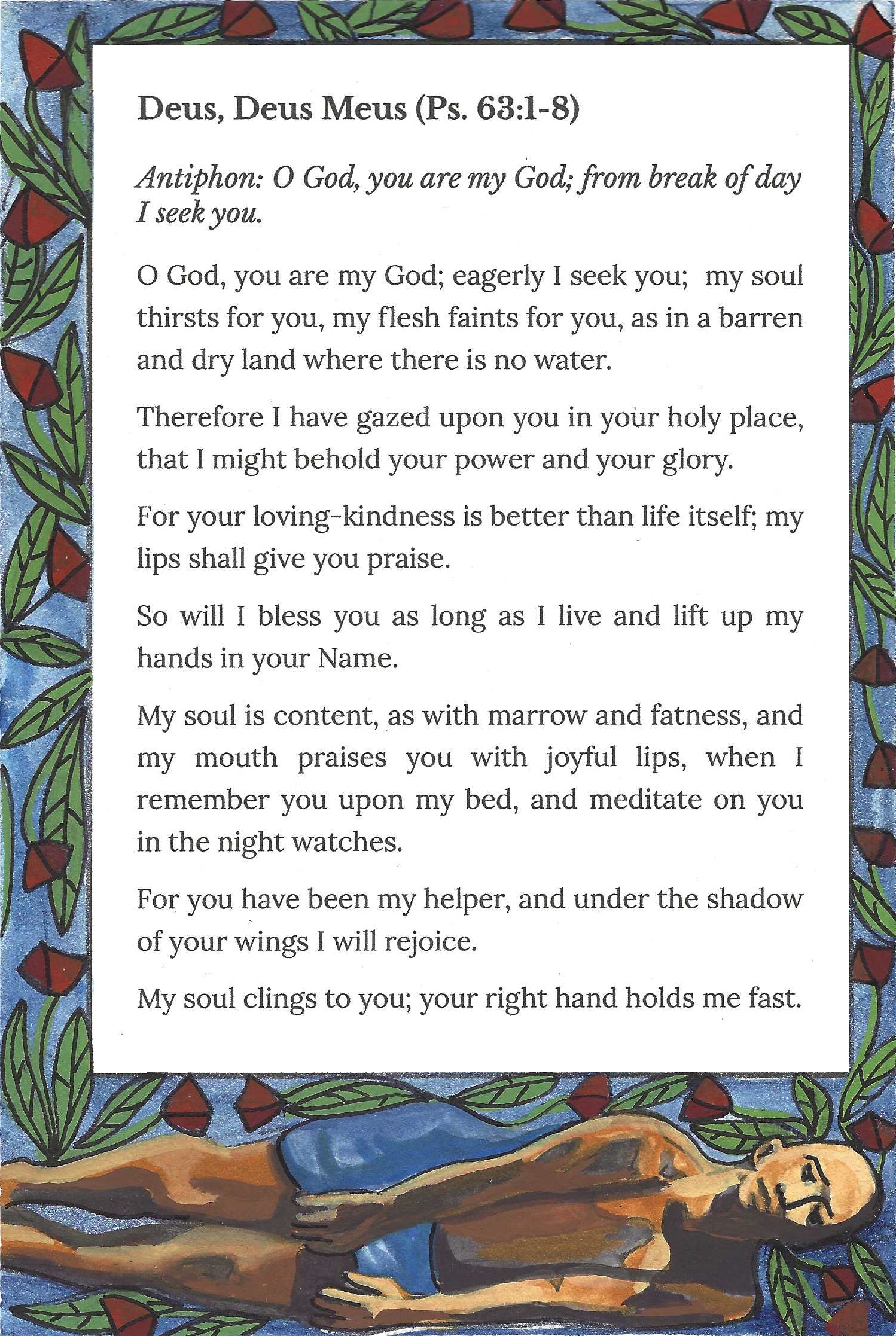
The psalm describes an experience of God, but it doesn’t do so directly. It speaks of the effects of the encounter, the sense of satiation and contentment. It seems exaggerated with its talk of fainting flesh and thirsting souls. It doesn’t name the gifts that God has bestowed, as it isn’t at all transactional – there is no sense of God having made good on a promise or responded to a request for anything but divine presence. To write a hymn of praise like this requires that we take seriously everything else that we’ve learned about laments, particularly last week’s learning about petitionary prayer.
Writing A Prayer of Praise
First, read through what you’ve already written, and ground yourself in the feelings and images. Then…
- Reflect on an encounter with God. (You don’t have to describe the specifics of the encounter. It is enough to name the encounter, as in Psalm 63: “I have gazed upon you in your holy place.”)
- Try to find words for the aftermath of the encounter, how it felt in your body and in your mind, how you continue to reflect on it. (Example: “My soul is content, as with marrow and fatness…I remember you upon my bed and meditate on you in the night watches.”)
- Name “witnesses” to the encounter, other parts of your life and of creation where you experience “Thou-ness”. (Example: “Let the earth glorify the Lord, sing praise and give honor for ever. Glorify the Lord, O mountains & hills, & all that grows upon the earth, sing praise and give honor for ever. Glorify the Lord, O springs of water, seas, and streams, O whales and all that move in the waters.” -The Book of Daniel.)
Here’s what I wrote in response to these prompts, continuing my meditation on the war in Iran and my own feeling of futility as I try to figure out if there’s anything at all that I can do about it:
I have seen a child grin with joy in the midst of devastation,
and have seen you in a child’s face as she plays in the rubble.
I close my eyes and see that joy, I grow unreasonable with joy,
I smile secretly, and only you know what I am feeling, what I am hearing.
Every child in every place, every voice raised in laughter,
every babble of imagination, every game, and dance,
every moment spent singing in the grass, insists,
with you, that joy, like the world, remains.
Some final thoughts, before offering more examples
I have been thinking a lot about how I might use laments as part of my regular prayer practices in the future. In particular, I’m wondering if they might be a way to keep my petty resentments from spilling over. If a person or situation has upset me, can I sit down and write a lament before I react? Will it help clarify my own sense of disappointment, or reveal my pettiness or peevishness? If laments are meant to help us maintain a right relationship with God, can they help with human relationships as well?
Perhaps. I might find that it’s best to reserve lament writing for those times when my soul wants to howl with despair, not over some difficult relationship, but over the state of the world. For those moments when I want to curl up in bed and cry, or deaden myself with drink and distraction.
I am a neophyte when it comes to lament, but also enticed by it, and I will look for ways to deepen my practice.
Full text of sample laments
Here, in full, are the two laments I wrote as I prepared to teach. I hope you find them helpful, and that, if you write your own laments, you might share them with me.
Lamentation, The Masked Men
Doxed Divinity,
naked-faced agitator caught in a camera’s eye,
strip away the bully’s costume,
pull the mask down from his face,
send him reeling back in nakedness,
bring him to his knees.
We voted for our destruction,
gave away our liberties because of the price of eggs.
Now doors crack inwards, windows shatter,
the frigid day stalks in, the masked face of winter
squints through beady eyes.
Children weep as gloved hands grasp and hold their heads.
There is no tenderness.
Schools empty, children starve,
and pompous, apostate senators
clasp their hands upon their bellies and regard
our destruction as Your best wish.
Why don’t you haunt their nights and make them weep,
and make the cold stretch across their naked skin?
Why don’t you batter and berate them?
You, who, when the flood had ended,
sent a beam of sunlight
onto the post of a broken fence,
after everyone had fled,
and the long, sallow girl
who spoke in gangly sentences
played a song of hopefulness.
The stuffing had come out of the houses
and lay, gray on dirty streets,
and the ship that broke the levy
balanced on the neighborhood’s jagged edge.
But still, the light on the post, and the song,
and we agreed with each other
that even destruction welcomes the sun.
Warm the winter skies,
shine within the icicle’s shattering,
be a shard of collapse, cold’s downfall.
The people sit in cages
and all who love have worry in their eyes.
We cannot stop hearing children cry.
We must learn to live without our masks.
We must learn to see you face to face,
and each other, face to face, us.
Let children wave blessings in the air
when the summer world wakes the dead,
let them invite us into their care.
Grow like grass through cracked belief.
Be the animal that we thought was extinct,
who returns to wander ruined streets.
I have seen your breath as snowdrops
growing from a patch of melting snow,
the cold grown granular and cracking,
the flowers heavy, clumped, and sprawling.
I wake and know that the world is ready,
again, for us to walk in it,
that children make toys out of ruins,
that my own body can know their joy.
Let you be glorified with photographs,
pictures of released captives,
and triumphant whistling in the streets,
all warnings turned to victories,
winter turned to rain with sunlight following,
nature, and us, conspiring
in the end of ice and cruelty’s defeat.
Lamentation, Pharoah’s Silos
Grain of spirit milled for bread,
fill the children who hide inside,
sharpen their minds,
give freedom to their play,
remind them, through your buried taste,
that they will emerge into daylight,
that the world is always being remade.
This is the season of starvation,
the old season that our ancestors feared,
lean with empty cupboards, sacks emptied of grain.
Joseph built great silos and put them in Pharaoh’s hand.
Pharaoh still controls them, and there’s famine in the land.
The grocery stores are open,
the shelves are laden and the coolers softly glow.
But a glacier spans the city,
and the children live beyond it,
starving on ice flows.
Why aren’t you sunlight, hot and fierce?
Why don’t you drown the pharaohs and lead us into wilderness?
Once, in the desert, we built a house.
The sun made a cooking stone of the concrete slab,
and we built quickly, making shade,
and the family that would live there
lifted sheetrock with us, then retreated, in the heat,
to their shack of cardboard walls.
Power lines were slack in a street of dust,
and when our saws stopped working
children lifted cables, looking for the break,
ignoring the electricity that would kill them at a touch.
Sweat, a stinging in the eyes,
and the scratch of insulation
to keep the cold of the desert night outside.
And then, with dirty hands, we ate together in the dust,
bean burritos, and the taste of the hands that made them,
and of contentment, and our acceptance of Your love.
Allow us, now, to taste contentment,
that lovely taste of tiredness,
and work well done, and hard.
Create banquets for those who hide and starve.
The mind grows sluggish
and words are hard to find,
and anger, like dust, grows
in the corners of the rooms.
Let Your leaven fill the air,
let us taste it on our tongues.
Everyone will eat, everywhere, when You come,
when You arrive as a guest at the starving house,
the silos broken behind You,
the grain spilling from your tomb.
I have seen you, thick as sunlight,
in the yellow room where we sit and eat
beneath the poster of the market –
stacked tomatoes, antique trucks,
an artist’s vision of fulness
after the plains had turned to dust.
I have caught a glimpse of you,
as I make our bread,
the deep contentment of a kitchen,
the delight as dough rises,
as the air summons its leaven
to eat and rise, invisible,
in the body of the bread.
Give glory, hidden nourishment –
yeast within the air,
mitochondria in our cells,
nitrogen in dangling beans,
the germ safe for eating
within the stalk
of grain’s covered head –
sing, O mysteries of human feasting,
limestone used to shuck the casing
of dried and hoarded corn,
smoke putting bees to sleep
so we may taste the honey in the hive,
potatoes dug from earth,
their green tops swaying,
rooted with our life.
We become storehouses,
we open up our doors,
the grain of ingenuity
pours out into the square.
We feast and dance together,
having shared our secret food.
Give glory for all nourishment,
and all preservation of the good.

