
Acts 9:1-31 The Road to Damascus

Paul’s story is probably one of the most important conversions in human history. It is the pivot point for the Book of Acts, the moment when the book’s true hero is introduced, the moment that will lead to the conversion of the gentiles and, hence, turn the followers of Jesus from a small community of Jews, living in Israel and worshipping at the temple, into a world religion. The import of this moment cannot be underestimated, but in this post I will only talk about two things – Saul’s vision, and the persecuted community that accepts him and renames him.

First, the vision. A light flashes, a voice is heard, God’s presence is announced. My guess is that, for Paul, a great deal happens as well. Teresa of Avila, whom I have mentioned many times and has been so fundamental to my reading of Luke/Acts, talks about those moments when “the soul sees into God himself.” She says that

all things can be seen in God because God has all things inside himself. Even though this vision passes in a moment, it engraves itself deeply in the memory and causes the most blessed confusion in the soul. This is a great favor. The soul becomes keenly aware of imperfect acts she has committed while inside of God. If only she had realized that she was dwelling inside the Beloved himself when she was doing those unconscious things!

For Paul, this feeling of imperfection must have been much worse than it is for most of us. When we see through the eyes of God, when we come to truly understand that we dwell within the divine, we can feel bad about all of our small failures that have ignored or taken for granted the great love that we’re swept up in. But Paul actively conspired against and tried to murder that love. His sin against the Holy Spirit was much greater than most other people’s. No wonder he was struck blind for three days. One can only imagine how he wrestled with his shame during that time, and how, in his blindness, his great vision remade him.

And yet there was a community that tried, always, to dwell within God, to align itself constantly to that great love. Ananias had a vision of his own, and this vision is as important to Paul’s story as his own. Love compelled him to go and find Paul, to heal him and take care of him. Then, when Paul escaped from Damascus and went to Jerusalem, it was Barnabas, the Son of Encouragement, whom he approached and who vouched for him with the community. Both Ananias and Barnabas understood that Paul, even when he was persecuting them, was also inside of God, to use Teresa’s metaphor. He was already united to them, even though he didn’t realize it and actively tried to resist it.

Which leaves me in awe of this early community, and of the potential of community in general. A community that realizes that it, and all things, are inside of God, is a community that can forgive more easily and love more easily. You can tell if you’re living within a community that sustains and cultivates this vision, because it will be a community that maximizes forgiveness and doesn’t worry much over slights. People still wrestle with their egos within such communities, but their egos don’t get final say. As Paul will later write in his second letter to the Corinthians, in such communities love doesn’t insist on having its own way.
(1) https://www.penguinrandomhouse.com/books/288621/the-interior-castle-by-teresa-of-avila/9781594480058/

Luke 17:1-10 We Will Find Ourselves in Communities of Forgiveness and Grace

Jesus issues a duo warning in this passage. First, when you fail (and we are all bound to fail), don’t lead anyone after you in your failure. Second, the surest guard against failure is the encouragement and forgiveness of community. If we are to accept the schema of self that I’ve talked about previously in these posts, we must ask what role community plays in our efforts to strip away ego and grow close to God. And it must be admitted that identity is not necessarily bad, just as its not necessarily good. We saw, in the parable of the heavenly banquet, that clinging too strongly to our identities prevents us from joining in the banquet that God is preparing for us. But it isn’t really possible to be part of a community without taking on an identity. As soon as you say “I belong,” you are necessarily claiming an identity in the group that you belong to. Identity cannot be entirely wrong or bad. As long as we hold it lightly, and don’t confuse our identities with our souls, we are helped by it, because we are helped by the communities we belong to.

What a community Jesus is describing! The community of his disciples is very different from many of the other communities we might belong to. To belong to this community is to be raw and exposed. This is a community that requires one to admit fault and abandon the need to be thought well of. In this community love, as the Apostle Paul puts it, does not insist on having its own way. And because one is exposed, faulty, and repentant, it becomes hard to lead other people astray in such a community.

At Youth Group a week ago, I said that I 95% believed in something. My daughter, who knows me well, and who has lived sixteen years listening to my opinions, asked me what I meant. I said that I always try to hold five percent back from any of my political or moral beliefs, because I always want to keep open the possibility that I might be wrong. I stand by that, even though it might make me seem wishy washy. But being one hundred percent certain is insisting on having things our own way, and I don’t want to lead children into this one hundred percent certainty mindset. When we embrace this mindset, it becomes much harder to admit our faults and ask for forgiveness. It also becomes harder to forgive, as forgiveness becomes associated with winning. “Of course I’ll forgive you, once you admit that I’m right.”

Such thinking is at the root of communities of dominance and exclusion, exactly the kinds of communities that create destructive, self-serving identities. But a community that has an ethic of repentance and forgiveness, and doesn’t misuse that ethic or turn it into a form of control, posits a different kind of identity, one that reduces the controlling needs of the ego and cultivates humility in its members. Living in such a community is easy and joyful. Laughter is heard often in such a community, and people feel free to play. It is in this passage that at least two of the main spiritual themes of Luke are realized, and we see how joy and forgiveness lead to beauty and grace.

Luke 7:36-50 Forgiveness and Gratitude

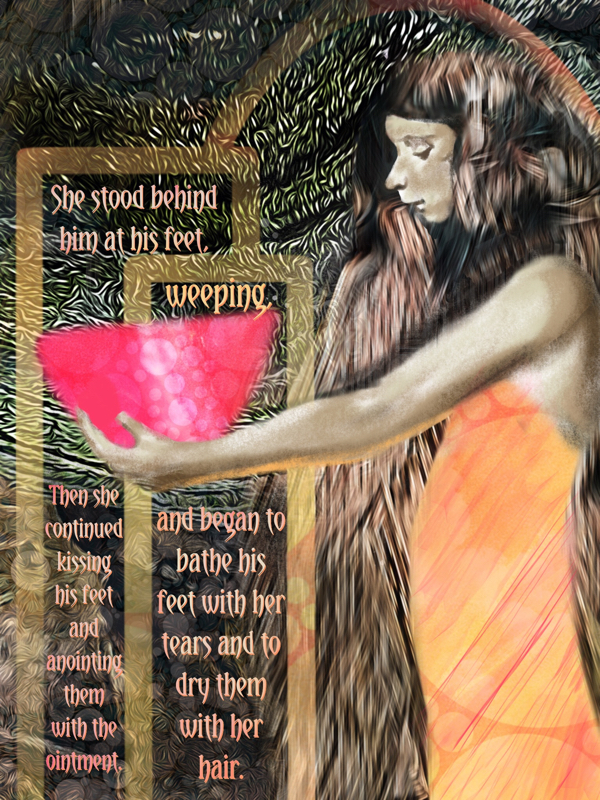
The Weeping Woman by KPB Stevens

Jesus doesn’t condemn people for their sins because everyone has flaws.  Only God is perfect, and while we strive to imitate God (and sometimes even succeed) we remain flawed, temporal beings.  The secret to peace and joy is not getting too upset about it, not punishing ourselves or others for not being perfect, while, obviously, trying to refrain from letting our flaws harm other people.  We need to maintain a certain balance. As T.S. Eliot wrote at the end of “Ash Wednesday”: “Teach us to care and not to care,/Teach us to stand still.”

This is what Jesus’ forgiveness is.  Jesus restores balance in the woman who weeps and wipes his feet with her hair.  So why does Simon the Pharisee take offense at it? Adyashanti explains it well:

The open heart is compassionate because it maintains an essential connection. But as soon as we separate ourselves from another – as soon as we say, “No, there’s nothing in you that corresponds with something in me” as soon as we forget that you and I essentially share the same spiritual essence – then we cut ourselves off, and we go into blame. Forgiveness comes from that deep intuition of our sameness, of our shared humanity. That perception starts to lower the walls of defense, and being judgmental is ultimately a defensive game, a way of staying, “I am not like you.” To forgive is really a way of saying, “I see something in you that’s the same as in me.” Then, even though you may be upset, even though the other person may have caused you pain or harm, when you connect with your shared humanity, there’s forgiveness.

Simon’s response to the woman is essentially defensive.  He wants to separate himself from this woman so that he doesn’t have to consider his own flawed nature. And Jesus doesn’t let him off the hook.  The parable he tells is about two people who both have flaws, and both get healed.

The proper response to forgiveness, as to so much else, is gratitude.  And gratitude is so precious and joyful that God wants us to generate more and more of it.  It is, after all, the thing that will keep us in equilibrium, despite our flaws. Whenever we start to focus too much on our sins, and feel the heat of past embarrassments rush to our cheeks, and become paranoid that other people are judging us for all of our foolishness, the best way to stop this spiraling sense of our own flaws is to start naming the things we’re grateful for.  I often think of my wife, and am amazed that this person, whom I’ve loved for twenty-five years, and who knows all of my manifold flaws and failures, loves me anyway, with a deep, enduring love. That’s the love that Jesus is offering to the weeping woman, and for the rest of her life she will be able to look back on his forgiveness and use it as a wellspring of gratitude. That’s the true power of forgiveness.


Quote from Resurrecting Jesus by Adyashanti.  View the book here.