A Priest at the End of Christendom

Published May 22, 2023 on Substack

“I’ve come to realize that I don’t need to reform the church. I just need to love people.” This is what I said when interviewing for my current position as the rector of a small, urban Episcopal church in the midwest. Eight years before I had begun working for our diocese as a “missioner,” a kind of free-floating staff position charged with figuring out what was coming next for the church. I worked with a brilliant priest named Jane Gerdsen, whom I credit with saving my ministry. When I met Jane I was in the midst of one of my periodic moments of wondering whether I was truly called to the priesthood. I loved preaching and celebrating, but I didn’t love, or even like, the institution of the church. I would go to clergy meetings and everyone would be competing with each other, bragging about the importance of their ministries so that the bishop would hear them and send them a trickle of resources so that they could keep going, at least for another year. This spirit of competition made it hard to make friends. And, at least twice, retired priests had approached me when at these gathering and told me all of the things that they didn’t actually believe. They had spent their lives preaching and teaching these things out of a sense of plodding duty, even as they began to question, then doubt, then cease believing altogether. What was I doing, I wondered, competing for scant resources in a church that couldn’t be honest about its fundamental hopes and dreams?

Jane saved me by bringing me into a creative, hopeful, relationship-based network that was sometimes called Fresh Expressions and sometimes called Praxis Communities. We read Diana Butler Bass and Brian McClellan, and agreed that we were living on the cusp of a third reformation (the first being an attempt at centralization that took place in the 11th and 12th centuries, the second being the one with Martin Luther that you’re probably familiar with). We talked seriously about improv and play. We founded urban farms and art galleries. We met for dinner church and Art of Hosting trainings. I really believed in this work. I still do. But a strange thing started happening. We thought that we were creating a church for young people, but older people kept showing up to our events and conferences. It seemed that the yearning we were feeling didn’t have an age requirement. So I began to wonder if the practices we had learned, the wisdom circles and shared leadership and community organizing skills, could make its way into the parish. There was a practical side to this. We were able to do this work because we had a visionary bishop. Any new bishop might not support it. And the parish is still the basic economic unit of the church. If the work was to continue, it had to find a home in the parish. Hopefully it would do so to the parish’s benefit.

But I wasn’t lying when I told the search committee at my parish that I wasn’t hoping to reform the church. For one thing, I was pushing fifty, and reformation is the work of young people. For another, I had, and have, a real sense that the church I want to live in can be a model for compassionate understanding, and compassion isn’t unidirectional. One has to be as compassionate towards the grief of a way of being that is ending as one is towards the uncertainty of a way of being that is emerging. Any reformation without love isn’t a real reformation, and if one has to pick, I will pick love every time.

Does that mean that the first two reformations weren’t real? Well, neither ended the church’s historic alliance with empire. We call that alliance “christendom,” and it was as strong in the kingdoms and states that abandoned Roman Catholicism as it was in Italy or Spain. Both previous reformations were periods of great violence and persecution. Both ended up constricting the boundaries of what could be thought or said. Both had their dogmas, their witch hunts, their antisemitism, their racism, their unexpected and bewildered scapegoats. Both tied themselves to wealth, status, and power. Perhaps this is because they were led and enacted by human beings, and any human endeavor will have its share of violence and oppression. But why start there? Why start with the violence of telling people that their opinions don’t matter, their practices are old and stupid, and that everything they love will die if they don’t change?

I was honest when I said that I would choose love over reformation. I try to make that choice every day. Yet the end of Christendom is arriving. Perhaps it’s already arrived. And many things are changing as a result. I am fortunate that I serve a church that is progressive and open to change, at least in some ways. But every group has its third rails and sacred cows, and new people arrive with fresh ideas and passions, which means that serving any church is a continual tightrope.

So I walk the tightrope, day by day, and I am choosing to reflect on that balancing act here, in this newsletter. I will tell stories of daily encounters, with respect and with permission. I will delve into liturgy, into religious anthropology, into the contemplative tradition, and into art and poetry. These are the things that interest me. Fortunately, many of my parishioners share these interests. Or at least they’re polite and complimentary when I preach about them. But mostly I will reflect on what it’s like to live through the end of Christendom, a fifth of the way into the twenty-first century, in a liberal city in a conservative state, in a progressive denomination within a religion that is widely thought of as reactionary. I hope to do so in community with you, honoring your thoughts and opinions, and learning from you as I go.

Under the Covers

“Why didn’t Jesus have sex?”  One of my students asked me this some years ago.  We were in the middle of cooking dinner for our weekly campus ministry meal, and my thoughts were on the onions simmering in a pan and on gathering the ingredients to make dessert.  I was distracted and the answer I gave her wasn’t well thought out.

“Because Jesus’s love is for everybody,” I said.  “There’s something about sex that creates a really deep intimacy between just two people, and Jesus’s intimacy is for everyone.  He either had to have sex with no one or everyone.”

I don’t think my student was satisfied with this answer.  I think she was probably asking a more specific question, “Is sex related to God,” or “does having sex take me out of my relationship with Jesus?”  If I had been able to hear these real concerns beneath the question that she did ask, I would have answered differently.

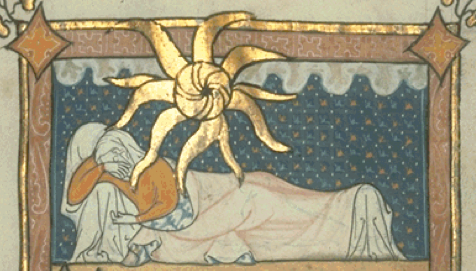
There’s a lovely illumination in the Rothschild Canticles that shows a nun, meditating upon her bed.  The Godhead appears above her in the shape of a sun, and one ray of that sun is reaching under the sheets.  It’s an image that reflects a late medieval spirituality that sought mystical union with God through erotic imagery.  I like it very much, because I think that it has something to teach us.  That teaching can be simplified to this – Jesus is with us under the covers.  He’s engaged in our intimacy, not absent from it.

rothschild

My friend Laurie and her friends used to open the hymnal when they were bored in church and add the words “under the covers” to the ends of hymn verses.  They giggled at phrases such as “Lo how a rose ever blooming, under the covers,” or “Come thou font of every blessing, under the covers.”  But this game was unexpectedly theological, even though they may not have intended it to be.  It was probably the only acknowledgement they ever heard in church of the idea that God is present with us in our intimacy.  Why is this idea so unnerving that preachers can’t preach on it, and it only gets expressed in the titillation of giggling children?

Imagine the gift that the church could give to people if it only dared to talk about the ways in which God can be present in our intimacy.  One of the paradoxes of sex is that it’s bodily, but also out-of-body at the same time.  The accumulation of physical sensations leads us into a kind of physicality that we don’t experience in any other way – the scent of a lover, the caress of a hand, the movement of a gaze across the body of a beloved, these things create a kind of altered state, a holistic sense of being present in the body so thoroughly that we transcend it.  There is a deep spirituality in sex, and Christians are always called to make Christ part of our spirituality.  Sex is intensified when we acknowledge that spirituality and invite Christ’s participation in it.  We could begin to define a Christian sensuality, one that acknowledges the godhead as a ray of light that’s with us under the sheets, and then offer this definition to others.  Our relatively shallow American conversation about sex could be deepened by this in a way that would help individual lives.

The Episcopal church, like many mainline denominations, has gone through a decade of pain and contention over issues of sexuality.  One of the things that make these disagreements so hard is that we lack a language for talking about sex at all, let alone about sexual orientation.  But such language hasn’t always been missing from Christianity, as the Rothschild Canticles and other medieval texts show.  Perhaps one of the fruits of the debate about sexual orientation is that it’s allowed us to talk about sex more generally, and start articulating real answers to people who ask us simple questions, such as “Why didn’t Jesus have sex?”  Jesus the man may not have had sex, but Jesus our Lord and Savior is surely with us under the covers.

A Story about Saint Mark

Mark was a Levite, ranked as a member of the second most holy group in Israel, but he wasn’t treated with any respect. He met Jesus and then rejected him, because he still wanted to think of the world in terms of purity and impurity, and Jesus wanted him to think of the world in terms of compassion. Eventually he returned to the ideas of Jesus after the crucifixion, became Peter’s secretary, and wrote down the stories that Peter told, forming the Gospel of Mark.

Perpetua and Her Companions

Perpetua was a young mother when she was arrested in 203 A.D.  She had become involved with a group of Christians, and was walking with her fellow catechumens through the town of Thuburbo Minus when she was taken into custody.  The crime of these early Christians was a refusal to sacrifice to the gods on behalf of the emperor.  The Emperor in this case was Septimius Severus, who had risen to power in 193, a year that was so politically chaotic that it was know as the Year of the Five Emperors.  Septimius Severus was the son of a freedman, which showed how quickly the Roman Empire was changing.  It used to be that Emperors had to be born into the senatorial classes, but not any more.  The Empire was so desperate for stability that the son of a former slave would do, as long as he could provide that stability.  Septimius Severus managed to do just that.  He waged successful wars in Africa and against the Parthians in the East, he built triumphal arches, and he put an end to the venal corruption that had been destroying Rome.  And he had two sons, Caracalla and Geta, which meant that when he died he would have a natural successor and the Empire could avoid more civil war.  Since the stability of the Empire depended on one man, it was natural for people to wake up every morning worrying about his health and to run to their temples to beg the gods that he might have long life and prosperity.  But it wasn’t natural for Christians, and because of this they were persecuted.

Perpetua was imprisoned in Carthage.  She spent her first days of incarceration without her baby.  The baby was still nursing and she worried about its nourishment, and suffered pain in her breasts because she couldn’t relieve the pressure of the milk.  Her father came to beg her to recant and make sacrifice to the Emperor.  He would appear again and again during her time in prison.  He wasn’t a Christian himself, and when Perpetua said that she was, “he moved towards me as though he would pluck my eyes out.”  When she next saw him, he was “worn with worry,” and instead of violence he tried persuasion, begging Perpetua to have pity on him in his old age.  He kissed her and wept at her feet.  But it was clear that his concern wasn’t only for her.  “You will destroy us!” he said.  “None of us will ever be able to speak freely again if anything happens to you!”  Again Perpetua refused him.  A few days later, she and her fellow Christians were dragged before the governor, Hilarianus, who passed judgement on them in the forum.  Her father appeared, this time with her infant son in his arms, and shouted to where she stood in the prisoner’s dock – “Perform the sacrifice – have pity on your baby!”  He made himself so obnoxious that the governor ordered soldiers to push him down and beat him with rods.

Up until this point, Perpetua’s baby was a bargaining chip between her and her father.  After his first visit to her, her mother came and brought the baby with her.  The warden allowed the infant to stay locked up with Perpetua so that it could nurse.  This relieved her mind and seems to have changed the very nature of prison for her.  “At once I recovered my health, relieved as I was of my worry and anxiety over the child.  My prison had suddenly become a palace, so that I wanted to be there rather than anywhere else.”  In her recount of her martyrdom, she doesn’t mention how the baby came to be in her father’s arms there in the forum.  But after Perpetua and her companions were sentenced to death, and her father, despairing, left the forum, he kept the baby with him.  However, as Perpetua says, “As God willed, the baby had no further desire for the breast, nor did I suffer any inflammation: and so I was relieved of any anxiety for my child and of any discomfort in my breasts.”

What did she do while she was waiting for execution?  Mostly, she and her companions had visions.  These must have been odd, shining, God-struck days.  Some of the places they were kept were very dark and horrible.  But they prayed together ceaselessly, and when they slept, they were given intimations of their futures.  Perpetua’s first vision occurred when she still had the baby with her.  She saw a narrow bronze ladder reaching to the heavens, with sharp weapons attached to it that would cut a climber if she didn’t stick to the middle of the rungs.  There was a dragon at the base of the ladder, but it was so cowed by Perpetua’s faith that it stuck out its head so that she could use it as her first step up the ladder.  When she reached the top, she found a gray-haired man milking sheep, who was surrounded by thousands of witnesses in white garments.  He welcomed her and gave her milk which she drank from cupped hands, a ritual action which ended in the crowd saying “Amen!”

After she had been sentenced and her father had made off with the baby, she had a vision of a younger brother who had died when he was seven years old.  This boy, named Dinocrates, had cancer of the face, “and his death,” Perpetua writes, “was a source of loathing to everyone.”  In her vision, she saw him in a kind of limbo, forever trying to drink from a pool of water that was just above his head and out of reach.  The poor child had been ostracized in life because of his illness and was now sentenced to eternal misery.  This tells us something about the dearth of compassion for sick people in the Roman Empire.   But it also tells us something about the harshness of the Christian vision of the afterlife at the time, the apparent belief that unbelievers would be sentenced to eternities of sorrow.  Perpetua resolved to try to save him from this misery by praying for him every day.  And on the day when she and her companions were transferred to the military prison, from which they would go to their deaths, she had a vision of her brother in which he was clean and refreshed and had lost the cancerous sores on his face.  The pool of water had been lowered and he could drink from it, and there were other children there for him to play with.  After she had this vision, her father came to visit her one last time.  He tore out his hair and rolled, sobbing, on the ground, and Perpetua felt pity for him.  It’s hard not to sympathize with this father.  From his perspective, his daughter was involved in a death cult.  And his repeated entreaties and fervent appeals demonstrated how much he loved her.

Perpetua and her companions were to be killed by wild beasts in the arena, in celebration of the birthday of Septimius Severus’s second son, Geta.  Death in the arena was a kind of highly ritualized state murder.  On the day before their executions a public feast was held for them, called ‘the free banquet,’ because the crowds who would jeer at them the next day could eat with them at the expense of the state.  There was, in the arena, a gate called the Porta Sanavivaria, ‘the Gate of Life,’ through which gladiators who had been victorious and people who had been spared by the crowds could leave.  That ‘Gate of Life’ featured largely in Perpetua’s last, and strangest, vision.  She saw one of the deacons who had been regularly visiting the prisoners come through the prison gates.  He led her by her hand into the arena, where she found herself facing a huge Egyptian, whom she understood to be the devil himself.  She was supposed to fight him in gladiatorial combat.  And when her clothes were stripped off so that she could fight, she found that she had become a man.  A giant came into the arena to judge the match.  Perpetua defeated the devil, and walked in triumph to the Gates of Life, as the crowd sang psalms.  What to make of this vision?  Perhaps she became a man simply to ensure her modesty.  Or maybe it was because gladiators were men, and if she was to be one in her vision, she had to be a man as well.  But maybe her transformation had to do with her role in the community of catechumens.  She was clearly one of the two leaders.  Her own account of her imprisonment up until the day of her martyrdom is one of the earliest Christian works written by a woman.  In her life and in her death she obviously assumed a role that was normally reserved for the opposite gender.

In one of her companion’s visions, the martyrs in heaven were greeted by God and given a preeminent position over the priests and the bishops.  They professed to be surprised by this, but it’s obvious that in early Christianity the martyrs role was becoming all important.  Much of this had to do with the peace and composure with which the martyrs went to meet their deaths.  While in prison, their prayer and evident love for each other so impressed the warden that he became a Christian.  When Perpetua and her companions were led out for the free banquet, they turned the meal into an agape feast.  They preached to the mob that had gathered to watch them eat.  The next day, when they were led out to die, they thought of it as “the day of their victory.”  Their jailers tried to mock their faith by dressing them in the robes of the priests of Saturn and the priestesses of Ceres.  But Perpetua stared them down and shamed them, and the military tribune ordered that they should be left alone.  When they were led out onto the sands of the arena, the screaming crowd demanded that they be scourged, and they excepted this whipping gladly, since it allowed them to share in the scourging of Christ.  Animals were used in horrifying ways into the arena.  Some of the martyrs were tied to posts and mauled by enraged bears.  Some were tied to the backs of wild boars, which dragged them through the arena, turning to gore them as they went.  One of the martyrs endured this, and then had his throat ripped out by a leopard.  Perpetua and her companion Felicitas, who had just given birth, were brought out naked in a net, so that they could be trampled by wild heifers.  But the crowd rose to their defense, shocked to see new mothers with milk at their breasts treated in this way.  So they were taken back in, dressed, and then given to the wild heifers.  Perpetua was thrown up in the air, but not badly injured, and when she was led through the Gates of Life for a reprieve, she came out of a trance and asked when the executions were to begin.  She had been praying so deeply that she hadn’t noticed what was happening to her.  Goring and battering by animals rarely killed anyone outright, and so at the end of their ordeal the martyrs were led back into the arena to have their throats cut by the gladiators.  The young gladiator who was assigned to Perpetua was trembling and he missed with his first stroke, so she steadied his hand and led the sword to her neck herself.  Her last act was one of pity for her young executioner.

What can we make of this gruesome story?  The faith of these martyrs was so deep, so profound, that they were willing to leave behind home and family, even infant children, in order to remain true to that faith.  And those who witnessed it were awed by their fearlessness.  In a world that was full of chaos and calamity, such calm perseverance must have seemed deeply hopeful.  People died all the time, in civil wars and random street violence, from disease and hunger and childbirth.  Yet almost everyone still feared death.  They feared it so much that they subjected other people to torture, just so that they could taunt death and fool themselves into thinking that if it happened to the poor suckers in the arena it wouldn’t happen to them.  But in the Christian martyrs they found people who didn’t fear death one bit.  Death had truly lost its sting.  And what was the source of that fearlessness?  Curiosity sparked interest, and interest sparked conversion.  The church grew because of the martyrs, and they were considered the great heroes of early Christianity.

Unknown. “The Passion of SS. Perpetua and Felicitas.” Medieval Saints: A Reader. Peterborough, Ont.: Broadview, 1999. 21-32. Print.
Also check out the iTunes U course, “History 106B – Spring 2008: The Roman Empire,” taught at UC Berkeley by Professor Isabelle Pafford (available through iTunes).

Some Thoughts about the Cheddar Man, Ray Kurzweil, and Jesus

In 1903, a human skeleton was discovered in Gough’s Cave in the Cheddar Gorge of Somerset, England.  It was an unusual skeleton, very old and bearing marks that suggested it had belonged to a man who had died from a blow to his head.  Scientists determined that this wasn’t a recent murder victim at all.  In fact, the skeleton belonged to the most ancient murder victim in the British Isles, a man who had lived and died seven thousand years before the birth of Christ.  The body of this ancient man was positioned near a cave that was full of animal bones.  Presumably it had once been his store house.  The man’s bones bore the same kinds of marks as those of the animals, suggesting that the flesh had been stripped from them in the same manner as theirs had been.  In other words, he was killed, butchered, and eaten by other human beings.  He was about 23 years old when he died.

Ninth thousand years have passed since the murder of the Cheddar Man, as this skeleton came to be known.  In those nine millennia, human life has changed significantly.  There are very few cannibals left in the world.  It is rare for someone to die before they are twenty-three years old.  We don’t know what kind of social system the Cheddar Man lived in, but it’s safe to assume that his day to day life and his interactions with other people were very, very different from our own.  This paleolithic man was a hunter gatherer, who had never heard of hunting, who moved about the land following grazing animals and collecting nuts and berries, rarely running into other people who weren’t part of his little family group.  The technology he used was entirely different from our own.  He used stone tools and bits of hide and sticks to catch his pray and make his clothes and carve out his dwellings.  Physiologically he was different, shorter than we are, less well nourished.  The resemblance between his humanity and ours was minimal.

In terms of time, Jesus is much more our contemporary than he was the Cheddar Man’s contemporary, but in terms of technology he would find the Cheddar Man understandable and us incomprehensible.  When Jesus appeared two thousand years ago, he told the disciples that he was the Son of Man.  He was claiming his humanity, stating that he had come to show us what God is like, but also to show us what a true and perfect human being is like.  True humanity consisted of service to others (Mark 10:45), forgiveness (Mark 2:10), bringing justice to others (Luke 18:8), and giving himself up as a ransom for other people (Matthew 20:28).    That, for a Christian, is what it means to be human, and it’s important for us to remember it, because so much in our humanity is changing.

Let’s consider, for a moment, changes within our own lifetimes.  I just recently read Zilpha Keatley Snyder’s book The Bronze Pen to my daughter.  It’s protagonist, Audrey Abbott, finds herself isolated from her friends and classmates because her father has a heart condition that requires bypass surgery. Now, this book is set during my own childhood, in the 1970s.  Bypass surgery was still experimental surgery, and in order for Audrey’s father to get an operation he has to find the rare doctor who was willing to do it, and go to San Francisco for a week for surgery and recovery.  So he malingers, always ill and sad and not expecting to live much longer, and Audrey rushes home from school every day so that he won’t be alone while her mother works an afternoon shift at a bank.  These days, this scenario couldn’t really drive a plot.  Bypass surgery is routine, and can be performed almost anywhere.  People still do linger in the grasp of malign and seemingly incurable illnesses, but the numbers who do are much, much fewer.  Our attitude to health has, correspondingly, changed.  We expect modern medicine to be able to fix us, no matter what our illness is.  We don’t expect death to reach out and grab us without a fight.  And I think this changes our inward, spiritual attitudes.  We are less complacent with the world, less accepting of fate.  We’ve lost a sense of the accidental.  When an accident happens, when someone dies, our first instinct is to try to determine who is to blame.  Our expectations as human beings have changed.  It used to be that we expected the universe to control us.  Now we expect to control the universe.

These physical, spiritual and mental changes to our humanity are only going to accelerate as history moves forward.  In 2005, Ray Kurzweil published a book called The Singularity is Near.  In it, he predicts all sorts of wacky changes for the future of humanity.  He believes that human beings and computers are going to merge at some point in the near future to make a new, augmented humanity.  Software will be able to mimic human intelligence by the mid-2020s, and then it will keep expanding, getting smarter and smarter.  Tiny little robots called nanobots with travel inside the capillaries of our brain and help us merge with machine intelligence.  More than that, they will manipulate our very cells and molecules, helping to heal all of the incurable diseases and even reversing human aging.  They’ll create virtual realities from inside our own nervous systems, telling our eyes that they’re seeing things that aren’t really there, and our ears that we’re hearing things that aren’t really there.  And there will be little nanobots floating in the air all around us, that will join together and form themselves into foglets, swarms of tiny robots that can alter sound waves and light waves and create virtual realities in the world outside of our nervous systems as well.  Supposedly, our human-machine intelligence will just keep growing and growing until, Kurzweil says, “the entire universe will become saturated with our intelligence.”

This reminds me of nothing so much as the scientific enthusiasts of the mid-19th century, particularly Auguste Comte.  Comte was the founder of positivism, which held that science would come to replace all other systems of thought.  He was so sure of science and rationality’s ascendency over the human spirit that he wrote to the Pope, suggesting that the Catholic Church consider folding itself into his new religion of science (you can read about this in Henri de Lubac’s The Drama of Atheist Humanism).  He saw the technological potentials of the human race and forgot about our seemingly unending moral limitations.  In the following century, after the holocaust and the dropping of the atomic bomb, it became much harder to believe that science represented human salvation.

I don’t know if Ray Kurzweil is right (although futurists rarely are), but even if he is, I have doubts that the future he describes is actually good.  He assumes that machines will treat us nicely, and that we’ll treat machines nicely, and that human-machine intelligences will treat each other nicely.  He forgets that we’ve never really learned the thing that Jesus came to teach us.  We’re all ready to become extra-human, but we’ve never learned to be truly human.  The truth is that the Cheddar Man isn’t that different from us.  In 1997, scientists in England sequenced the mitochondrial DNA of the Cheddar Man.  They found that they could trace patterns in his DNA to modern day people.  To one particular person, in fact, a history teacher named Adrian Targett who was living in Cheddar Village.  Here were two men, relatives separated by nearly 9,000 years, who lived within a few miles of each other.   Now I’m sure that Adrian Targett is a perfectly nice person, but he is still part of fallen humanity, as am I, as are you, as was the Cheddar man, so many millennia ago.

What does it profit us to gain the whole world, or the whole universe, and forfeit our lives?  Before we go rushing ahead into the future, we need to learn how to be of service, how to forgive others, how to bring justice to others, and how to give ourselves as a ransom, if need be, for the lives of others.  And we can only do that if we stop fearing death so much, and stop thinking of ourselves as masters of the universe.

How do we do that?  Carl Gregg, who wrote this week’s The Hardest Question blog post, suggests an answer.  He quotes Richard Rohr, who says this:

Once we have learned to discern the real, disguised nature of both good and evil, we recognize that everything is broken and fallen, weak and poor, while still being the dwelling place of God — you and me, your country, your children, your churches, even your marriage. That is not a put-down, but finally a freedom to love imperfect things! As Jesus told the rich young man, ‘God alone is good!’ (Mark 10:18). In this, you may have been given the greatest recipe for happiness for the rest of your life. You cannot wait for things to be totally perfect to fall in love with them or you will never love anything. Now, instead, you can love everything.

When we think about what it means to be truly human, it’s not excitable visions of the future that should draw us.  It’s not the hope that some technological improvement or new way of thinking about the universe will finally make us perfect.  It’s the fact that we have a chance to love the imperfect, here and now.  Just as Jesus did.  God loved imperfect humanity so much that he came down from heaven and dwelled among us.  To teach us how to be good, but also to teach us that our goodness depends on our ability to love imperfections.  Jesus turns to Peter and chastises him: “Get behind me, Satan!”  But he never stops loving Peter, imperfect as he is.  Because to be human is to be immersed in life, invested in it, here and now.