“Happy are they who wash their robes so as to have free access to the tree of life.” – The Revelation to St. John
Eve ate with tiny teeth, the seeds like gravel in her mouth, and sweet. You are naked said the syrup when sliding down her throat. Take my leaves, said the tree, and learn to sew. This was the first tree, that grew the fig of knowledge, the tree with wide leaves, cursed for lacking winter foliage.
Adam, wandering, with fig leaves chafing his nether regions, wished that they could begin again. When he watched one son kill another he thought, surely this deserves to be called the first sin. He knew, then, how hard it is to be a father, and wished that when Eve had acquired all reason, she had told him not to bother.
All this long life, learning how to atone, generations on this earth with an uneasy sense of home. Cloth from flax, cloth from cotton, cloth from wool, cloth from oil found outside the garden where we wander over ancient bones.
There is a fig tree in the city that the garden’s tree loves dearly. He sheds his dust of pollen onto a wasp’s vibrating wings, clothing it with purpose beyond its painful stings. A wasp was buried in the fruit that Eve first gave to Adam, it laid its eggs among the seeds and sweet flesh made a home for them. When Adam ate he ate this mother’s grave. As this was the first taste, can anything be saved? The trees stand fat and fruiting in the garden and the city. They see me standing in the distance, wondering what I know. We see you loitering there, they say. Approach, but first, you must wash your clothes.
Illumination
It is honest to meet God in a state of bewilderment. And if the divine is reflected in creation, bewilderment is also an honest response to the world. Imagine this. Someone, once, realized that the fibers within flax plants could be spun together and then used for weaving. Later, someone discovered that you could soften the husk of the flax plant in order to access those fibers sooner. Someone once looked at a sheep and said, “It looks dry and warm despite the rain. How can it be enticed to share its warmth and dryness?” In the very recent past, someone learned to make cloth from oil. Human imagination encountered creation and spun fabric from bewilderment. A coat is a concrete, realized thing. But the innovation that shifted and sorted and manipulated materials across countless generations is the result of accident, surprise, desire, conversation, coincidence. A string carries a story that we’ll never know. Put on the coat. Put on bewilderment.
Bewilderment is very close to wonder. But it carries within it a knowledge of being lost, led into the wilderness, an environment that is unknown and unreadable, where it is very easy to lose your way. I once got lost in the woods. I encountered a large turtle lumbering along. I followed it, marveling at the pattern of its shell. When I looked up, nothing was familiar. The path had disappeared. If you follow wonder for long enough, you will find bewilderment.
When Adam and Eve ate of the Tree of the Knowledge of Good and Evil, they were sent into the wild. Knowledge became bewilderment that quickly. What kind of tree was it? Rabbi Yosei provided a midrash. It must be a fig tree, he said, because all the other trees in the garden rejected Adam and Eve for having deceived their creator. Only the fig tree clothed them, to atone for being responsible for their plight. It is more complicated to bite into a fig than it is to bite into an apple. Many different textures arrive in the mouth, and you have to account for the seeds. Imagine that bite. So sweet and syrupy and full of things, including the wasp. Bewildering.
Its leaves were the first cloth. As Adam and Eve wore fig leaves and the leaves chafed them, did they resent the fig tree? Nudity is so uncomplicated, once you get past the social hindrances. Somewhere along the line, Adam and Eve discovered fashion. Now they not only needed to be warm, they needed to look good. The shame they first encountered when they discovered all reason became part of their daily reality. Glances on the street, worrying about which set of clothes would go with which dinner reservation. Knowing that this person has status because of their hat, and this person doesn’t, because of their socks. Bewildering.
Why does John of Patmos insist on a laundry day prior to encountering the Tree of Life? He urges those who read his visionary account to wash themselves in the blood of the lamb. Christ’s blood. Take on misery, he says, take on sorrow. Take on the sins of others. Know their loves, their hatreds, their tastes. Hear unkind words echoing in your ears, interspersed by shouts of joy. Let the weight of the world settle on your shoulders like the weight of a sodden coat. Life is better than knowledge, but there’s so much of it. Yet the Tree of Life beckons us home. An end to wandering in the woods. Only we have to bring the bewilderment home with us.
Last Sunday, we finished our five-part series on Lament by considering praise. It is rather beautiful that laments, which are so honest and raw about negative emotions, also have plenty of room for thanksgiving and expressions of joy. The ancient Israelites seemed to know that emotive prayer couldn’t be completely honest if it only dwelled on the hard things. Human beings are deeply complex, and moments of distress are often also moments of discovery and uplift. So we end our laments with praise not out of any insistence on false optimism, but from a sense that we can’t be complete people without acknowledging the light as well as the darkness.
Opening Prompt
Here’s the opening prompt that I offered to our study group:
Name something or someone that you love, yet struggle to find words to describe the love you have for them.
People talked about all sorts of things, from the natural world to familial relationships. Since the discussion that followed touched frequently on ineffability, it was good to start by acknowledging that even the things we’re most familiar with escape our powers of description from time to time.
A Teaching About Praise
The Bible describes different understandings of reality and selfhood than those held by most people in the post-industrial Western world. For the ancient Israelites, there was no understanding of self outside of encounters and covenant with God, who is understood to “author” reality. Scripture puts God’s justice at the center of reality and expects God to act in history and to be present in our current struggles. But encounters with God go far beyond any of our imaginings.
Martin Buber famously described our relationship with this present, active God as an “I/Thou” relationship. I/Thou relationships are intimate and lead to transformation, as encounters with a “Thou,” be it a tree, a building, the Godhead, or anything else, are totalizing. Buber writes that
“Nothing conceptual intervenes between I and Thou, no prior knowledge and no imagination: and memory itself is changed as it plunges from particularity into wholeness. No purpose intervenes between I and Thou, no greed and no anticipation, and longing itself is changed as it plunges from the dream into appearance. Only where all means have disintegrated encounters occur.”
When our experience of each other or the things of this world is one of utility, we are not in I/Thou relationships, but are involved in I/It forms of exploitation, as if the stuff of the universe exists only to serve our purposes.
Songs of praise are expressions of I/Thou encounters. They speak of relationship and transformation. Walter Brueggemann writes that “in this practice of praise the human person lives best and well and most freely when all of the self and all of the claims of the self are given over in full, unreserved surrender to God.” According to Bruggememann (all the following quotes are his), praise has these qualities:
It is unrestrained address to God in extremes of need and joy.
It is not transactional – not giving thanks for gifts received or services rendered, but “a lyrical expression of amazement, astonishment, and gratitude towards the Holy One who lies beyond everything the human persons can generate.”
It contains awed recognition of the wonders of creation, of God’s ongoing “birthing” of the cosmos, and sees creation as a form of generous extravagance that cannot be hoarded or even possessed by human beings. It asserts that there is a “limitless generosity at the root of reality.”
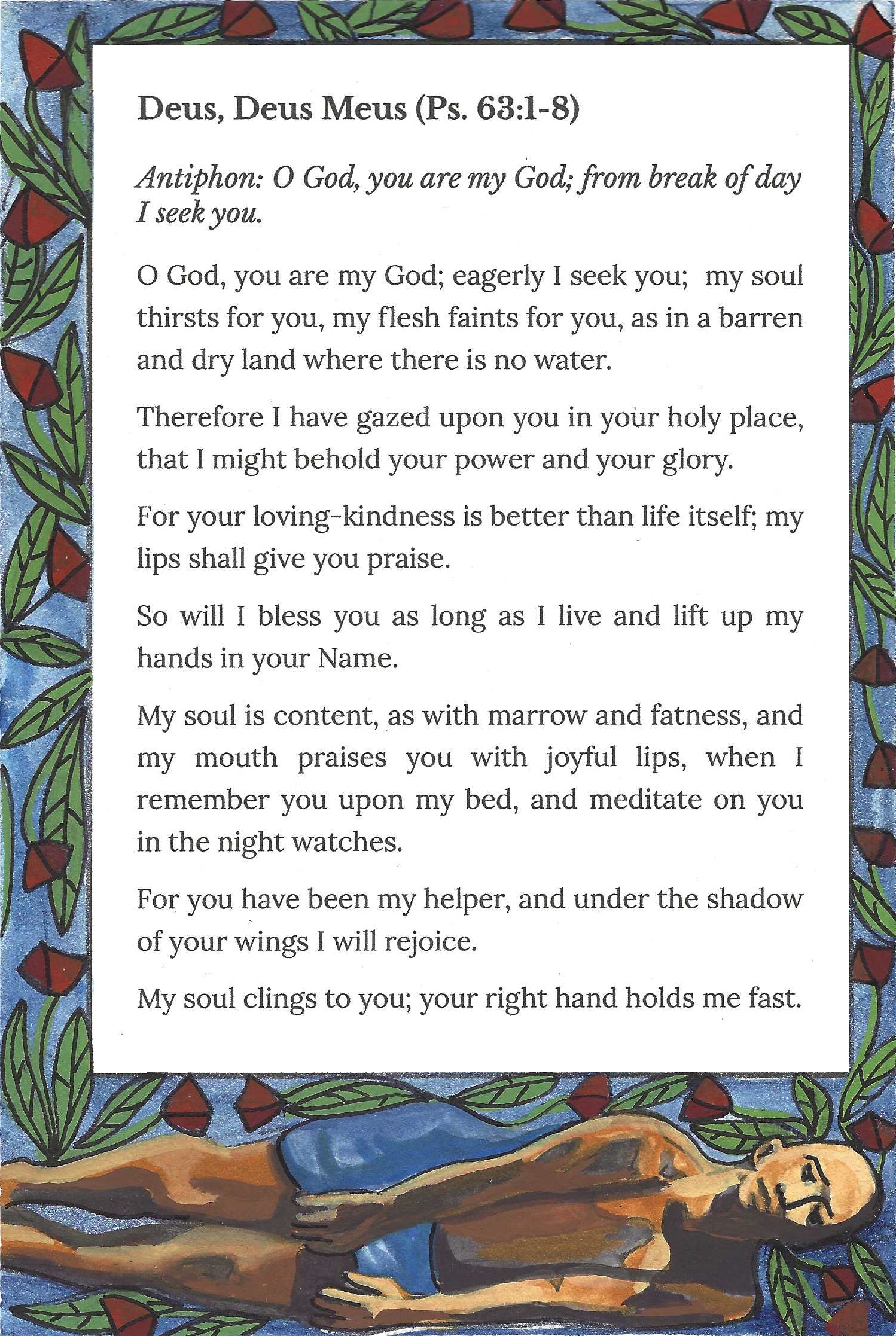
Psalm 63:1-8
We can see this sense of praise at work in Psalm 63, called, in the tradition Deus, Deus Meus which means “God, my God.” Here’s the text of the psalm:
The psalm describes an experience of God, but it doesn’t do so directly. It speaks of the effects of the encounter, the sense of satiation and contentment. It seems exaggerated with its talk of fainting flesh and thirsting souls. It doesn’t name the gifts that God has bestowed, as it isn’t at all transactional – there is no sense of God having made good on a promise or responded to a request for anything but divine presence. To write a hymn of praise like this requires that we take seriously everything else that we’ve learned about laments, particularly last week’s learning about petitionary prayer.
Writing A Prayer of Praise
First, read through what you’ve already written, and ground yourself in the feelings and images. Then…
Reflect on an encounter with God. (You don’t have to describe the specifics of the encounter. It is enough to name the encounter, as in Psalm 63: “I have gazed upon you in your holy place.”)
Try to find words for the aftermath of the encounter, how it felt in your body and in your mind, how you continue to reflect on it. (Example: “My soul is content, as with marrow and fatness…I remember you upon my bed and meditate on you in the night watches.”)
Name “witnesses” to the encounter, other parts of your life and of creation where you experience “Thou-ness”. (Example: “Let the earth glorify the Lord, sing praise and give honor for ever. Glorify the Lord, O mountains & hills, & all that grows upon the earth, sing praise and give honor for ever. Glorify the Lord, O springs of water, seas, and streams, O whales and all that move in the waters.” -The Book of Daniel.)
Here’s what I wrote in response to these prompts, continuing my meditation on the war in Iran and my own feeling of futility as I try to figure out if there’s anything at all that I can do about it:
I have seen a child grin with joy in the midst of devastation, and have seen you in a child’s face as she plays in the rubble. I close my eyes and see that joy, I grow unreasonable with joy, I smile secretly, and only you know what I am feeling, what I am hearing. Every child in every place, every voice raised in laughter, every babble of imagination, every game, and dance, every moment spent singing in the grass, insists, with you, that joy, like the world, remains.
Some final thoughts, before offering more examples
I have been thinking a lot about how I might use laments as part of my regular prayer practices in the future. In particular, I’m wondering if they might be a way to keep my petty resentments from spilling over. If a person or situation has upset me, can I sit down and write a lament before I react? Will it help clarify my own sense of disappointment, or reveal my pettiness or peevishness? If laments are meant to help us maintain a right relationship with God, can they help with human relationships as well?
Perhaps. I might find that it’s best to reserve lament writing for those times when my soul wants to howl with despair, not over some difficult relationship, but over the state of the world. For those moments when I want to curl up in bed and cry, or deaden myself with drink and distraction.
I am a neophyte when it comes to lament, but also enticed by it, and I will look for ways to deepen my practice.
Full text of sample laments
Here, in full, are the two laments I wrote as I prepared to teach. I hope you find them helpful, and that, if you write your own laments, you might share them with me.
Lamentation, The Masked Men
Doxed Divinity, naked-faced agitator caught in a camera’s eye, strip away the bully’s costume, pull the mask down from his face, send him reeling back in nakedness, bring him to his knees.
We voted for our destruction, gave away our liberties because of the price of eggs. Now doors crack inwards, windows shatter, the frigid day stalks in, the masked face of winter squints through beady eyes. Children weep as gloved hands grasp and hold their heads. There is no tenderness. Schools empty, children starve, and pompous, apostate senators clasp their hands upon their bellies and regard our destruction as Your best wish. Why don’t you haunt their nights and make them weep, and make the cold stretch across their naked skin? Why don’t you batter and berate them?
You, who, when the flood had ended, sent a beam of sunlight onto the post of a broken fence, after everyone had fled, and the long, sallow girl who spoke in gangly sentences played a song of hopefulness. The stuffing had come out of the houses and lay, gray on dirty streets, and the ship that broke the levy balanced on the neighborhood’s jagged edge. But still, the light on the post, and the song, and we agreed with each other that even destruction welcomes the sun.
Warm the winter skies, shine within the icicle’s shattering, be a shard of collapse, cold’s downfall. The people sit in cages and all who love have worry in their eyes. We cannot stop hearing children cry. We must learn to live without our masks. We must learn to see you face to face, and each other, face to face, us. Let children wave blessings in the air when the summer world wakes the dead, let them invite us into their care. Grow like grass through cracked belief. Be the animal that we thought was extinct, who returns to wander ruined streets.
I have seen your breath as snowdrops growing from a patch of melting snow, the cold grown granular and cracking, the flowers heavy, clumped, and sprawling. I wake and know that the world is ready, again, for us to walk in it, that children make toys out of ruins, that my own body can know their joy. Let you be glorified with photographs, pictures of released captives, and triumphant whistling in the streets, all warnings turned to victories, winter turned to rain with sunlight following, nature, and us, conspiring in the end of ice and cruelty’s defeat.
Lamentation, Pharoah’s Silos
Grain of spirit milled for bread, fill the children who hide inside, sharpen their minds, give freedom to their play, remind them, through your buried taste, that they will emerge into daylight, that the world is always being remade.
This is the season of starvation, the old season that our ancestors feared, lean with empty cupboards, sacks emptied of grain. Joseph built great silos and put them in Pharaoh’s hand. Pharaoh still controls them, and there’s famine in the land. The grocery stores are open, the shelves are laden and the coolers softly glow. But a glacier spans the city, and the children live beyond it, starving on ice flows. Why aren’t you sunlight, hot and fierce? Why don’t you drown the pharaohs and lead us into wilderness?
Once, in the desert, we built a house. The sun made a cooking stone of the concrete slab, and we built quickly, making shade, and the family that would live there lifted sheetrock with us, then retreated, in the heat, to their shack of cardboard walls. Power lines were slack in a street of dust, and when our saws stopped working children lifted cables, looking for the break, ignoring the electricity that would kill them at a touch. Sweat, a stinging in the eyes, and the scratch of insulation to keep the cold of the desert night outside. And then, with dirty hands, we ate together in the dust, bean burritos, and the taste of the hands that made them, and of contentment, and our acceptance of Your love.
Allow us, now, to taste contentment, that lovely taste of tiredness, and work well done, and hard. Create banquets for those who hide and starve. The mind grows sluggish and words are hard to find, and anger, like dust, grows in the corners of the rooms. Let Your leaven fill the air, let us taste it on our tongues. Everyone will eat, everywhere, when You come, when You arrive as a guest at the starving house, the silos broken behind You, the grain spilling from your tomb.
I have seen you, thick as sunlight, in the yellow room where we sit and eat beneath the poster of the market – stacked tomatoes, antique trucks, an artist’s vision of fulness after the plains had turned to dust. I have caught a glimpse of you, as I make our bread, the deep contentment of a kitchen, the delight as dough rises, as the air summons its leaven to eat and rise, invisible, in the body of the bread. Give glory, hidden nourishment – yeast within the air, mitochondria in our cells, nitrogen in dangling beans, the germ safe for eating within the stalk of grain’s covered head – sing, O mysteries of human feasting, limestone used to shuck the casing of dried and hoarded corn, smoke putting bees to sleep so we may taste the honey in the hive, potatoes dug from earth, their green tops swaying, rooted with our life. We become storehouses, we open up our doors, the grain of ingenuity pours out into the square. We feast and dance together, having shared our secret food. Give glory for all nourishment, and all preservation of the good.
Now we come to what is probably the most perilous moment in a lament. You might think that there’s peril in complaint, but it’s petition that is spiritually dangerous. Evelyn Underhill compared it with magic, the practice of a kind of wish-fulfillment that can easily disappoint if the things we pray for don’t appear in our lives. People often lose their faith because they feel that a petition went unanswered. “What good is God,” they say, “if my brother still died?”
Because of this tendency in myself and others, I used to make reference to free will when defending God’s apparent lack of action. If God is truly controlling every moment and every decision that we make, then we don’t actually have free will. In order for us to have it, God has to withdraw from our choices, and from their aftereffects. God does not create war and sickness and accident as necessary ingredients of some inscrutable cosmic recipe. We make choices, and those choices reverberate, and people die and suffer. God remains present in our suffering, urging us to clean up the messes we’ve made.
Within this schema, petitionary prayer becomes a kind of training in compassion. It comes to resemble metta, the Buddhist “Mother as Other” meditation. In that meditation, you send loving-kindness outward in concentric circles, starting with those you love the most and who occupy the inner circle of your attention and then moving outward through rings of acquaintances and strangers until your meditation comes to encompass the whole world. It’s a beautiful practice, and I recommend it to anyone, and it worked as long as my main hope was to let God off the hook.
But it doesn’t fit well with what we’ve been saying about God’s activity in the world throughout this study of lament. If lament is based on the presumption that God can and does act in history, such an assumption complicates free will. Preparing to teach about lament made me face those complications squarely, and what I offer below can be only a temporary stopping point on the way to greater understanding.
Opening Prompt
Before we get to the main teaching of our session together, I offer you the same prompt that I offered to our study group:
What relationship or situation is weighing on you the most? What are you most anxious about or heartbroken over?
This is a very tender and vulnerable question, and no one was obligated to answer it. Yet we did, slowly, people taking their time to face the question and then answering haltingly, trying to find words for their heartbreak. It was a good way to begin, because we would struggle in a similar way as we tried to find words for our petitions that fit with all of the complications and clarifications that we worked through as we discussed petitionary prayer.
Richard Beck’s Teaching on Petition
As I was engaged in research and trying to come to a new understanding of petitionary prayer, I was very fortunate to stumble upon a series of Substack posts written by the theologian and professor Richard Beck. The entire series is well-worth reading. I offer only a summary here, and if I’ve gotten anything wrong, I hope that Professor Beck will correct my mistakes. Anything quoted below is from Beck’s posts.
Beck says that our normal understanding of petitionary prayer operates within a “magic domino” theory, wherein we ask God to intervene in a chain of causation by either inserting a new factor (a magic domino) into the chain, or magically preventing the next domino from falling. Beck points out that this mechanistic view assumes that God is not present in the world, and therefore every action that God takes must be a form of intervening in the “natural order.”
But healthy petitionary prayer doesn’t operate within the assumption of causality that we’ve been taught in the Western world. Instead, it asserts that:
“Creation isn’t ticking along autonomously, like a machine. Creation is alive and exists in an ongoing radical dependence upon God. We are continuously bathed in God’s sustaining light and love, and should God ever look away from us, we would cease to be.”
“In petitionary prayer, we are not asking God to insert divinity into our world as a magic domino. We are, rather, asking the Origin and Source of Being to ‘bloom’ or ‘birth’ new realities into existence…Each petitionary prayer is our groaning ‘Push!’ through the pain that is birthing the world.”
We pray in two moments of time. The eschatological moment, when Christ has come again and death is defeated for all of creation, and the present moment, when pain, suffering, and death remain tragic and commonplace.
An eschatological vision is an assertion that justice will come, that love will reign supreme, that evil will be vanquished. Because we hold this vision, we can work towards it even in our current circumstances. This is proleptic prayer, in which we ask a vision of future reality to shape our understanding of the present.
There is a “petition behind all of our petitions” which is best summed up with the word maranatha, roughly translated as “Come, Lord.” It is “a simultaneous expression of both lament and hope. Lament for the fact that the Lord has not yet returned, that here in the penultimate, the powers of death and evil remain at large. But also hope in the knowledge that our prayers against death and evil have been heard and will be answered in God’s reconciliation of all things.”
As we talked about these ideas, we explored some of the birthing metaphors that Beck suggests. We talked about how a healthy birth is brought about both by the action of the mother and the child – the baby in the womb cues the mother’s body, announcing that it’s ready to be born. So if God is birthing creation at every moment, we, the creation that is being born, are cooperating in God’s labor, subtly cuing divinity, announcing our readiness through a spiritual release of metaphorical chemical signals and proteins. We spent some time talking through such metaphors, as they are odd within the scope of normative theological language, even though the Apostle Paul used a birthing metaphor right at the beginning of the Christian tradition. When we started to write the petitionary part of our laments, we also got somewhat tangled by language right at the start. Here’s what I asked us to do:
Writing a Petitionary Prayer
Make a request to God, using non-mechanistic metaphors. (Birth this reality…bloom within this anguish…emanate into this situation…be present in this moment.)
Describe the pain and grief that is being experienced.
Articulate a vision of a perfected cosmos. (Describe the healing, succor, result that you would like to see, for the person or situation that you’re praying for.)
Name how God is already present within the situation, and ask God to remain present.
As we wrote, we discovered how hard it is to switch from mechanistic metaphors (“O God, insert the magic domino”) to metaphors that assume that God is already present and that there is something other than mere causation affecting the events of our lives. The problem really lies within our habit of requesting things from God. We want to ask for something very specific, and the specific things we ask for often take the form of interventions. How do I pray for my friend’s sick mother without asking God to heal her? And if God is active in the world, shouldn’t I be asking God to heal her? Shouldn’t my prayer be something more than the metta meditation? How do I find good, solid, reassuring language for the idea that she is already living the reality of her healing in the eschaton even if she is still sick in the here and now?
We found that the theory is there but not the practice, and I think we all left knowing that we would have to try again, and again, because old, established habits are hard to break. Trying to pray in a new way is very challenging.
Here is my own attempt. In my lament so far I had been writing about the war in Iran, and my own sense of futility and uselessness in light of what is happening there. I continued this theme in my petition:
Send your breath through the dust of bombed-out places, hum hope into ears that listen for the missile’s scream, as eyes stare anxiously at the sky, and smoke stings, and people cry, and children die. Guide the hands that rebuild the houses, let the grandmothers tell the stories of how they survived, shield the children from memory and its terrors. Someone is lifting up the ruined stone, someone is bringing water, and bandages, is making food, someone is humming sad, remembered songs, and dreaming of a new house, its doors and windows.
In writing this petition, I asked for nothing but God’s presence to be known within the reality of death and despair. I wrote about that despair in a way that was all jumbled up with the request for God’s presence, but this felt right to me. I tried to articulate a vision of the future in which cities were rebuilt and those who are now suffering could share their wisdom and their stories. And I named God’s presence in those who give aid and those who hope.
Some More Examples
As I’ve written these posts, I’ve been sharing two laments that I wrote before I began teaching about lamentation. I’ll continue those laments here.
from a poem entitled “Lamentation, The Masked Men”
Doxed Divinity, naked-faced agitator caught in a camera’s eye, strip away the bully’s costume, pull the mask down from his face, send him reeling back in nakedness, bring him to his knees.
We voted for our destruction, gave away our liberties because of the price of eggs. Now doors crack inwards, windows shatter, the frigid day stalks in, the masked face of winter squints through beady eyes. Children weep as gloved hands grasp and hold their heads. There is no tenderness. Schools empty, children starve, and pompous, apostate senators clasp their hands upon their bellies and regard our destruction as Your best wish. Why don’t you haunt their nights and make them weep, and make the cold stretch across their naked skin? Why don’t you batter and berate them?
You, who, when the flood had ended, sent a beam of sunlight onto the post of a broken fence, after everyone had fled, and the long, sallow girl who spoke in gangly sentences played a song of hopefulness. The stuffing had come out of the houses and lay, gray on dirty streets, and the ship that broke the levy balanced on the neighborhood’s jagged edge. But still, the light on the post, and the song, and we agreed with each other that even destruction welcomes the sun.
Warm the winter skies, shine within the icicle’s shattering, be a shard of collapse, cold’s downfall. The people sit in cages and all who love have worry in their eyes. We cannot stop hearing children cry. We must learn to live without our masks. We must learn to see you face to face, and each other, face to face, us. Let children wave blessings in the air when the summer world wakes the dead, let them invite us into their care. Grow like grass through cracked belief. Be the animal that we thought was extinct who returns to wander ruined streets.
from a poem entitled “Lamentation, Pharaoh’s Silos”
Grain of spirit milled for bread, fill the children who hide inside, sharpen their minds, give freedom to their play, remind them, through your buried taste, that they will emerge into daylight, that the world is always being remade.
This is the season of starvation, the old season that our ancestors feared, lean with empty cupboards, sacks emptied of grain. Joseph built great silos and put them in Pharaoh’s hand. Pharaoh still controls them, and there’s famine in the land. The grocery stores are open, the shelves are laden and the coolers softly glow. But a glacier spans the city, and the children live beyond it, starving on ice flows. Why aren’t you sunlight, hot and fierce? Why don’t you drown the pharaohs and lead us into wilderness?
Once, in the desert, we built a house. The sun made a cooking stone of the concrete slab, and we built quickly, making shade, and the family that would live there lifted sheetrock with us, then retreated, in the heat, to their shack of cardboard walls. Power lines were slack in a street of dust, and when our saws stopped working children lifted cables, looking for the break, ignoring the electricity that would kill them at a touch. Sweat, a stinging in the eyes, and the scratch of insulation to keep the cold of the desert night outside. And then, with dirty hands, we ate together in the dust, bean burritos, and the taste of the hands that made them, and of contentment, and our acceptance of Your love.
Allow us, now, to taste contentment, that lovely taste of tiredness, and work well done, and hard. Create banquets for those who hide and starve. The mind grows sluggish and words are hard to find, and anger, like dust, grows in the corners of the rooms. Let Your leaven fill the air, let us taste it on our tongues. Everyone will eat, everywhere, when You come, when You arrive as a guest at the starving house, the silos broken behind You, the grain spilling from your tomb.
Continuing our project of writing laments using the ancient literary forms found in the Hebrew Scriptures, we turn to the naming of covenant. It is probably good to reiterate that the form of ancient lament has five parts: invocation; honest complaint; expressions of confidence; petition; and praise. Today we investigate the third part, which actually does more than express confidence – it names covenant.
Expressions of Confidence
This past Sunday, I opened our discussion with this prompt: Tell a story about an event in your life that led to you becoming more fully yourself.
It proved to be a very emotional prompt, as people often become more whole by challenging brokenness. Maybe they’re finding ways to face their own internal brokenness. Maybe they’re confronting someone else’s brokenness, and find that the cost of that confrontation is a more clear-eyed view of themselves. When in the midst of the struggle to become more fully alive, we can find these confrontations and burst of self-knowledge very destabilizing. Yet these are the very moments that I think of as “covenant-producing.” It is in these moments where old ways of being are overturned that we must make vital agreements with new ways of acting and looking at the world.
A Teaching about the Naming of Covenant and Expressions of Confidence
One of my source text’s for understanding the destabilizing and restorative effects of covenant-making is Walter Brueggemann’s The Covenanted Self. Here, in brief, are some of Brueggemann’s main ideas about covenant:
Brueggemann asserts that “the human self is not an independent, autonomous agent but is always and necessarily preceded by a Thou, one radically other than us, who evokes, summons, authorizes, and ‘faiths’ us into existence as persons.”
Our relationship with this Thou, who we call God, is strangely intimate and equal. God, who is so much more than we can imagine, enters into a mutual relationship with us through covenant.
But God is not equal to us. We are always aware that God is greater than us, and so we find this covenantal relationship strange and destabilizing.
Covenant makes us change by undermining our understanding of who we are and calling us to become someone else. To some extent this is always true when we enter into relationship. To be a parent, a friend, a lover, or to step into any new role in work or in life, requires us to change. The change required within a covenant with God is even greater, and more destabilizing.
But at the heart of that change is the sure knowledge that God loves us, and will also change in response to the demands of love. God’s love is stable, and that is enough. The demands of love require expression, and the moments of covenant that we name are moments when we accepted and acted on those demands. I have been writing, in this series, about how God, as presented in scripture, does change and makes change happen. This can be a profoundly challenging idea. So much of our sense of security rests on an idea of divine stability. For Brueggemann, and for me, that stability is found in the constant nature of God’s love. Such love changes its tactics as it responds to the world’s needs. But the love itself doesn’t change. As we remember moments of covenant in our lives, we find that they are always moments when we felt God’s love.
Examples of Expressions of Confidence
The examples I drew from scripture are not as fraught or complicated as they were in the previous weeks of this study. They are meant to show the nod towards covenant in the texts that we’ve been examining. As you’ll see below, they don’t really articulate the shape of those covenants. They simply assert that covenant is still there, that God has not abandoned us. That’s why they might properly be called “expressions of confidence” rather than “expressions of covenant.” But such confidence is based on covenant – we are confident that God is staying true to the relationship. Here are the examples, but I won’t comment on them much, since much of what I have left to say about covenant is best said in terms of our own writing.
“God has not despised – not disdained – the suffering of those in pain! God didn’t hide, but answered them when they cried for help!” -Psalm 22
“I trust in your love; my heart rejoices in the deliverance you bring.” – Psalm 13
“God’s favor is not exhausted, nor has God’s compassion failed. They rise up anew each morning, so great is God’s faithfulness.” -Lamentations 3:22-23
Naming and Describing Moments of Covenant
We set out to name and describe moments of covenant following these rubrics:
First, read through what you’ve already written, and ground yourself in the feelings and images. Then…
Write about a moment of change and covenant when you learned something that effects this present moment. (Where were you? What was the weather like, what did you hear, what did you see, what did your surroundings smell like, what tastes lingered in your mouth, how did your body feel? Who was with you? What were you doing?)
Write about God’s participation in that moment. (Why did this moment come to mind when you were asked to write about covenant?)
Write about the meaning you have made from your experience of that moment. (What did you learn about God? About love? About yourself? About the world? Who did you talk to about the event, and how did they reflect upon your experience?)
I found myself writing about a very recent event, an Iftar dinner that one of the local mosques invited me and my wife to. Until this point I had been shaping my own lament around the grief I feel over the spread of war in the Middle East and the out-sized part that my own country has been playing in the violence. I felt exhausted with caring, but compelled to care, useless in my anger, but raging. I yearned for sabbath, for a break from all of the destruction and misery, but expressed my doubts that I, or the world, would get to enjoy such a sabbath. Pausing to name the Iftar dinner as a moment of covenant helped to reestablish my confidence in God’s abiding care for the world. Here’s what I wrote:
We ate in an abandoned factory that the mosque had bought to serve the city. After the talks our hosts went to pray, but invited us to the serving line, where we piled our plates. We ate dates, and salad, and falafel, and beans. We talked of old friends, and when our hosts rejoined us, of our traditions, wishing each other holy fasts, full of intention. Even in the midst of war, of despair, we broke bread together.
I wanted to fill this description with detail, as any creative writing teacher will tell you that specificity is the heart of narrative. Detail does more than make a good story, though. It grounds us in reality. To speak of covenant can be abstract. To speak of salad and beans is to remember that covenant exists in the fulness of our lives, that it is tangible, something that we smell and taste.
Some More Examples
As I’ve written these posts, I’ve been sharing two laments that I wrote before I began teaching about lamentation. I’ll continue those laments here.
from a poem entitled “Lamentation, The Masked Men”
Doxed Divinity, naked-faced agitator caught in a camera’s eye, strip away the bully’s costume, pull the mask down from his face, send him reeling back in nakedness, bring him to his knees.
We voted for our destruction, gave away our liberties because of the price of eggs. Now doors crack inwards, windows shatter, the frigid day stalks in, the masked face of winter squints through beady eyes. Children weep as gloved hands grasp and hold their heads. There is no tenderness. Schools empty, children starve, and pompous, apostate senators clasp their hands upon their bellies and regard our destruction as Your best wish. Why don’t you haunt their nights and make them weep, and make the cold stretch across their naked skin? Why don’t you batter and berate them?
You, who, when the flood had ended, sent a beam of sunlight onto the post of a broken fence, after everyone had fled, and the long, sallow girl who spoke in gangly sentences played a song of hopefulness. The stuffing had come out of the houses and lay, gray on dirty streets, and the ship that broke the levy balanced on the neighborhood’s jagged edge. But still, the light on the post, and the song, and we agreed with each other that even destruction welcomes the sun.
from a poem entitled “Lamentation, Pharaoh’s Silos”
Grain of spirit milled for bread, fill the children who hide inside, sharpen their minds, give freedom to their play, remind them, through your buried taste, that they will emerge into daylight, that the world is always being remade.
This is the season of starvation, the old season that our ancestors feared, lean with empty cupboards, sacks emptied of grain. Joseph built great silos and put them in Pharaoh’s hand. Pharaoh still controls them, and there’s famine in the land. The grocery stores are open, the shelves are laden and the coolers softly glow. But a glacier spans the city, and the children live beyond it, starving on ice flows. Why aren’t you sunlight, hot and fierce? Why don’t you drown the pharaohs and lead us into wilderness?
Once, in the desert, we built a house. The sun made a cooking stone of the concrete slab, and we built quickly, making shade, and the family that would live there lifted sheetrock with us, then retreated, in the heat, to their shack of cardboard walls. Power lines were slack in a street of dust, and when our saws stopped working children lifted cables, looking for the break, ignoring the electricity that would kill them at a touch. Sweat, a stinging in the eyes, and the scratch of insulation to keep the cold of the desert night outside. And then, with dirty hands, we ate together in the dust, bean burritos, and the taste of the hands that made them, and of contentment, and our acceptance of Your love.
Featured Image Credit:Kathe Kollwitz, “The Widow,” print, 1921
On Sunday, we continued to write laments in the style of the ancient Israelites. As I said in the last post, the genre of Biblical lament has five basic parts: invocation; honest complaint; expressions of confidence; petition; and praise. In today’s post, I’ll talk about honest complaint and invite you to add to your own laments, if you’re writing along with us.
The Opening Question
The opening question I set for our consideration of honest complaint was:
What grieves you most about the world at the present moment? What are you mourning over?
This led to a very heartfelt discussion. Some of us talked about climate change, about the spread of autocracy, about children killed in various unending international conflicts. Some spoke of personal challenges— illness, loss, broken relationships. The question helped us ground our complaints in the actual tragedies of our lives and our world.
Take some time to answer it for yourself before you read more of this post.
A Teaching About Honest Complaint
A complaint holds within it a plea and petition for help. It asks for a change from the One who is able to bring about change. We would not be complaining if we didn’t think that things could be different.
An honest complaint is clear-sighted about our current situation. It describes that situation well and is rooted in the present moment. Understanding the reasons why we are suffering is less important than simply naming our suffering. Lindsay Wilson writes that “our deepest need is not to understand why our suffering or loss has occurred, but to know if God cares and can be trusted.”
An honest complaint
expresses our current circumstances;
clarifies our settled convictions;
avoids glib propositions about what must be true;
asks bold questions;
levels bold accusations;
expresses the pain of loss in grief and tears;
treats nothing as if it’s out of bounds.
This description of honest complaint seems fairly straightforward, but in practice our complaints get tangled up and loaded with hard questions. In the moment of our distress, it is sometimes hard to have a clear understanding of our current circumstances. Something in a treasured relationship might be wrong. Are we responsible for the wrongness, or is the other person? Or is it a condition that we have created together, offending and letting each other down in little ways that eventually erode our trust? It is also hard to state our settled convictions, as this might feel like an intellectual exercise when we are deeply rooted in our emotions and don’t have the distance that clear thought often requires. Our pain is exasperated by a feeling that our certainties are under attack, and so we might try to defend our core beliefs even while we are experiencing their limitations. We don’t always feel that we can be bold or even aggressive with God, even if we know, intellectually, that God can take it. Will God find our complaints too burdensome and abandon us? Will God say that we’re being unfair, and reject us? Tears are often inarticulate, a storm of agony that has no other expression. And if our worlds are shaken, we might prefer the security of clear borders and boundaries, even when we are finding those boundaries restrictive and detrimental to our growth as persons.
Examples of Honest Complaint
Here are some examples of Biblical complaint. Some of them continuations of texts that we considered last week.
“Oh my God, I cry in the daytime, but you do not answer; by night as well, but I find no rest.” -Psalm 22
“How long shall I have perplexity in my mind, and grief in my heart, day after day? How long shall my enemy triumph over me?” – Psalm 13
“God lies in wait for me like a bear or like a lion prowling after its prey, forcing me into the briars, throwing me to the ground and leaving me in anguish.” -Lamentations 3:10-11
“Sighing is my only food, and groaning pours out of me like water. For what I feared most has come upon me, and what I dreaded has happened to me. I have no peace; I have no quiet; I have no rest – only turmoil.” -Job 3:24-26
Psalm 22 complains of God’s silence. Because God doesn’t answer, the psalmist can’t rest. This is the complaint of the sleepless night, of tossing and turning upon the bed, of a mind that is feverish with agony and self-doubt. The psalmist speaks in the voice of wounded love, and that voice sounds in a void. Where is God? Where has reassurance gone? St. John of the Cross spoke of the pervasive sense of divine absence as “the dark night of the soul.” Such times can be experienced as a kind of numbness, the depression that makes you want to turn your face to the wall. But they can also be quite active, as we cry and scream over God’s absence, and accuse God of abandoning us.
Psalm 13 complains of perplexity and grief. There is a triumphant enemy, and the psalmist isn’t afraid to name that enemy. As we talked about this psalm, we were honest about the struggles that Christians have with the idea of enemies. How does having enemies fit into our pursuit of Christian love? Yet we noted that Jesus tells us to love our enemies, not to pretend that we don’t have them. The psalmist is very honest about the fact that there is an enemy, and that enemy is actively working for the psalmist’s destruction. All sorts of people in the world have the experience of being undermined and attacked by enemies, and in our context as Americans we see this play out in the lives of queer people, people of color, and women, whose enemies are activated by homophobia, racism, and misogyny. If we can’t honestly name these things, we can’t act against them. We are called to act out of love but not hatred, but one can practice an oppositional love.
Lamentations aligns God with predatory animals, and for people who lived very close to the land, such animals could easily be thought of as enemies. What does it mean to claim that God is sometimes an enemy? This is a bold accusation. In misery and agony, the author of Lamentations calls God a predator and protests against the experience of being hunted. We could dismiss this with pietistic platitudes and say that the parts of us that have to die might indeed protest against their own destruction, but it is probably better to leave it as a bold complaint. Why explain it away? Why not accept the validity of the anguish that leads the author to name God as predatory?
Job’s complaint is that his righteousness didn’t protect him from calamity. We can caution people against catastrophizing, but sometimes the situation is just as bad as they fear that it will be. We all have protections that we’ve put in place to keep disaster from our door. When those protections fail, all we have is complaint or acceptance, and acceptance is very hard to get to if we refuse to ever indulge in honest complaint.
Writing Honest Complaints
To help us shape our honest complaints, I broke the process of complaining into three parts. I gave these prompts:
Express Your Current Circumstances
Express Your Settled Convictions (The world must be this way…life must be this way…the future must be this way…)
Ask Bold Questions and Level Bold Accusations
We all found this fairly easy to enter into intellectually, although it left us feeling quite tender and exposed. We’re committed to protecting each other’s confidentiality, so I provide only my own lament as an example.
Last week I invoked God with these words:
“You whom I forget when I read the news, use photographs as reminders, headlines as heralds, break open my indifference.”
This week I added my complaint, breaking it down into the three parts that I outlined above:
Current Circumstances – “I hear of the deaths of children, and my misery makes me want to turn away, to bury my distress in comforts and distractions.”
Settled Convictions – “The world should have moments of rest, and release me from the pain of caring, and of failing to care. Your Sabbath should spread among us, and heal us with rest.”
Bold Questions and Accusations – “Why allow us to hear of atrocities when there is so little that we can do about them? You won’t allow us a moment of peaceful ignorance. You bring the clamor to my ears.”
It felt a little odd to complain about how I felt burdened by the death of children. But I wrote it anyway, since complaining rarely makes us look good. In writing it, I realized how selfish and foolish I sounded, but I accept that this is part of the honesty I’m seeking. When I’m complaining, I might sound like a toddler throwing toys. That is, really, the point. There can be something irrational and ridiculous about complaint. When we complain, we have permission to say things that we wouldn’t say if we were feeling mentally and emotionally healthy. We might express some unarticulated and barely recognized conviction, but in expressing it, we disrupt it. I might occasionally believe that I should have an easy and enjoyable path through life, as if such a thing is an enshrined right. Saying it out loud makes me see how ridiculous such an attitude is, and helps me shake it lose, unsettling its status as a secret conviction.
Some More Examples
Last week, I offered the invocations from two poems that I wrote when teaching myself the form of lament. I’ll add to them every week, as further examples of how laments develop. Here are the two poems, with their invocations and their honest complaints.
from a poem entitled “Lamentation, The Masked Men”
Doxed Divinity, naked-faced agitator caught in a camera’s eye, strip away the bully’s costume, pull the mask down from his face, send him reeling back in nakedness, bring him to his knees.
We voted for our destruction, gave away our liberties because of the price of eggs. Now doors crack inwards, windows shatter, the frigid day stalks in, the masked face of winter squints through beady eyes. Children weep as gloved hands grasp and hold their heads. There is no tenderness. Schools empty, children starve, and pompous, apostate senators clasp their hands upon their bellies and regard our destruction as Your best wish. Why don’t you haunt their nights and make them weep, and make the cold stretch across their naked skin? Why don’t you batter and berate them?
from a poem entitled “Lamentation, Pharaoh’s Silos”
Grain of spirit milled for bread, fill the children who hide inside, sharpen their minds, give freedom to their play, remind them, through your buried taste, that they will emerge into daylight, that the world is always being remade.
This is the season of starvation, the old season that our ancestors feared, lean with empty cupboards, sacks emptied of grain. Joseph built great silos and put them in Pharaoh’s hand. Pharaoh still controls them, and there’s famine in the land. The grocery stores are open, the shelves are laden and the coolers softly glow. But a glacier spans the city, and the children live beyond it, starving on ice flows. Why aren’t you sunlight, hot and fierce? Why don’t you drown the pharaohs and lead us into wilderness?