
Christ the King

King Louis IX of France, better known to us as Saint Louis, lost his father when he was twelve years old.  His mother Blanche became regent and ruled France until he was old enough to become king.  Blanche was a domineering personality, so domineering that, after Louis had married the lovely young Margaret of Provence, he and his new bride would have to sneak away to the back stairs of the castle for cuddling and smooching (a detail that I throw in here for no better reason than to gross out a certain ten year old girl of my acquaintance).

Louis went on two crusades.  He built a personal chapel, Le Sainte-Chapelle, which was of such magnificence that it was copied everywhere in Europe, and although I’ve never been there, it is a place of such delicate beauty that just looking at a picture of it is enough to rest my mind when I’m weary.  His reign was a golden age for France, and the arts flourished.  He purchased the crown of thorns from the Latin Emperor of Constantinople and brought it to Paris in a long procession that took many days.

But it wasn’t these actions that made him a saint.  It was the fact that he would dress in a plain linen tunic and go out into the streets and wash the feet of the poor people who gathered around him.  He did this frequently, and one can imagine that some of his courtiers found it disinteresting, yet for many of them it was an example of righteousness, and more than righteousness, holiness – and it became an example that they wanted to follow.

What is a saint, exactly, and how is being a saint different from being a king?  And if we assert that there is a difference, and that it’s better, far better, to be a saint than a king, then what do we make of the fact that Jesus was called the King of Kings, and today we celebrate Christ the King?

The best definition of a saint that I know of comes from Sam Wells book Improvisation.  A saint, says Wells, is not a hero.  The hero, says Wells

is at the center of the story.  It is the hero’s decisive intervention that makes the story come out right.  Without the hero all would be lost.  So if the hero makes a mistake, if the hero bungles or exposes a serious flaw – it is a disaster, a catastrophe, probably fatal for the story and, if it is a big story, pretty serious for life as we know it.  By contrast, the saint expects to fail.  If the saint’s failures are honest ones, they merely highlight the wonder of God’s greater victory.  If the saint’s failures are less admirable ones, they open out the cycle of repentance, forgiveness, reconciliation, and restoration that is what Christians call a new creation.  A hero fears failure, flees mistakes, and knows no repentance; the saint knows that light only comes through cracks, that beauty is as much (if not more) about restoration as about creation.

Louis wasn’t a saint because he tried to invade Egypt and led his troops in battle.  Both of his crusades were failures.  If he had thought that the survival of the world, or Christendom, depended on his eventually retaking Jerusalem, then he would have retired from the Seventh Crusade (the first crusade he went on) in total misery, and lived out his life in the belief that he was an abject failure, and that the world was doomed.  But he understood – and this is a hard thing for a king to understand – that he wasn’t the center of the story.  Ultimately, the story wasn’t about him.  It wasn’t even his story.  It was God’s story, Jesus’s story, and he, Louis, was just a bit player.  More than that, it was a story that was, in a sense, already finished.

As Sam Wells points out, Christians are living in the fourth act of a five act play.  The first act was creation, the second was the establishment of Israel as a chosen people, the third act was the coming of Christ and his life on the earth, and the fifth and final act will be the eschaton, the end of time, when Christ will come again in clouds descending and all of creation will be restored to the original beauty that God dreamt when first setting out to make heaven and earth.  We are actors in the fourth act, not responsible for creation, since God has already created, and not responsible for the ending, for bringing everything to fulfillment, because Jesus has promised that he’ll do that.  The only thing that we’re truly responsible for, in this fourth act, is imitating Christ.  That is, trying as hard as possible to be saints.

When Louis washed the paupers feet, he was imitating Christ.  We might tend to disparage this, to point to the horror and stupidity of the crusades and say that they, in some way, canceled out a few clean feet on the streets of Paris.  But light only comes through the cracks.  When Louis was able to set aside the mantle of kingship, when he was able to forget about being heroic, when he was able to let light seep through the facade of greatness, then he became saintly.

To say that Christ is the King is to say that no one else is.  It is to say that Christ is the only hero we need, and we don’t have to be worried about being heroes ourselves.  I am not the hero of my own story.  Jesus is the hero of my story.  I can fail in all sorts of things, and the world won’t end.  So can you.  I’m not called to be tremendously successful, or to have people admire me.  I’m not called to create great art, or preach great sermons, even though I would like to.  I’m called, simply and intimately, to be a follower of Christ, to wash the world’s feet.  I will sometimes fail in that.  We will all, sometimes, fail in that.  Hopefully, our failures will be honest ones.  If they’re not, if we fail because we’re selfish, or lazy, or distracted, then at least they can call us into a cycle of repentance, forgiveness, reconciliation, and restoration.  And when that cycle has worked its creative powers, and we feel ourselves refreshed again, there is really only one thing that we should do.  Find a way to kneel down, and wash the world’s feet.
My Week with God – Living within Ecclesiastes

Professor Fredal was talking about Ecclesiastes.  Wealth, reputation, accomplishment, none of these things matter, he said.  The ultimate and only reality is death.  Everything else is vanity and the chasing after winds.  The wise and the foolish both die.  It doesn’t matter how you live your life.

In the third row, a girl with blonde hair raised her hand.  “Why is this book even in the Bible?” she asked.

I had an answer.  I often worry about raising my hand in class.  It’s a Bible survey class, and I have a distinctly unfair advantage.  I’m learning amazing things every day, but maybe I can listen for them easier because I understand the material that they emerge from.  The literary structure of the psalms is instantly interesting to me, because I hold some of the psalms in my mind, and can begin examining that structure right away.  But the undergraduates in the class are being assailed with fact after fact, ideas and thoughts that they’ve never encountered before.  It must be bewildering.  And if they enrolled for reasons of faith, it must be deeply confusing to find that the Bible argues with itself, that it’s multi-voiced, that Ecclesiastes disagrees with Proverbs.

“Ecclesiastes is a corrective,” I said.  Proverbs assumes that rich people are rich, and healthy people are healthy, and successful people are successful, because they’re virtuous.  There’s a nasty tendency in Proverbs to blame all suffering on foolishness.  If we could only be wise enough, we’d never know pain or loss.  But Ecclesiastes doesn’t allow for that kind of thinking.  Everyone experiences pain and loss, it says.  It doesn’t matter if you’re wise or foolish.

Yes, Professor Fredal said, that is a corrective.  But there’s more to Ecclesiastes than that.  If we can’t rely on our own wisdom, or prominence, or reputation, what can we rely on?  If our actions in the world will ultimately be forgotten, if one generation ignores the generations that proceeded it, if every thing we do has been done before and originality is a vacant category, what is the purpose of being alive?  Grace, Professor Fredal said.  We cannot rely on ourselves.  We can only rely on, fall back on, rest in, God’s grace.

I’m learning, slowly, to do this.  My work is tenuous and rootless at best, and I find myself drifting through my days without a large sense of where my actions are leading.  My priesthood has become a work of art, and I’m following my instincts, and sometimes going far astray, producing bad art with my life and with my vocation.  I often long for familiar settings and roles.  What I really want is to have a list of actions and ways of being that I could strive to fulfill, and by fulfilling them be assured that I am good and wise.  I’m living within Ecclesiastes, and I long for Proverbs.

But I’m learning to rely on God’s grace.  At a retreat several weeks ago, a woman who has been battling cancer read this poem by Denise Levertov:

The Avowal

As swimmers dare
to lie face to the sky
and water bears them,
as hawks rest upon air
and air sustains them,
so would I learn to attain
freefall, and float
into Creator Spirit’s deep embrace,
knowing no effort earns
that all-surrounding grace.

Living within Ecclesiastes means learning to attain free fall.  It means learning to accept all-surrounding grace.

My Week With God – The Face in the Tortilla

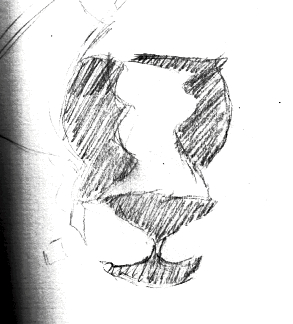
The smudge on the conference room table didn’t really show a lion’s face.  But I’ve been drawing lions lately, and have begun to know the pattern of their faces, and so I was predisposed to see eyes and muzzle staring up at me from the dark, burnished wood.  I was so taken with it that I got out my sketchbook and drew it, even though I knew I was being rude, and seemed to have checked out from the conversation in the room.  And I thought about the woman who saw Jesus’s face in the tortilla.  I thought about her without cynicism, because I felt that I understood her.  It wasn’t that she needed a miracle.  She didn’t need Christ’s face to appear to her in a burn pattern on flat bread.  If something miraculous was happening, it was happening inside of her, because she was so focused on Jesus that she could see him everywhere.

We see the things that we’re already concentrated on – they become visible to us in the world.  I’ve always loved this tendency towards saliency, our ability to make meaning by narrowing our focus.  But these days I’ve become wary of forcing my meanings on the world around me.

I’ve been reading nature poetry, Mary Oliver especially, and I love the turn that her poems take about three quarters of the way through.  She’ll be doing nothing more than describing a scene in nature and then, suddenly, she lets insight break in like a break in the clouds.  I admire this, but I also wonder about its merits.  Should we inflict our insights onto the environment, onto swans and frogs and herons?

I wonder about this because I’ve realized that I’m not a nature poet.  I’m not really a poet at all.  The focus of my writing is on people.  Yesterday morning I was standing in line at Buckeye Donuts.  It was early, and the restaurant had that sparse, clear feeling of a well-lit place in the predawn.  The man in front of me was deaf, and obviously a regular.  He pointed to what he wanted with great precision, and the man behind the counter was fluent in reading his gestures.  There was a young black man in a vest and a trilby hat standing against the far wall, waiting for his order to be handed to him.  The deaf man gestured at him, and the man responded with words, smiling, because it was a conversation that they’d obviously had many times before.  I watched all of this and felt a great inner joy, the same joy that Mary Oliver seems to feel when watching a loon rise from a lake.  But I couldn’t say what the meaning was, because the deaf man and the man in the trilby hat have their own meanings, and who am I to superimpose my meanings onto them?

Perhaps its enough to simply observe their gestures.  And yet, I have Christ in mind when I do so.  An image rooted in my consciousness, a tendency to see His face swimming up to the surface of things.  Sometimes its the face of a lion.  I will not say that the deaf man and the man in the trilby hat were Christ, the Christ that

plays in ten thousand places,
Lovely in limbs, and lovely in eyes not his
To the Father through the features of men’s faces. (Hopkins)

They may have been, and Christ’s face may emerge from their own.  I will always be watching for it.  But I want things, and people, to have their own meanings, too.  Maybe it is only a statement about myself, the specificity of my concentration, the direction of my saliency, when I say that I see lions in tables and Jesus in people.  Maybe that is enough.  And maybe there is something miraculous about it, in a small way, because it points to a change in me, if not the world.

My Week with God – Mysterious Divine Life Form

Maybe it was the sunlight on the turning trees that made me think of animism as I drove north to the Hermitage on Saturday.  I was remembering an old argument I’d had with some conservative catholic students over whether or not animals had souls.  Of course they have souls, I’d said, and I still believe it, and will go farther and say that plants have souls, and soil, and maybe even rocks.  I’m not alone in this.  Many of the early church fathers saw nature as ensouled.  Trees had to have souls, they reasoned, because we have souls, and when we die we decay and become the soil itself and the root-matter for trees.  But I know that this comes close to animism, the belief that the natural world is full of spiritual beings.

I was going to the Hermitage for a poetry and spirituality retreat.  It was led by my friend John Holliger, a retired priest and photographer.  He’d gathered almost twenty people together, and we read poems to each other throughout the day.  Some of us were artists, and shared our art in whatever form it took.

We had long rest periods in which we could go and wander through the forested hills.  The autumn light was crisp and cold, and the leaves patterned the ground.  I kept catching sight of the sunlight, of different beams falling at different angles through the canopy, and I kept grinning and taking pictures.  And, inspired by the day, I found myself writing a poem, something I haven’t done for a very long time.  Here it is:

The sunlight on stacked firewood
is thick, although its cold.
I go deeper into the woods,
past the choral mumble of the chimes
beside the lake, and the voice
of the bald psychologist,
stopped to talk beside two women.
Stones and moss and the stalactite sag
of an insect’s egg sac, distended
from a creviced rock.
All these things, the insects waiting
at the start of autumn for spring,
the shell pattern of leaves,
brown and dry on the wet and cold ground,
all these things are shaped to mean
something, only what they mean
would require the right words.
And I am only wondering, like them,
perhaps, when the hard white sunlight
might release the world, and let it,
until spring, at least, sleep.

This poem surprised me, because it seems to intimate that natural things could use a rest from my desire to flood them with meaning, or to name meanings that go far beyond words.  Animism only works if our imaginative minds are ready to impose themselves on nature, and I found myself oddly reluctant to do so.

After one of these rest periods, John read William Stafford’s poem “Vocation,” which begins with the line “This dream the world is having about itself.”  I heard that line and didn’t listen to the rest.  Is the world really dreaming, I wondered.  Is it sentient?  Despite all my morning thoughts about the souls of plants and stones, this didn’t seem believable to me.  Maybe it was simply that Stafford’s poem wraps all of nature up into some greater entity, “the world,” and that I’m more comfortable with separated mysteries, the single mystery of a fallen leaf’s soul, than I am with one, powerful, overreaching mystery.

And yet I believe in God.  Perhaps this is the single greatest reason that I believe in God as an entity, separate and greater than nature, certainly separate and greater then myself.  Perhaps this is why I believe that God acts in history, even our history, even now.  It seems kinder to nature.  Kinder to not demand that nature speak with a single unified voice, but to listen as it speaks with many little voices, individual voices that aren’t necessarily prodded into a chorus.  I would rather think of the world as a stage which God walks across, important and beautiful, certainly, but not divine within itself.  Divine as we are divine, divine when aligned to God, when allowing the touch of divinity.

My Week with God – Annie Leibovitz and Mary Oliver

Walking through the Annie Leibovitz exhibit at the Wexner was like reading a novel or a short story.  The images built and built, and there was a sense that they were leading to something, some high point which would pull all of the images together and make their meaning coherent.  It was a rainy afternoon, but the light inside the galleries was clear and bright.  I went up narrow interior stairways, around corners, through open hallways, all of which grew the sense of moving through a labyrinth – the sense that there was a center, and I only had to get there.

I came around a corner and found four black and white images, all in a row.  Plain, awkward looking women.  They stood out, because the last few galleries had been full of intense color.  Ella Fitzgerald in a red hat and dress, standing against the green and silver leaves of a rose bush, ferns of a more consistent green pulling the viewer’s eye to the grass at her feet.  Mohammed Ali reclining against the red sweep of a staircase.  Leibovitz is a genius at placing colors in startling, lovely contrast.  All of that, and then the four plain women, in black and white.

I studied them.  They looked tranquil, thoughtful, kind.  And then I turned to the other wall.  Four large portraits of Las Vegas showgirls.  Breasts and feathers everywhere.  Teased hair, heavy mascara, blush and sequins.  Four women, in order.  I studied the caption cards on the walls beside them.  After a moment, I realized that they were the same four women from the black and white photographs. But how could that be?  They didn’t look the same.  One set of photographs showed quietness, relaxed humanity, faces drawn inward and almost indifferent to beauty.  The other set showed wild exuberance, a nearly manic showiness, faces posed for display in a carnival.  They seemed like different women, but were the same, and as I looked back and forth at the two sets of portraits, I couldn’t decide which set expressed the greater reality.

I’ve been reading Mary Oliver’s House of Light, and have stopped to read this poem again and again:

LILIES

I have been thinking
about living
like the lilies
that blow in the fields.

They rise and fall
in the wedge of the wind,
and have no shelter
from the tongues of the cattle,

and have no closets or cupboards,
and have no legs.
Still I would like to be
as wonderful

as that old idea.
But if I were a lily
I think I would wait all day
for the green face

of the hummingbird
to touch me.
What I mean is,
could I forget myself

even in those feathery fields?
When van Gogh
preached to the poor
of course he wanted to save someone—

most of all himself.
He wasn’t a lily,
and wandering through the bright fields
only gave him more ideas

it would take his life to solve.
I think I will always be lonely
in this world, where the cattle
graze like a black and white river—

where the ravishing lilies
melt, without protest, on their tongues—
where the hummingbird, whenever there is a fuss,
just rises and floats away.

Perhaps the plain, black and white portraits are the lilies, simple in their bright fields.  But I think I’m wrong to call those portraits human, and not describe the garish show girls as human as well.  After all, can our humanity stand plainness?  Don’t we long for the green, bright face of the hummingbird?  I, like Mary Oliver, have often wanted to just be.  To set aside human complexity and complication, and become like the lily, or the deer that longs for the water brooks.  But to do so would be to pretend that I’m something other than I am.  Human, complex, and sometimes garish, wild, and showy.  Yet I feel Oliver’s loneliness as well.  We can never rest like a lily without longing for something more, and we can never stretch ourselves towards that something more without longing for the lily’s rest.

I wandered away from the two sets of portraits, thinking these thoughts, but the exhibit wasn’t finished with me yet.  The story it was telling me hadn’t reached its climax.  On the top floor, in the second to last gallery, there was a display of pictures from Leibovitz’s recent pilgrimage.  She traveled across the country taking pictures without any people in them, trying to reclaim her art for herself, without worrying about financial or commercial interests.  The pictures were arranged like paintings in a 19th century exhibit, many images clustered together on three walls, at different heights and with very little space between them.  On the third wall there was a photograph of two lima bean pods, both open, their sides like wings of a moth.  I stopped before it, transfixed.  The beans nestled against gray, webbed plant fiber, pale against the green.  The fiber was dense and clumped, like old plaster or crusted salt.  The pods sat on red, pebbled dirt.  They were so simple, and so complex.

Nature is simple and complex.  Both our nature, and the nature of the lily.  That is why we want to be like lilies of the fields.  Not because they’re different then us, but because they remind us of ourselves.  Like us, they are both plain and elaborate, webbed with cells of tremendous complexity, composed of varied colors.  Yet they seem free within themselves, within their complexity, free to be two things at once, rooted and sparse, caught in a wedge of wind, always wild with change.  Perhaps this is what Christ meant.  Consider the lilies of the fields.  Consider yourselves.