Saint Peter Returns to the Garden

unless a grain of wheat by KPB Stevens

Unless a Grain of Wheat, India ink and pastel on paper

St. Peter Returns to the Garden
by KPB Stevens

God of calloused hands, like splinters,
like wooden bowls full of dinner,
I returned here with morning,
wanting to return
to that last evening we spent together,
all of us in a shadowed room,
our sorrow true as winter.
It was your winter –
your limbs like graying trees,
your body like this garden –
its dirt and worms were in your eyes.
Your blood was picnic trash,
your bones the tumbling walls of tombs.
Everything was falling feathers,
everything was embryos
spilled from broken eggs.

How did Spring come so quickly to this garden?
The birds are hollow bones and light
and flight. The leaves are a touch
on my face. I see the sweet wounds
of your body replaced
by roses that open with a fragrance
as green as sunlight,
as sunlight echoed from wet grass.
Each sorrow a petal, a caress.
You make pain itself into the lightness of Spring.
You make doubt into bird song, the sky into grace –
the last meal each meal –
each sight into taste.
Station Seven, Jesus Dies on the Cross


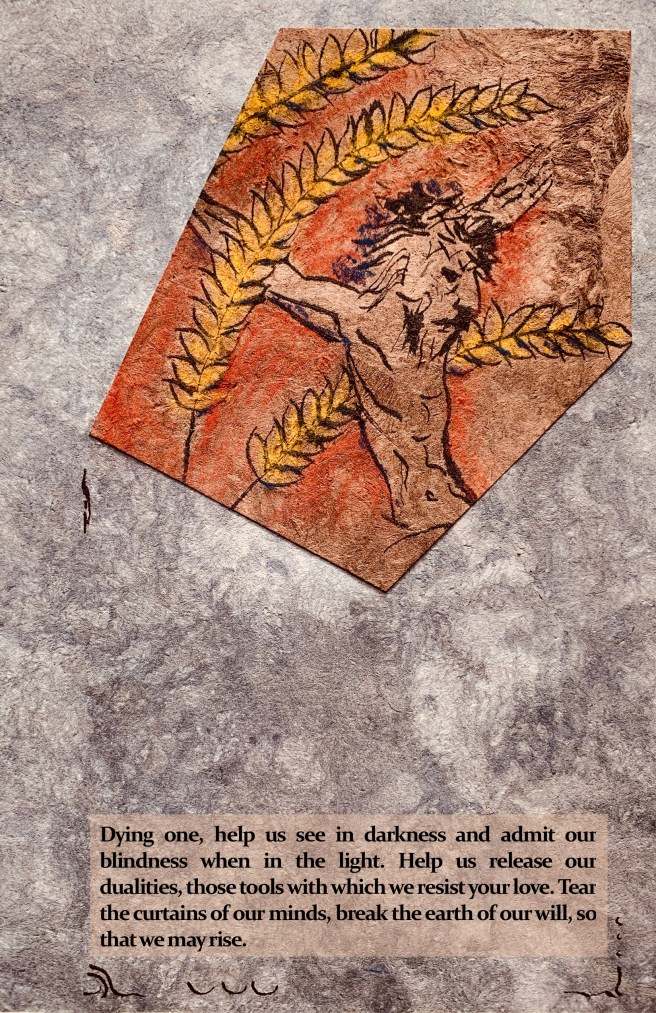
Station 7 Jesus Dies on the Cross by KPB Stevens

Then Jesus cried again with a loud voice and breathed his last. At that moment the curtain of the temple was torn in two, from top to bottom. The earth shook, and the rocks were split. The tombs also were opened, and many bodies of the saints who had fallen asleep were raised. After his resurrection they came out of the tombs and entered the holy city and appeared to many. Now when the centurion and those with him, who were keeping watch over Jesus, saw the earthquake and what took place, they were terrified and said, “Truly this man was God’s Son!”

His death ends all divisions. Life and death, the holy and the profane, are no longer opposed. The ground opens to the sky. The day becomes the night. Shamans and priests, gurus and sages, rabbis and imams rise from their graves and wander the many cities of our lives, speaking wisdom in the streets and in the hidden rooms of our souls. When the sun disappears the starkness of our shadows disappear, the blaze of triumph grays to the same quietness that hold defeat. God is present in everything, even in the shadows, even in our pain.

His death only reveals what is already here. Divinity cracked open at the moment of creation. Divine love flowing through all beings. All the oppositions that we make, all the divisions we use to conquer, fall away. We do not control or rule this world, or ourselves. We are not the same people from day to day, and the world, also, flows with endless change. The only constant is divine love, full of solace, full of fear for us. The only constant is God’s participation in each person’s joy, and each person’s cross.

Station Six, Gestas and Dismas

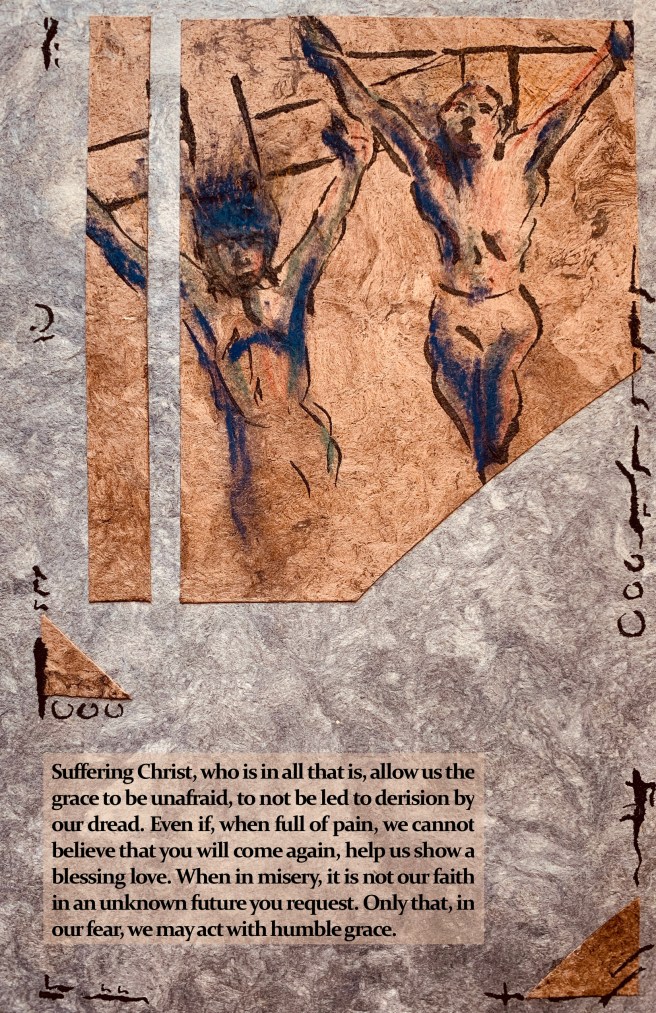
Station 6 Gestas and Dismas by KPB Stevens


One of the criminals who were hanged there kept deriding* him and saying, ‘Are you not the Messiah?* Save yourself and us!’ But the other rebuked him, saying, ‘Do you not fear God, since you are under the same sentence of condemnation? And we indeed have been condemned justly, for we are getting what we deserve for our deeds, but this man has done nothing wrong.’ Then he said, ‘Jesus, remember me when you come into* your kingdom.’ He replied, ‘Truly I tell you, today you will be with me in Paradise.’

Perhaps they both believed in Christ. Perhaps both thieves could see that there is some force that creates and sustains and renews the universe. If this force died, then the universe would die. The oceans would rise. Giant fissures would open in the earth. All life would seem purposeless and absurd. Save yourself, one thief said, and us. Christ’s own salvation was the same as the salvation of the universe.

But the other thief, strangely, was less afraid. Maybe things could be allowed to end. Nothing would be lost. Beyond time, all things would be held by a timeless God. He didn’t say that he believed that all things would find new birth. Only that innocence should be loved and blessed as it passes, painfully, from the earth. Only that fear isn’t stronger than love, even at the end.

Station Five, The Cross is Laid on Simon of Cyrene

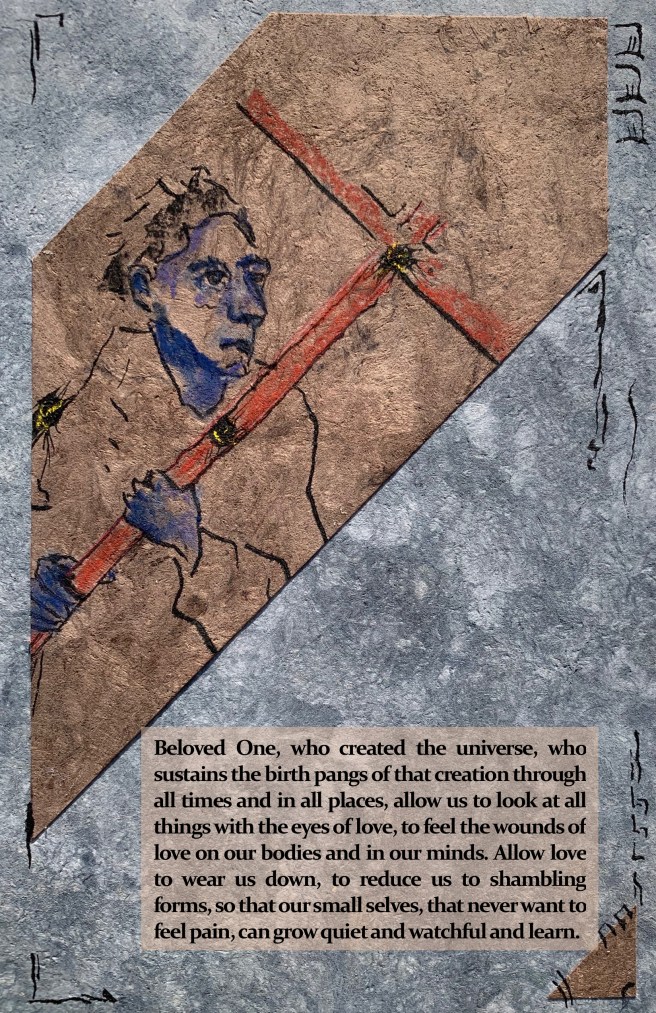
Station 5 The Cross is Laid on Simon of Cyrene by KPB Stevens

As they went out, they came upon a man from Cyrene named Simon; they compelled this man to carry his cross. And when they came to a place called Golgotha (which means Place of a Skull), they offered him wine to drink, mixed with gall; but when he tasted it, he would not drink it. And when they had crucified him, they divided his clothes among themselves by casting lots; then they sat down there and kept watch over him. Over his head they put the charge against him, which read, ‘This is Jesus, the King of the Jews.’

Imagine Simon on the street that day. He is not a man who enjoys other people’s pain, so he tries to avoid the procession of the cross, and looks for side streets by which he can go a different way. But the procession always seems to find him, the streets twist and turn, he finds himself, each time, in the middle of the crowd. And he grows angry at God. Why does God want him to look at pain?

Is God forcing him to look through divine eyes, eyes that cannot look away? No where does it say that he’s willing. Is it accident that he’s the one to carry the cross? Or is he a stand in for all of us?

If we wish to be God’s body in the world, we must try to look through God’s eyes. If we would agree to see through these eyes, we would understand the fragility of each person, each thing. With God’s hands, we can act. We can use them to bless and absolve within the sacrament of each moment. We can ease suffering and share joy.

But God’s body also felt the world’s pain, and we must agree, not only to see, but to bear that pain on behalf of the world. And on our own behalf. Can we accept the cross, even when it’s placed on us without our consent? Can we accept the heaviness of love?

Station Four, Jesus is Condemned to Death

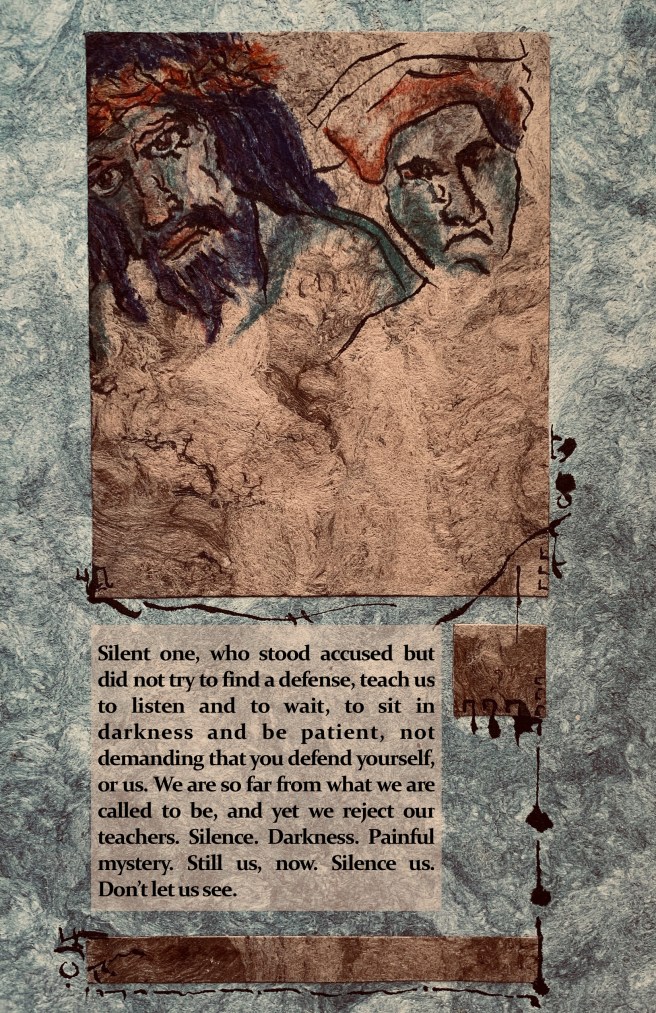
Station 4 Jesus is Condemned by KPB StevensJESUS IS CONDEMNED TO DEATH

 Now Jesus stood before the governor; and the governor asked him, ‘Are you the King of the Jews?’ Jesus said, ‘You say so.’ But when he was accused by the chief priests and elders, he did not answer. Then Pilate said to him, ‘Do you not hear how many accusations they make against you?’ But he gave him no answer, not even to a single charge, so that the governor was greatly amazed. When Pilate saw that he could do nothing, but rather that a riot was beginning, he took some water and washed his hands before the crowd, saying, ‘I am innocent of this man’s blood; see to it yourselves.’ Then the people as a whole answered, ‘His blood be on us and on our children!’ So he released Barabbas for them; and after flogging Jesus, he handed him over to be crucified.

We don’t know how to speak. We expect the holy to be full of words. We expect the Holy Spirit to be eloquent. We are confused when God is silent. We have waited for something more than ordinary miracle, some wizardry that will change the world, some reversal of the nature of things – and the holy is thin and silent. It will not speak.

The miracle would be if we could abide in silence ourselves, if we could pay attention and let the silence linger. If we could be patient in our pain and worry. But we believe in words like we believe in light – a path to lead us out of the darkness. Stay in darkness, the holy says. Let it slow you and impose its sleep, even when sleep holds suffering dreams. Let it disturb you, so that when you wake, you will wake to wonder and fear, the world undone. That is how we become aligned to the silence of God.