“A Psalm” by Thomas Merton

A friend asked me for my definition of hope, and I found myself talking about covenant. Hope is the love of neighbor and the world that keeps you going, despite all of the reasons for despair. During an interfaith panel that I sat on a student asked how the panelists different traditions maintained hope in the midst of political conflict, war, and climate change. I found myself talking about the eschaton. I said that Christians make a huge claim when we say that we know the end of the story. We believe that Christ will come again in great glory to judge the living and the dead. We believe that the story of humanity on this earth has a meaning that will be revealed at Christ’s coming. I also said that while I yearn to learn that meaning, I am afraid of the end of the world, and am in no hurry to get to the eschaton. I live in the tension of loving the world and grounding my hope in that love, while at the same time being reconciled to the notion that many things are beyond my control, and that the love of God will be made most plain at the end of all that we know.

Merton’s poem speaks directly to this tension. At the beginning of the poem, a psalm leads him into a revery of love:

New eyes awaken.
I send Love’s name into the world with wings
And songs grow up around me like a jungle.
Choirs of all creatures sing the tunes
Your Spirit played in Eden.

But it is a brief revery. Soon, in his imagination, the universe dies of excellence. All of that beauty, all of the singing of zebras and antelopes and birds of paradise lead these creatures, and Merton, into communion with God. As if, for him, it is the very love of the world that leads us beyond it.

The stanzas that follow describe the eschaton:

Sun, moon and stars
Fall from their heavenly towers.
Joys walk no longer down the blue world’s shore.

Though fires loiter, lights still fly on the air of the gulf,
All fear another wind, another thunder:
Then one more voice
Snuffs all their flares in one gust.

This is not a reassuring vision of the parousia. Not a painting of a renaissance Christ descending on a cloud. The destruction is real, the abandonment of joy is real, the fear is real, and the end is real. But the poet makes a claim for continued existence:

And I go forth with no more wine and no more stars
And no more buds and no more Eden
And no more animals and no more sea:

While God sings by himself in acres of night
And walls fall down, that guarded Paradise.

That “I” is important. Wine-less, starless, exiled from growing things and gardens, from animals and oceans, the person persists. If it is an “I”, a person, who falls into a trance at the beginning of the poem, it is that same person who enters paradise through fallen walls. The person who loves is the person who will be judged worthy of eternity.

Is that the way out of the tension that I feel? To go further into love of neighbor, of family, of the world as a whole, and trust that such love will be what remains of me at the ending? Is hope the covenant that draws us into heaven? Merton attests that it is. I try to love that vision enough that I can believe it, and set my fear aside.

Here is the poem in its entirety:

A Psalm

by Thomas Merton

When psalms surprise me with their music
And antiphons turn to rum
The Spirit sings: the bottom drops out of my soul.

And from the center of my cellar, Love, louder than thunder
Opens a heaven of naked air.

New eyes awaken.
I send Love's name into the world with wings
And songs grow up around me like a jungle.
Choirs of all creatures sing the tunes
Your Spirit played in Eden.
Zebras and antelopes and birds of paradise
Shine on the face of the abyss
And I am drunk with the great wilderness
Of the sixth day in Genesis.

But sound is never half so fair
As when that music turns to air
And the universe dies of excellence.

Sun, moon and stars
Fall from their heavenly towers.
Joys walk no longer down the blue world's shore.

Though fires loiter, lights still fly on the air of the gulf,
All fear another wind, another thunder:
Then one more voice
Snuffs all their flares in one gust.

And I go forth with no more wine and no more stars
And no more buds and no more Eden
And no more animals and no more sea:

While God sings by himself in acres of night
And walls fall down, that guarded Paradise.

To You Be Your Way, and To Me Mine

A few weeks ago, I received a Chick tract in the mail. It was delivered to my home in a handwritten envelope with no return address. The little booklet inside contained a smug, homophobic comic in which Jesus was portrayed as offering love through the medium of hate. One of my colleagues at St. Stephen’s also received one of these tracts, and he said that he had at first recycled it, then decided that recycling was too good for it and put it in the garbage. I kept the one that was sent to me so that I could report it to the post office if this harassment continued.

On the following Sunday, a man approached me as I was returning from my weekly donut run between services. “You’re not going to like this,” he said. I’d been curious about this man, who is a gifted musician and had taken to playing the piano in the sanctuary on Sunday mornings, but never stayed for the services. This behavior wasn’t that unusual, as many people have been harmed by the church, and are negotiating their involvement in the light of that past harm. I had supposed that this man might, at some moment, decide that a church service was a safe place for him.
Then he handed me a handwritten note that he intended to send to our new bishop. The note attacked queerness and LGBTQiA+ people using all of the same tired tropes that I’ve heard throughout my career, and that had been present in the Chick tract. It included a demand that we take down the Pride banner from in front of our sanctuary. I read it and said, “You’re right, I don’t like it.” But I tried to engage my curiosity rather than my offense and asked, “Why did you feel the need to write it?”

“That banner doesn’t represent me,” he said.

“Well,” I told him, “it represents the people here.” I offered him a donut and invited him to stay for the service. He took the donut and left.

A week later, he sent a photo of the note to the bishop and to our parish office. I’ve been keeping a careful eye on our Pride banner, especially as there are increased reports of banners being torn down around the Columbus metropolitan area. In addition to the Chick tract and to this man’s note, the church has received a voicemail denouncing our LGBTQiA+ affirming ethic, and so we are necessarily on guard against harassment and vandalism.

I haven’t been able to stop thinking about the man’s comment that the Pride banner doesn’t represent him. We are an inclusive church, and so it rankles when the bounds of our inclusivity are tested. I think I was right to invite him to stay for the service. But if he had stood up in the midst of the service and started shouting out his views, I would have had to counter him, and to enforce the boundaries that keep queer people safe. Still, Paul’s words in First Corinthians echo in my mind: “The eye cannot say to the hand, ‘I don’t need you!’ And the head cannot say to the feet, ‘I don’t need you!’” As do the words of Jesus in Matthew’s Gospel: “But I say to you that if you are angry with a brother or sister, you will be liable to judgment; and if you insult a brother or sister, you will be liable to the council; and if you say, ‘You fool,’ you will be liable to the hell of fire.”

I have been wrestling with the question of how I can believe so deeply in love and interconnectedness, and still want nothing to do with the attitudes that this man, and the others who have been harassing us, have articulated. We can say that “all people are welcome here but all behaviors are not,” and sometimes we have to say it, but it feels perilously close to “hate the sin and love the sinner.” In some churches, a queer person might be told that their presence is welcome but that their expression of queerness is not.

On Tuesday night, I attended the Interfaith Pride Service at Stonewall Columbus 1 with all of these thoughts rolling around in my mind. It was a beautiful service. The music was good, the speakers were funny and vulnerable and wholly themselves, the prayers and scripture passages from the different faiths were powerful. And two of the speakers really helped me come to a new understanding. Mounir Lynch, reflecting on identity and pride in Islam, quoted the Quran: “To you be your way, and to me mine.” For Mounir, this indicates that we can be responsible for the things we are responsible for, without needing the approval of those who have chosen other areas of responsibility and work. Reflecting on this, I came again to the realization that a church doesn’t have to be all things to all people. Our work at St. Stephen’s is to embrace and participate in theologies and spiritualities of liberation. It’s not like there aren’t plenty of other churches that understand their work differently. But Christianity has a complex history of orthodoxy, of really wishing that everyone would just think and act the same. I know that this wish is a legacy of Christendom, but it is deeply ingrained. To truly think in terms of a diverse, multifaceted, multi-vocal and multifocal body of Christ is challenging when you’ve been brought up in a tradition that has been so invested in being systemized, hierarchical, and controlling. And yet it’s so freeing to realize that I don’t actually have to engage with the arguments of others. I can simply say, “to you be your way, and to me mine.”

The other helpful piece of wisdom came from Glenn Ge Jie Gustafson, a Zen priest. Glenn told us that “we can acknowledge our interconnection and choose not to interact with those who would disparage or attack us.” This is so simple and so true, and yet I find it very easy to forget. When I breathe or drink I partake in air and water that has passed through other people’s bodies, and is indifferent to their political beliefs. I can catch a cold from a bigot and receive a blood transfusion from a racist. I do not demand to know the politics of those who cook in restaurants or stock grocery shelves. I am connected with all of these people through myriad systems, and I am grateful for the things they provide to me, as I hope they are grateful for the things I provide. That doesn’t mean I have to be friendly and accepting, let alone lovingly attentive, if they decide to spew hate.

All this has led me to reexamine one of my central, faith-based ideals. I have spent my life hoping for the Kin-dom of God, and trying to act in ways that will help bring it about. I have imagined it in terms taken from Isaiah: “The wolf will live with the lamb, the leopard will lie down with the goat, the calf and the lion and the yearling together; and a little child will lead them.” Or through the parables of Jesus, as a mustard tree that all the birds can nest in. Yet there has been a subtext to my dreaming. Without realizing it, I have imagined the Kin-dom as a place where the wolf, lamb, leopard, and goat all agree with each other, where the birds are all singing the same song. Queer theology is teaching me many things, among them the flaw in this way of thinking. Perhaps in the Kin-dom the wolf is still a wolf and the lamb is still a lamb, and they treat each other with a kind of Ignatian indifference, not threatening each other with violence but also saying to each other “to you be your way, and to me mine.”

Of course, as my friend Ben points out, the wolf neither hates nor is motivated by hate when it eats kills and eats the lamb. In this world, I feel that I must stand up to hate as a person of conscience. When I’ve done so in the past, it’s been with a sense of grief, and perhaps that grief is appropriate. Why can’t we all just get along? Why must I feel anger, however justified, when I really want to love and live in a love-world? These questions still rankle, and are, perhaps, unresolvable. Yet I find hope in realizing that I can creatively choose my moments of engagement or non-engagement, and that I am not responsible for everyone’s sense of belonging.

  1. Co-created and co-sponsored by LOVEBoldly. ↩︎

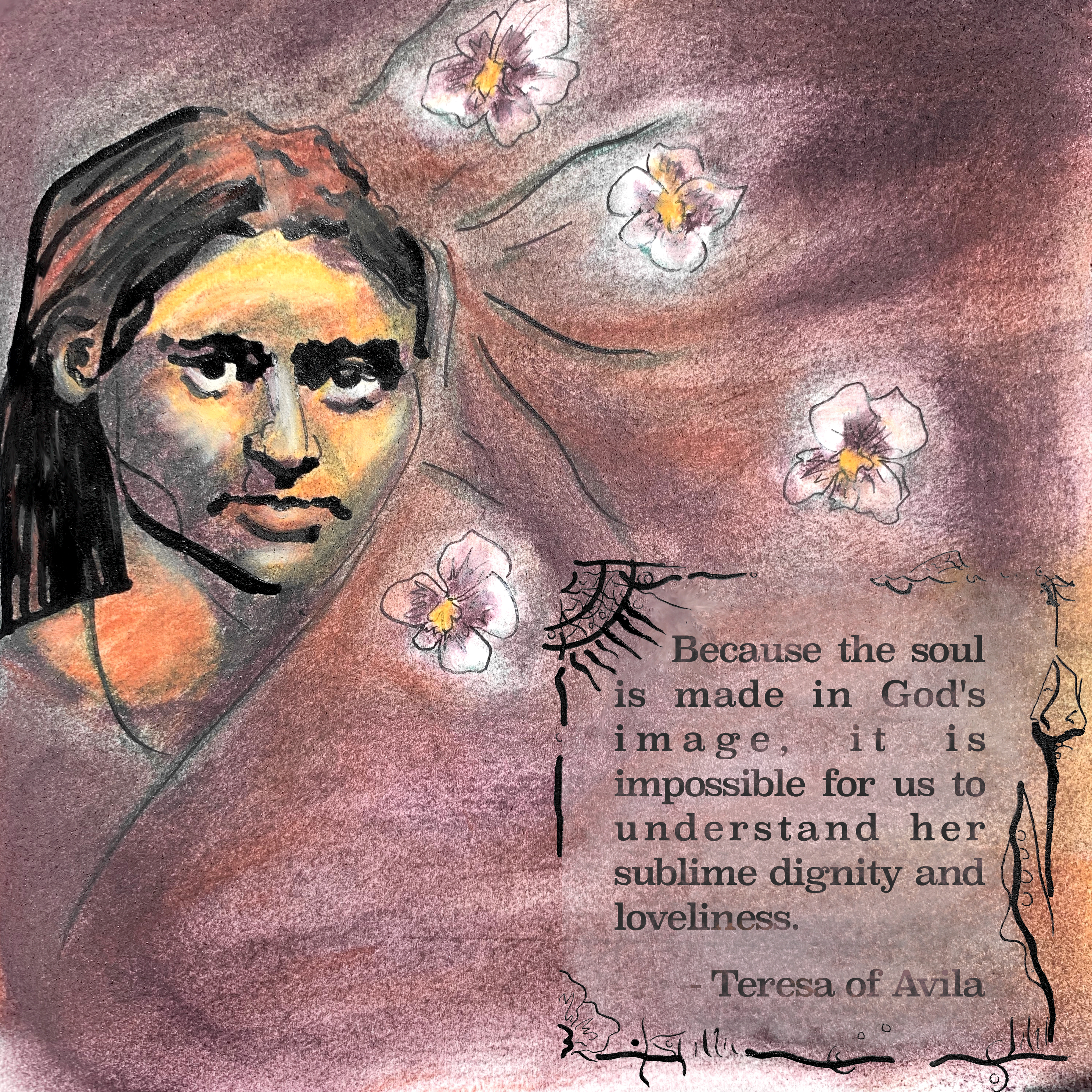
A Little Flower from St. Teresa

Teresa Because the Soul by KPB Stevens

Florilegium, or “little flowers,” were small sayings from scripture or from saints and mystics that were illuminated and placed in Medieval prayer books. I drew this image in my sketchbook (and drawing for me is a form of prayer) using India ink. I don’t pencil things in first, I just try to cooperate with the ink and the paper and accept whatever comes out. Lately I’ve been using chalk pastels to add the color, in part because many of my favorite Odilon Redon’s pieces are pastels. The quote is from the Interior Castle, of course. I love Teresa’s idea that the mysteries of God are echoed in the human soul.

Mary Magdalene

Magdala was a town of almost forty-thousand.  It was a town of white pigeons hatched from three hundred shops, birds for sacrifice that sometimes escaped to roost in eves and on rooftops and descend in flocks on a piece of dropped fish.  Magdala was a town of fish.  Mary watched the fishermen heave them from the sea in shaking nets and deposit them in the midgals, the little stone towers in which layer upon layer of fish flopped and died.

Mary hated the arrogant purity of the pigeons.  They were supposed to be without blemish, but light itself blemished them, catching out the iridescent colors in the fibers of a wing.  The same colors she saw on the enamel of the seashells she picked up on the shore.  But seashells never claimed that they were clean.  Seashells were allies of fish, whose scales caught those colors also, the oily blues and greens that looked like bruises turned to water.

Mary left Magdala like she always did.  One moment she was squatting beside the boats, a small, disquieting figure with her long face and chewed over lips.  The next moment she was gone.  The fishermen shrugged.  She was unclean.  She belonged to no one.  No Jew would touch her, and no Greek either, unless he was insane, unless he heard her babbling out the voices of her seven demons and found it, somehow, exciting.  Who could know.  Since Herod Antipas had built the city of Tiberias, with its pagan gods and Roman baths, many unclean things came down the road.

It was summer.  The hot winds had already come and killed the blue and red anemones.  The plain of Gennesaret had turned gray, dead with too much light.  Mary carried this seer landscape within her, even though the land had rebounded, even though figs and olives hung on green trees.  The memory of the dead ground was like a veil that the demons had settled over her.  A long veil that fell past her face and then blew outward, draping the landscape.  She laughed at it as she walked, held up her hands to shake it, tried to bite it.  People ran away from her, except for a group of children who followed, daring each other to run up to her and try to step on her shadow.  They were called away by their fathers, who told them that she was unclean.  Everything she saw had too much light.  Not gentle light, but imposed light, light that denied the colors that it touched.

She came to Capernaum without noticing it, without noticing the huts on the outskirts, the goats and sheep that spread across the road.  She didn’t even notice the others who were like her.  Bedraggled, slouching shapes.  Women and children.  A man, tied to a litter, was carried past her.  A wan girl fell to the ground and shook against the dirt.  Mary’s demons didn’t leap to see the demons within these others.  Her demons lay still, and that is what she noticed.  And because they were still, she suddenly noticed the town around her, the small basalt houses, the returning smell of fish.  But no pigeons.  The bleating of goats, but something more.  Something the demons had blinded her to.  Small glittering pebbles in the road.  The fleece of a passing sheep, its dirty gray nap, the small resilient curls of its wool.  She saw the exact lines in the weave of the shepherd’s cloak.  She saw a surprising number of faces, too many for a town this size.  Too many people, and yet her demons lay silent.  Cowed.

She remembered why she had left Magdala and walked through the orchards.  She remembered a name.  They said that a man had been lowered to him through the roof of a house.  She turned to study the roofs.  She kept turning, her eyes seeking, unaware of the circumference of her steps.  A body brushed past her, then another.  She was borne along, still turning, her eyes trying to take in every angle of roof, looking for a pile of masonry, a slab of broken stone.

The crowd slowed.  There were others before them, and there was nothing they could do but stop.  The sun beat down on them.  Mary lowered her eyes from the roofs and looked at the coarse grain of a nearby man’s cheek, the varying colors in a nearby girl’s hair.  She wanted her veil back.  She wanted these details to be bleached and neutered by light.  But the demons were not only quiet, they were crawling away.  She hissed at them, trying to get them back.  A woman standing next to her began singing in a high, soft voice.

She didn’t see him that night.  She let the crowd move past her and stood alone in the growing cold of the darkening street.  Someone gave her bread, which surprised her.  It was in her hand and the man was moving away before she could see his face.  She ate it, and then thought how easy it would be to do what she had always done.  She hunched her shoulders, drew her face down and stared out, darkly, from under her brows.  She chewed her lips.  No one noticed.

She saw him the next day.  She shuffled into the house where he was staying, one in a line of many others, but he looked at her and saw her.  “Seven demons,” he said.  She stopped and stared at him.  “They’re gone now,” he said, “but it isn’t enough.”

“Rabbi?”

“Your house has been swept clean, but they’ll only find that more inviting when they come back.”

“Rabbi.”

“You need something else.  Something else has to happen.  A singing breath entered Adam.”

“Rabbi!”

“A singing breath entered Adam.  Let me breathe on you.”

But really, he was already breathing on her.  As he spoke the whole room became breath.

It is not enough to merely lose our demons.  We must experience resurrection, be filled with the Holy Spirit.  Joy.  Joy is at the root of it.  The great carved places inside of Mary were filled with joy.

She followed him up the mountain and sat in the diminishing evening light with the other disciples.  They were silent for a long while, listening to the voices from the lower slopes, the people who had come out the cities to see him.  At last he spoke.  “Blessed are the poor in spirit, for theirs is the Kingdom of Heaven.  Blessed are those who mourn, for they will be comforted.  Blessed are the meek, for they will inherit the earth.”  Every word he spoke terrified her.  He spoke of light and she knew that light, but she also knew that she had been Mary the Skulker, Mary the Unclean, and she feared for the light inside of her.  In the dusk, as his voice continued and the profiles of the seated disciples became blurred with shadow, she feared that there was something in the world that could take her joy from her.

He wasn’t speaking to her alone, but she knew that he meant her to hear him.  His face turned towards her and she lifted her head to look at him in the semi-gloom.  She clutched her knees to her chest.  “Love your enemies and pray for those who persecute you, so that you may be children of your Father in Heaven.”

“Lord,” she mumbled in her rough voice.  “Lord, I pray for my seven demons.”  And she felt surprising pity for them.  They were wandering over the plain of Gennesaret, looking for a home.  They were shaking the long black veil out to cover the trees, insisting on the insulting light that had no interest in the sheen of green olive skins.  They would be despised beside the fishing boats, and pecked about by holy pigeons.  She began to laugh, but not maliciously.  She began to laugh because she knew, in her pity for them, that she was free of them.  They could never pity themselves.

And when he told her and the other disciples not to worry about their lives, she laughed again.  She had never worried about her life.  The demons had never allowed her fine clothes, or the taste of good food.  And now that they had left her she was a lilly of the field, a bird of the air, trained by desolation not to care for vanities and suddenly given into the keeping of God.

As they walked towards Jerusalem, she noticed patterns on the ground.  The scuffed over prints of many feet, the calligraphy of mule droppings.  There were grasshoppers in the grain fields.  She paid attention to the way the husks of wheat rasped against her fingers when she picked them.  There was a slow design to the way the disciples walked.  Matthew held his slight wrists at his side and swayed them back and forth like the beads of an abacus.  Philip pushed his face slightly forward.  Joanna, dressed in plain clothes that she’d bought to be plain in, was still aware of her neck’s length and softness.  Her hands still gestured to show their beauty.  “We are so small,” Mary thought.  “Every one of us.  We are like heads of grain, or ripe olives, or the rain.  And God knows every hair on our heads.”  She thought of God’s attentiveness.  She thought of her mother, who surely hadn’t remembered every loaf of bread she’d shaped with her hands, and her father, who couldn’t have remembered each net he’d woven.  She looked at the sky, and it was as if it was speaking to her.  She knew the sense of the words, but not their phrasing.  God was in His creation, complete.  Human beings might create, but no one created like God.

Jesus began to say that he would suffer when they got to Jerusalem.  Mary was not afraid.  When Peter argued, and when the Sons of Thunder tried to settle their place in the hierarchy, she walked calmly beside them.  She measured her stride to Jesus’ own.  She would have taken his hand if she could.  Would have stood on her toes so that she could whisper in his ear, “I know what it’s like.  There is a great hollowness, but then there’s breath.”  Wherever they buried him, she’d go there to wait.  No one should be alone in that hollowness.  She’d wait beside his body until he rose.

But when they came to arrest him she ran like the others.  She hadn’t expected the soldiers or the jeering priests.  She hadn’t expected this evil to be accomplished by men.  Maybe she had never known that men could be evil like this.  The veil of her demons had protected her.  It had turned the details of each day to chaff, had allowed the words and touch of men to blow away.  She watched a soldier strike him and she wanted her veil back.  She crept away.  Maybe the other disciples hid together.  She wandered away from the city, alone.

She moved across scarred ground, the seared slopes of the land around Jerusalem, and she tried not to look at anything.  She wanted her eyes to fill with blank light that would deny the russet stone, the green scrub.  She muttered to herself.  “Unclean!  Unclean!”  But these words had no meaning.  She wanted them to chisel her flesh, to create places for the demons to return to.  But they were dull words, and she saw the world despite them, the white hairs of a donkey’s muzzle, the slim arms of the boy who waited, so patiently, for the animal to drink.  The vision that Jesus had given her wouldn’t leave her.  It drew her back to the city.  It is impossible for us to ignore our resurrections.

She learned of his sentencing and was there at his death.  She stood beside Joanna and the other women.  She watched his mother, and was curious to know if the light could subsist even now, if she could see its varying shades settle across Mary’s anguished face.  She turned to watch him as he died on the cross, and felt the smallest touch of his breath reach her.  Was it possible that God was creating even now?  She studied him and saw an iridescent sheen, his sweat laid across the bruises of his skin.  A fish, a shell, a bird of sacrifice.  But it wasn’t her who was sacrificing him.  It was the men standing near the cross, the soldiers and the priests.  How could God, who was aware of each husk of grain, each movement of her breath, demand the death of living things?  She looked at the soldiers and the priests, and she said what he said.  “Father, forgive them, for they know not what they do.”

The women wept, but she remained quiet, watching with lifted gaze.  When they took him down there was a commotion, argument over his body, the flashing of coins that moved from hand to hand.  Somebody’s servants were carrying him away.  The women gasped with consternation.  They followed, walking quickly, pushing through the crowds, afraid of losing sight of him.  Mary was swept along with them, her legs moving briskly, her eyes looking everywhere.  She felt anger, and it was the first time that she remembered feeling anger.  Her demons had kept her from being aware of other people, but now she saw that other people were blind, indifferent, lost within the empty light of their many errands.  She wanted to grip them, to hold them to her and breathe on them.  She remembered the young man who had come to Jesus in his clean robes and oiled hair, his slaves standing a little way off, and who had gone away weeping, and she remembered Jesus’ sorrow, and understood that now that he had left them she could finally see with his clear eyes.

They laid him in a tomb and she sat beside it until sundown.  Sabbath, and the other women bade her come away.  She couldn’t tell them how little it mattered, how no one could convince her that she was unclean even if she spent the night resting with the dead.  She went with them out of pity for them.  They needed her peace.  And as they spent the long day in a dusty room, she tried to send her peace out to them, so that it could rest on them.  She prayed for each, staring at every face, at Joanna, and Peter, and James, and Mark, and Mary, Jesus’ mother.  And on the morning after the sabbath, she arose and went to the grave.

Can we be surprised by resurrection when each of us has known it?  When, at some moment in our lives, we each have noticed the depth of light, familiar objects suddenly suffused with intricacies, with shapes and patterns we never knew were there?  Can we be surprised by resurrection when we have felt the breath of grace arrive at unexpected moments, when we’ve done nothing to bring it and don’t deserve it, and yet its there?  When we feel it enter into us and blow past the filaments of chatter, of every day life to show us something waiting beneath the world’s skin?

We have all known little deaths.  The ends of relationships, of eras of our lives, of long-held dreams that we’ve finally put to rest.  Or stranger, more subtle deaths.  Incisions made in our souls to remove some tumor of doubt or anger.  The exorcism of some preference for self-destruction that we’ve clung to because we’ve been afraid of what redemption might demand of us.

And yet we are all here.  Resurrected at some moment or another, brought together to witness and celebrate the one resurrection with Mary and the other disciples.  We are here because we know that, despite death and doubt, despite our desires to hide with our familiar demons, God’s favor is life, and joy cometh in the morning.

She met him in the garden.  She was weeping because the resurrection had already happened when she arrived, because the tomb was empty and there were two men there.  Or maybe his body had simply been moved, and she didn’t know where to go to witness the resurrection, to feel the breath of God, as she had felt it when he healed her and cast out her seven demons.  When she saw him, she thought that he was a gardener.  But she should have known, from the way that the morning light cast a shadow on the tomb’s wall behind him, a round shadow that circled his head, a halo, that this was her risen Lord.  From then on she saw that halo everywhere, appearing on the walls behind the apostles as they ate and spoke and healed.  Surrounding the heads of the people as they gathered together and prayed.  She saw it on new converts as the apostles went out from Jerusalem, and the light spread, and the world’s cold, pitiable demons fled to wander in the barren places.  The world was haloed with new light.  Our world is haloed with new light.  May it help us see and understand and love.