Another Account of Creation – Three Images

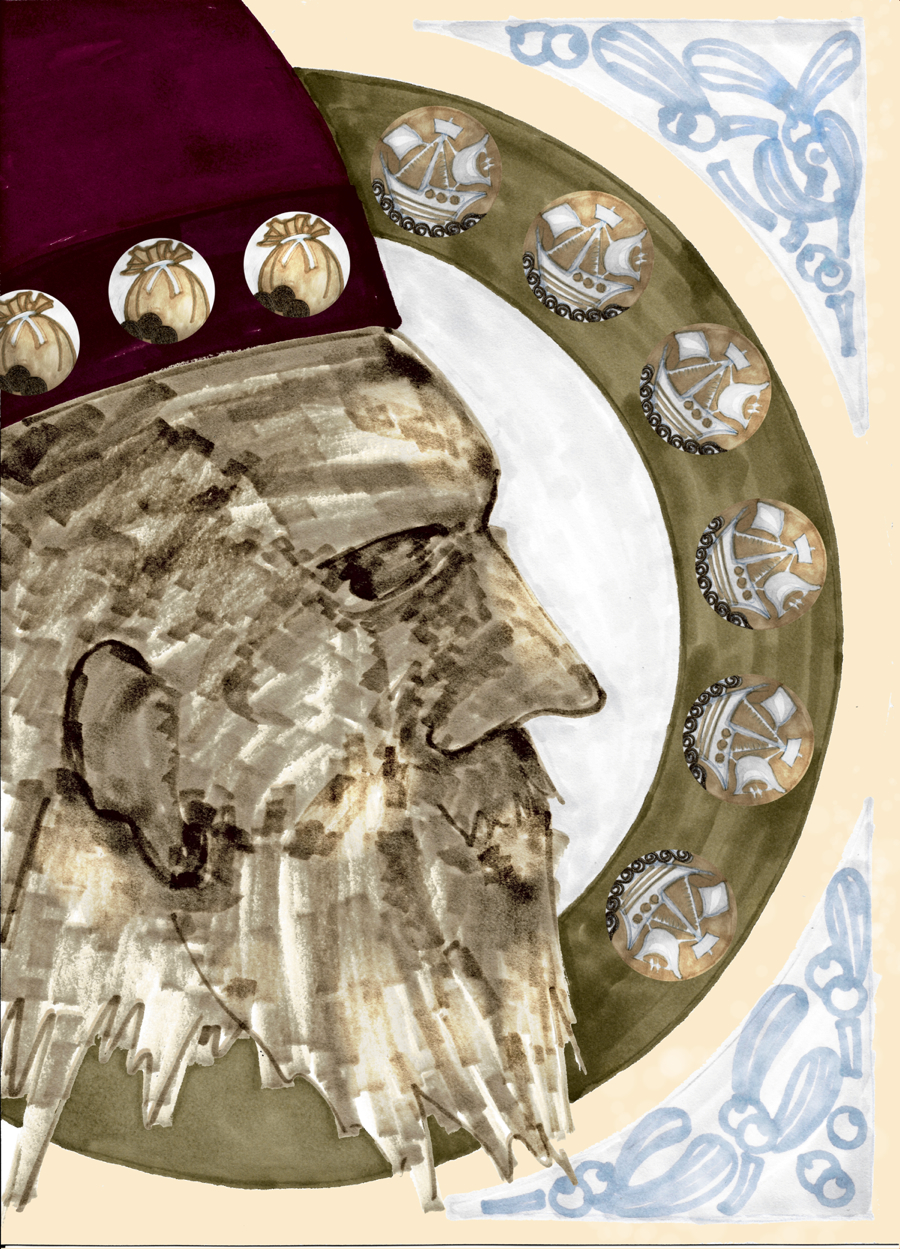
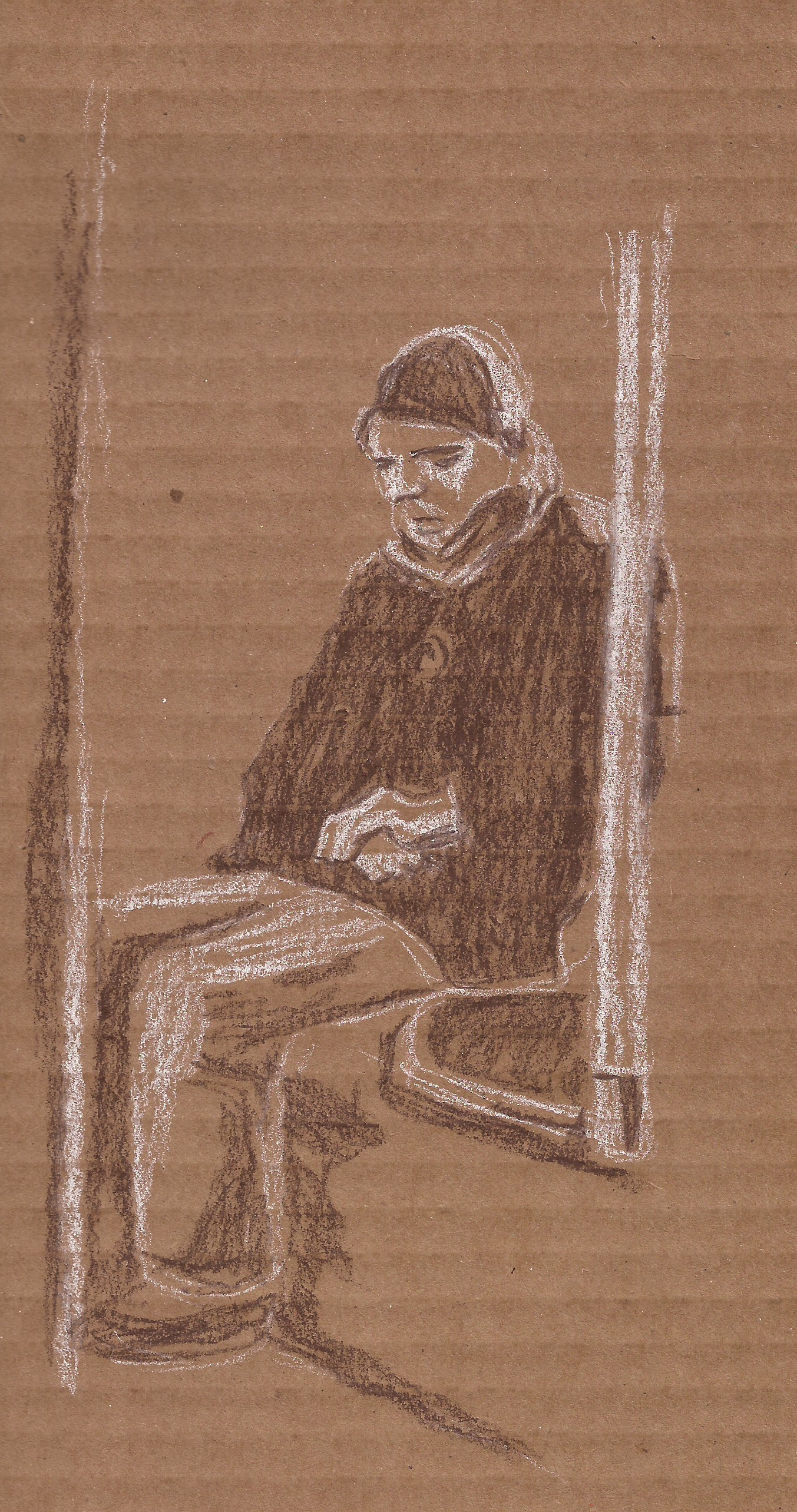
Following the example of Jan Richardson at The Painted Prayerbook, I’ve been trying to do a kind of modified Lectio Divina with drawing.  Here are the results from today’s session, in which I was reading Genesis 2.

A stream would rise from the earth, and water the whole face of the ground.
And the Lord God planted a garden in Eden, in the east; and there he put the man whom he had formed.
Of the tree of the knowledge of good and evil you shall not eat, for in the day that you eat of it you shall die.


My Week with God – Annie Leibovitz and Mary Oliver

Walking through the Annie Leibovitz exhibit at the Wexner was like reading a novel or a short story.  The images built and built, and there was a sense that they were leading to something, some high point which would pull all of the images together and make their meaning coherent.  It was a rainy afternoon, but the light inside the galleries was clear and bright.  I went up narrow interior stairways, around corners, through open hallways, all of which grew the sense of moving through a labyrinth – the sense that there was a center, and I only had to get there.

I came around a corner and found four black and white images, all in a row.  Plain, awkward looking women.  They stood out, because the last few galleries had been full of intense color.  Ella Fitzgerald in a red hat and dress, standing against the green and silver leaves of a rose bush, ferns of a more consistent green pulling the viewer’s eye to the grass at her feet.  Mohammed Ali reclining against the red sweep of a staircase.  Leibovitz is a genius at placing colors in startling, lovely contrast.  All of that, and then the four plain women, in black and white.

I studied them.  They looked tranquil, thoughtful, kind.  And then I turned to the other wall.  Four large portraits of Las Vegas showgirls.  Breasts and feathers everywhere.  Teased hair, heavy mascara, blush and sequins.  Four women, in order.  I studied the caption cards on the walls beside them.  After a moment, I realized that they were the same four women from the black and white photographs. But how could that be?  They didn’t look the same.  One set of photographs showed quietness, relaxed humanity, faces drawn inward and almost indifferent to beauty.  The other set showed wild exuberance, a nearly manic showiness, faces posed for display in a carnival.  They seemed like different women, but were the same, and as I looked back and forth at the two sets of portraits, I couldn’t decide which set expressed the greater reality.

I’ve been reading Mary Oliver’s House of Light, and have stopped to read this poem again and again:

LILIES

I have been thinking
about living
like the lilies
that blow in the fields.

They rise and fall
in the wedge of the wind,
and have no shelter
from the tongues of the cattle,

and have no closets or cupboards,
and have no legs.
Still I would like to be
as wonderful

as that old idea.
But if I were a lily
I think I would wait all day
for the green face

of the hummingbird
to touch me.
What I mean is,
could I forget myself

even in those feathery fields?
When van Gogh
preached to the poor
of course he wanted to save someone—

most of all himself.
He wasn’t a lily,
and wandering through the bright fields
only gave him more ideas

it would take his life to solve.
I think I will always be lonely
in this world, where the cattle
graze like a black and white river—

where the ravishing lilies
melt, without protest, on their tongues—
where the hummingbird, whenever there is a fuss,
just rises and floats away.

Perhaps the plain, black and white portraits are the lilies, simple in their bright fields.  But I think I’m wrong to call those portraits human, and not describe the garish show girls as human as well.  After all, can our humanity stand plainness?  Don’t we long for the green, bright face of the hummingbird?  I, like Mary Oliver, have often wanted to just be.  To set aside human complexity and complication, and become like the lily, or the deer that longs for the water brooks.  But to do so would be to pretend that I’m something other than I am.  Human, complex, and sometimes garish, wild, and showy.  Yet I feel Oliver’s loneliness as well.  We can never rest like a lily without longing for something more, and we can never stretch ourselves towards that something more without longing for the lily’s rest.

I wandered away from the two sets of portraits, thinking these thoughts, but the exhibit wasn’t finished with me yet.  The story it was telling me hadn’t reached its climax.  On the top floor, in the second to last gallery, there was a display of pictures from Leibovitz’s recent pilgrimage.  She traveled across the country taking pictures without any people in them, trying to reclaim her art for herself, without worrying about financial or commercial interests.  The pictures were arranged like paintings in a 19th century exhibit, many images clustered together on three walls, at different heights and with very little space between them.  On the third wall there was a photograph of two lima bean pods, both open, their sides like wings of a moth.  I stopped before it, transfixed.  The beans nestled against gray, webbed plant fiber, pale against the green.  The fiber was dense and clumped, like old plaster or crusted salt.  The pods sat on red, pebbled dirt.  They were so simple, and so complex.

Nature is simple and complex.  Both our nature, and the nature of the lily.  That is why we want to be like lilies of the fields.  Not because they’re different then us, but because they remind us of ourselves.  Like us, they are both plain and elaborate, webbed with cells of tremendous complexity, composed of varied colors.  Yet they seem free within themselves, within their complexity, free to be two things at once, rooted and sparse, caught in a wedge of wind, always wild with change.  Perhaps this is what Christ meant.  Consider the lilies of the fields.  Consider yourselves.

My Week with God

It was raining on Tuesday when I walked into Paul’s Diner and saw that Laurie had gotten there first and was sitting in our regular booth, reading her Bible and making notes in a wire bound notebook.  Laurie’s Bible is black and small and slim.  Its black cover is crinkled and chipped in places from years of use.  We talked, as we usually do, about our lives, our children especially, and about the lectionary readings for the coming Sunday.  We’ve been meeting for a year now, and I’ve come to rely on Laurie’s insights.

It was near the end of our breakfast together that I began talking about the thing that had really been bothering me.  The Friday before we had talked about the end of Exodus in the Biblical literature class I’m taking at Ohio State University.  My professor, Jim Fredal, had been talking about the similarities between both Exodus and the Deuteronomic Code, and suzerainty treaties in the ancient near east.  Scholars believe that a good portion of the Pentateuch is formally based on these treaties, in which an Emperor would set out the expectations he had for his client kings.  As Professor Fredal talked, I felt a quiver at the edges of my faith. To base an understanding of God’s relation to the world on an elaborate ancient treaty form feels a little like basing that understanding on an iTunes contract in today’s context.  I’ve always defended the Old Testament from its detractors, mostly because I love Job and the stories in Genesis.  But now I had to admit that those detractors had a point.  God in the Old Testament doesn’t seem to offer us unconditional love.

I said all of this to Laurie, and she asked if the story of Jesus didn’t take away all of that.  If we read the Bible as a story of God’s development as much as humanity’s, we see that God eventually abandons this contractual, conditional relationship with us.  It is, of course, good to remind ourselves that the Deuteronomist was putting words in God’s mouth, that if God changes throughout the Bible, it’s only because our understanding of God changes.  But with Jesus we see a profound change in that understanding.  “All God really wants is to be with us,” Laurie said.  We talked about the Gospel reading for this coming Sunday.  “All God really wants is to welcome us as children.”

This felt profound to me, even though I’ve heard it in a hundred sermons and said it myself any number of times.  I’ve started a new job, and its parameters are wide and somewhat ill-defined, although the scope it gives me for creativity and experimentation is amazing.  But I’ve been looking for someone to approve of my work, to say to me “you’re doing a good job.”  And the funny thing is that many people have said that, but I haven’t been able to hear them, because a large part of me keeps worrying that the work isn’t justified somehow.  I don’t know what success looks like, and neither does anyone else.  It’s as if I’m afraid of being judged by God.  Yet all God wants to do is welcome me.  I feel like I’ve fallen into the mindset of the Deuteronomist, hoping to get the contract right, and hoping that if I do, God won’t abandon me.  I needed Laurie to tell me that God will never abandon me, because all God really wants is my company.

The rain had let out when we left the diner, and I took a bus downtown.  I was meeting Dick Burnett, the Rector of Trinity Episcopal Church, for lunch.  We planned to meet at the noon service and go to a restaurant afterwards.  It turned out that Dick and I were the only ones who attended the service.  But Dick didn’t seem worried about this at all.  He led us in the prayers and the readings, gave a small sermon, and then he did something remarkable.  Before we celebrated communion together, he blessed me.  Specifically, he read this blessing over me, from John O’Donohue’s book To Bless the Space Between Us:

May your new work excite your heart,
Kindle in your mind a creativity
To journey beyond the old limits
Of all that has become wearisome.

May this work challenge you toward
New frontiers that will emerge
As you begin to approach them,
Calling forth from you the full force
And depth of your undiscovered gifts.

May the work fit the rhythms of your soul,
Enabling you to draw from the invisible
New ideas and a vision that will inspire.

Remember to be kind
To those who work for you,
Endeavor to remain aware
Of the quiet world
That lives behind each face.

Be fair in your expectations,
Compassionate in your criticism.
May you have the grace of encouragement
To awaken the gift in the other’s heart,
Building in them the confidence
To follow the call of the gift.

May you come to know that work
Which emerges from the mind of love
Will have beauty and form.

May this new work be worthy
Of the energy of your heart
And the light of your thought.

May your work assume
A proper space in your life;
Instead of owning or using you,
May it challenge and refine you,
Bringing you every day further
Into the wonder of your heart.

I don’t know how Dick knew that this was the blessing that I needed, but it felt like magic.  “May you come to know that work / Which emerges from the mind of love / Will have beauty and form.”  Indeed.  And may I feel God welcoming me into that work, and welcoming me as a child into divine presence.

Why I believe in evil

When I was nineteen, I took a class called Female Biology.  I don’t entirely remember why, but I do remember that I was one of four men in a class of around fifty students.  One of our assignments was to write a sexual history.  The women students could write about themselves, but, not surprisingly, the professor didn’t think that men’s sexual histories really pertained to the subject of the course, so I and my three compatriots were asked to interview a female friend.  I had just made a new friend, a really interesting woman whom I’d met in an English class.  When I asked if I could interview her, there was doubt and fear in her eyes.  But for some reason she decided to trust me.

It turned out that she had been raped when she was thirteen, at camp, by one of the guys working in the kitchen.  I sat and listened to her describe the rape, and the subsequent years of self-doubt and sexual fear, and I felt angry for her, and saddened by what I’d just learned about the world.  A few months later she invited me to take part in the first Take Back the Night rally that the campus had ever held.  It was a massive rally, hundreds of people walking together, students, faculty, and staff, many women and some men.  I marched and chanted and, for the first time, felt the power of a crowd.  We ended up in front of the concert hall, where microphones had been set up for a Speak Out.  I stood and listened as woman after woman got up and told the story of her rape.  And I felt myself alter, become outraged, and burn with a real desire to change society.

But that wasn’t the full introduction to evil.  The next day I went to my job in the dining hall, where I served eggs and pancakes to the other early rising students.  I shared the shift with a friend, a girl who I never saw outside of work but who I’d gotten to know quite well in the seven months we’d been working together.  I began to tell her about the rally, and my outrage, and she looked at me carefully, as if deciding to risk something.  “If you feel that way,” she asked, “why do you have those things on your key ring?”

At that time, in the early nineties, people would take the tabs off the top of soda cans and put them on their key rings, one for each person they’d slept with.  It was a way of bragging about sexual conquest.  I had about fifteen tabs on my key ring, and their presence there was a lie.  I’d had one girlfriend at that point in my life, and she was the only person I’d ever slept with.  But I had wanted to brag.  So I had cluttered my key ring with tabs, a sign of my foolishness and insecurity, but also a sign that I had accepted a certain way of thinking about the world and sex.

My co-worker’s question made me realize that there was a continuum, leading from the tabs on my key ring to the experiences of the women I’d heard talking about being raped the night before.  Behind both, there was an assumption about sex and conquest and masculinity.  Having sex was something to brag about, having lots of sex with many partners was more impressive than having little sex with one partner, and at the far end of this spectrum was rape, a crime of violence, but one born out of the impersonal, head-hunting manner in which men were being taught to approach sex in the first place.  My friend in the dining hall was right.  I couldn’t be outraged about what I had heard at the Take Back the Night rally and keep those tabs on my key ring.

I believe that rape is evil.  I’m not saying that the rapist is beyond redemption.  But his action is evil, and should be named as evil.  That’s the easy evil to name.  But what about the evil that I was caught up in when I put those tabs on my key ring?  Misogyny is a slipperier evil, one that many people will resist calling evil, because to do so would be to implicate themselves.  Like racism, almost everyone is caught up in the web of this evil and its very hard to break through.  But I find it helpful to call it evil nonetheless.  By doing so, I ensure that when I engage in it I will be reminded of its ultimate results.  I will be reminded of my friend’s story, and the stories of all of those women at that rally.  I want to name it as evil for the simple reason that doing so helps me to resist it.  And I decided, back when I was nineteen, that there were certain things that I would have to resist in order to be the person that I wanted to be.