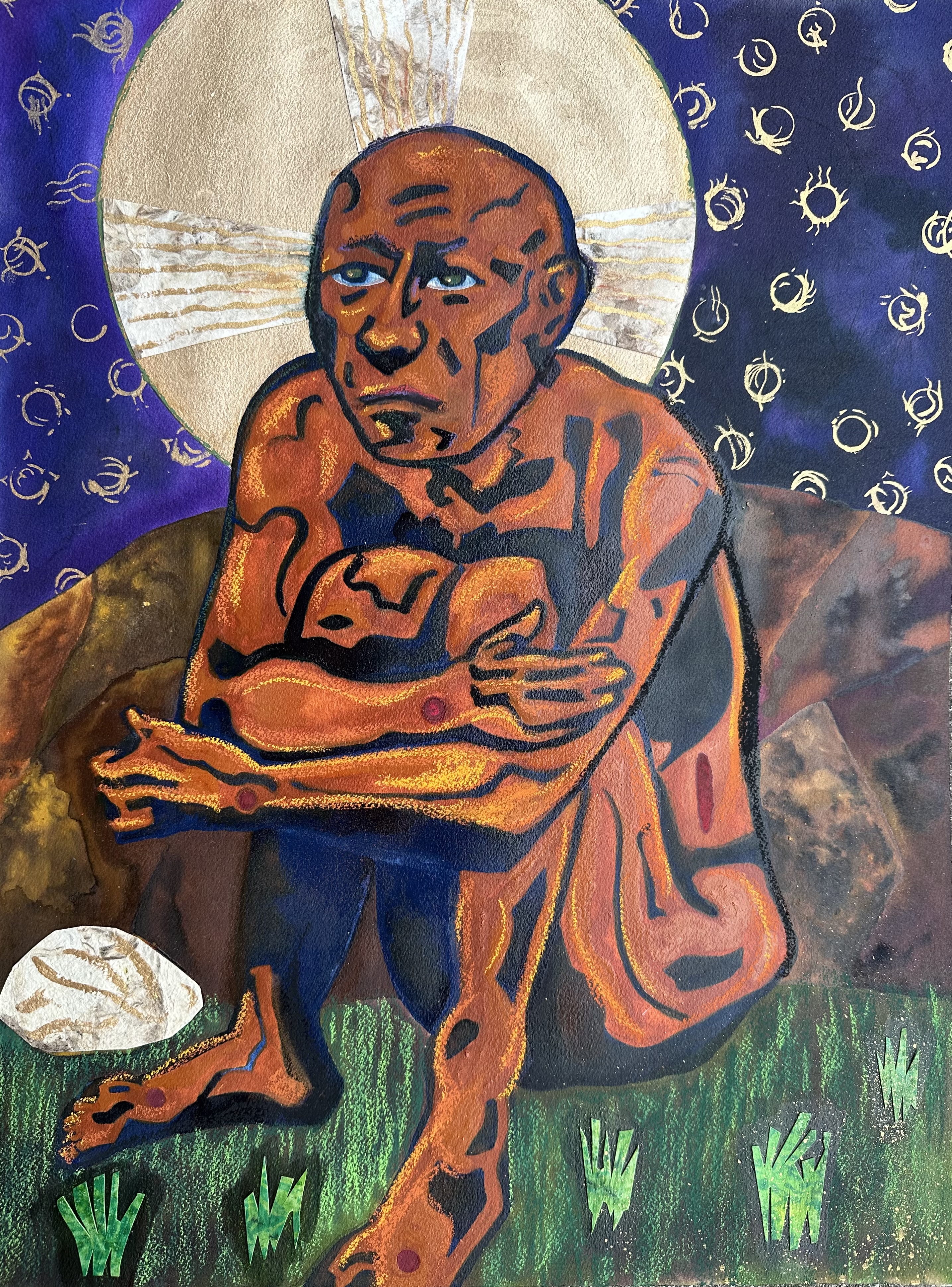
Laments & Expressions of Confidence

Continuing our project of writing laments using the ancient literary forms found in the Hebrew Scriptures, we turn to the naming of covenant. It is probably good to reiterate that the form of ancient lament has five parts: invocation; honest complaint; expressions of confidence; petition; and praise. Today we investigate the third part, which actually does more than express confidence – it names covenant.

Expressions of Confidence

This past Sunday, I opened our discussion with this prompt:
Tell a story about an event in your life that led to you becoming more fully yourself.

It proved to be a very emotional prompt, as people often become more whole by challenging brokenness. Maybe they’re finding ways to face their own internal brokenness. Maybe they’re confronting someone else’s brokenness, and find that the cost of that confrontation is a more clear-eyed view of themselves. When in the midst of the struggle to become more fully alive, we can find these confrontations and burst of self-knowledge very destabilizing. Yet these are the very moments that I think of as “covenant-producing.” It is in these moments where old ways of being are overturned that we must make vital agreements with new ways of acting and looking at the world.

A Teaching about the Naming of Covenant and Expressions of Confidence

One of my source text’s for understanding the destabilizing and restorative effects of covenant-making is Walter Brueggemann’s The Covenanted Self. Here, in brief, are some of Brueggemann’s main ideas about covenant:

  • Brueggemann asserts that “the human self is not an independent, autonomous agent but is always and necessarily preceded by a Thou, one radically other than us, who evokes, summons, authorizes, and ‘faiths’ us into existence as persons.”
  • Our relationship with this Thou, who we call God, is strangely intimate and equal. God, who is so much more than we can imagine, enters into a mutual relationship with us through covenant.
  • But God is not equal to us. We are always aware that God is greater than us, and so we find this covenantal relationship strange and destabilizing.
  • Covenant makes us change by undermining our understanding of who we are and calling us to become someone else. To some extent this is always true when we enter into relationship. To be a parent, a friend, a lover, or to step into any new role in work or in life, requires us to change. The change required within a covenant with God is even greater, and more destabilizing.
  • But at the heart of that change is the sure knowledge that God loves us, and will also change in response to the demands of love. God’s love is stable, and that is enough. The demands of love require expression, and the moments of covenant that we name are moments when we accepted and acted on those demands.
    I have been writing, in this series, about how God, as presented in scripture, does change and makes change happen. This can be a profoundly challenging idea. So much of our sense of security rests on an idea of divine stability. For Brueggemann, and for me, that stability is found in the constant nature of God’s love. Such love changes its tactics as it responds to the world’s needs. But the love itself doesn’t change. As we remember moments of covenant in our lives, we find that they are always moments when we felt God’s love.

Examples of Expressions of Confidence

The examples I drew from scripture are not as fraught or complicated as they were in the previous weeks of this study. They are meant to show the nod towards covenant in the texts that we’ve been examining. As you’ll see below, they don’t really articulate the shape of those covenants. They simply assert that covenant is still there, that God has not abandoned us. That’s why they might properly be called “expressions of confidence” rather than “expressions of covenant.” But such confidence is based on covenant – we are confident that God is staying true to the relationship. Here are the examples, but I won’t comment on them much, since much of what I have left to say about covenant is best said in terms of our own writing.

  • “God has not despised – not disdained – the suffering of those in pain! God didn’t hide, but answered them when they cried for help!” -Psalm 22
  • “I trust in your love; my heart rejoices in the deliverance you bring.” – Psalm 13
  • “God’s favor is not exhausted, nor has God’s compassion failed. They rise up anew each morning, so great is God’s faithfulness.” -Lamentations 3:22-23

Naming and Describing Moments of Covenant

We set out to name and describe moments of covenant following these rubrics:

  • First, read through what you’ve already written, and ground yourself in the feelings and images. Then…
  • Write about a moment of change and covenant when you learned something that effects this present moment. (Where were you? What was the weather like, what did you hear, what did you see, what did your surroundings smell like, what tastes lingered in your mouth, how did your body feel? Who was with you? What were you doing?)
  • Write about God’s participation in that moment. (Why did this moment come to mind when you were asked to write about covenant?)
  • Write about the meaning you have made from your experience of that moment. (What did you learn about God? About love? About yourself? About the world? Who did you talk to about the event, and how did they reflect upon your experience?)

I found myself writing about a very recent event, an Iftar dinner that one of the local mosques invited me and my wife to. Until this point I had been shaping my own lament around the grief I feel over the spread of war in the Middle East and the out-sized part that my own country has been playing in the violence. I felt exhausted with caring, but compelled to care, useless in my anger, but raging. I yearned for sabbath, for a break from all of the destruction and misery, but expressed my doubts that I, or the world, would get to enjoy such a sabbath. Pausing to name the Iftar dinner as a moment of covenant helped to reestablish my confidence in God’s abiding care for the world. Here’s what I wrote:

We ate in an abandoned factory
that the mosque had bought to serve the city.
After the talks our hosts went to pray,
but invited us to the serving line,
where we piled our plates.
We ate dates, and salad, and falafel, and beans.
We talked of old friends, and when our hosts rejoined us,
of our traditions, wishing each other holy fasts, full of intention.
Even in the midst of war, of despair, we broke bread together.

I wanted to fill this description with detail, as any creative writing teacher will tell you that specificity is the heart of narrative. Detail does more than make a good story, though. It grounds us in reality. To speak of covenant can be abstract. To speak of salad and beans is to remember that covenant exists in the fulness of our lives, that it is tangible, something that we smell and taste.

Some More Examples

As I’ve written these posts, I’ve been sharing two laments that I wrote before I began teaching about lamentation. I’ll continue those laments here.

from a poem entitled “Lamentation, The Masked Men”

Doxed Divinity,
naked-faced agitator caught in a camera’s eye,
strip away the bully’s costume,
pull the mask down from his face,
send him reeling back in nakedness,
bring him to his knees.

We voted for our destruction,
gave away our liberties because of the price of eggs.
Now doors crack inwards, windows shatter,
the frigid day stalks in, the masked face of winter
squints through beady eyes.
Children weep as gloved hands grasp and hold their heads.
There is no tenderness.
Schools empty, children starve,
and pompous, apostate senators
clasp their hands upon their bellies and regard
our destruction as Your best wish.
Why don’t you haunt their nights and make them weep,
and make the cold stretch across their naked skin?
Why don’t you batter and berate them?

You, who, when the flood had ended,
sent a beam of sunlight
onto the post of a broken fence,
after everyone had fled,
and the long, sallow girl
who spoke in gangly sentences
played a song of hopefulness.
The stuffing had come out of the houses
and lay, gray on dirty streets,
and the ship that broke the levy
balanced on the neighborhood’s jagged edge.
But still, the light on the post, and the song,
and we agreed with each other
that even destruction welcomes the sun.

from a poem entitled “Lamentation, Pharaoh’s Silos”

Grain of spirit milled for bread,
fill the children who hide inside,
sharpen their minds,
give freedom to their play,
remind them, through your buried taste,
that they will emerge into daylight,
that the world is always being remade.

This is the season of starvation,
the old season that our ancestors feared,
lean with empty cupboards, sacks emptied of grain.
Joseph built great silos and put them in Pharaoh’s hand.
Pharaoh still controls them, and there’s famine in the land.
The grocery stores are open,
the shelves are laden and the coolers softly glow.
But a glacier spans the city,
and the children live beyond it,
starving on ice flows.
Why aren’t you sunlight, hot and fierce?
Why don’t you drown the pharaohs and lead us into wilderness?

Once, in the desert, we built a house.
The sun made a cooking stone of the concrete slab,
and we built quickly, making shade,
and the family that would live there
lifted sheetrock with us, then retreated, in the heat,
to their shack of cardboard walls.
Power lines were slack in a street of dust,
and when our saws stopped working
children lifted cables, looking for the break,
ignoring the electricity that would kill them at a touch.
Sweat, a stinging in the eyes,
and the scratch of insulation
to keep the cold of the desert night outside.
And then, with dirty hands, we ate together in the dust,
bean burritos, and the taste of the hands that made them,
and of contentment, and our acceptance of Your love.

Laments & Honest Complaint

Featured Image Credit: Kathe Kollwitz, “The Widow,” print, 1921

On Sunday, we continued to write laments in the style of the ancient Israelites. As I said in the last post, the genre of Biblical lament has five basic parts: invocation; honest complaint; expressions of confidence; petition; and praise. In today’s post, I’ll talk about honest complaint and invite you to add to your own laments, if you’re writing along with us.

The Opening Question

The opening question I set for our consideration of honest complaint was:

What grieves you most about the world at the present moment? What are you mourning over?

This led to a very heartfelt discussion. Some of us talked about climate change, about the spread of autocracy, about children killed in various unending international conflicts. Some spoke of personal challenges— illness, loss, broken relationships. The question helped us ground our complaints in the actual tragedies of our lives and our world.

Take some time to answer it for yourself before you read more of this post.

A Teaching About Honest Complaint

A complaint holds within it a plea and petition for help. It asks for a change from the One who is able to bring about change. We would not be complaining if we didn’t think that things could be different.

An honest complaint is clear-sighted about our current situation. It describes that situation well and is rooted in the present moment. Understanding the reasons why we are suffering is less important than simply naming our suffering. Lindsay Wilson writes that “our deepest need is not to understand why our suffering or loss has occurred, but to know if God cares and can be trusted.”

An honest complaint

  • expresses our current circumstances;
  • clarifies our settled convictions;
  • avoids glib propositions about what must be true;
  • asks bold questions;
  • levels bold accusations;
  • expresses the pain of loss in grief and tears;
  • treats nothing as if it’s out of bounds.

This description of honest complaint seems fairly straightforward, but in practice our complaints get tangled up and loaded with hard questions. In the moment of our distress, it is sometimes hard to have a clear understanding of our current circumstances. Something in a treasured relationship might be wrong. Are we responsible for the wrongness, or is the other person? Or is it a condition that we have created together, offending and letting each other down in little ways that eventually erode our trust? It is also hard to state our settled convictions, as this might feel like an intellectual exercise when we are deeply rooted in our emotions and don’t have the distance that clear thought often requires. Our pain is exasperated by a feeling that our certainties are under attack, and so we might try to defend our core beliefs even while we are experiencing their limitations. We don’t always feel that we can be bold or even aggressive with God, even if we know, intellectually, that God can take it. Will God find our complaints too burdensome and abandon us? Will God say that we’re being unfair, and reject us? Tears are often inarticulate, a storm of agony that has no other expression. And if our worlds are shaken, we might prefer the security of clear borders and boundaries, even when we are finding those boundaries restrictive and detrimental to our growth as persons.

Examples of Honest Complaint

Here are some examples of Biblical complaint. Some of them continuations of texts that we considered last week.

“Oh my God, I cry in the daytime, but you do not answer; by night as well, but I find no rest.” -Psalm 22

“How long shall I have perplexity in my mind, and grief in my heart, day after day? How long shall my enemy triumph over me?” – Psalm 13

“God lies in wait for me like a bear or like a lion prowling after its prey, forcing me into the briars, throwing me to the ground and leaving me in anguish.” -Lamentations 3:10-11

“Sighing is my only food, and groaning pours out of me like water. For what I feared most has come upon me, and what I dreaded has happened to me. I have no peace; I have no quiet; I have no rest – only turmoil.” -Job 3:24-26

Psalm 22 complains of God’s silence. Because God doesn’t answer, the psalmist can’t rest. This is the complaint of the sleepless night, of tossing and turning upon the bed, of a mind that is feverish with agony and self-doubt. The psalmist speaks in the voice of wounded love, and that voice sounds in a void. Where is God? Where has reassurance gone? St. John of the Cross spoke of the pervasive sense of divine absence as “the dark night of the soul.” Such times can be experienced as a kind of numbness, the depression that makes you want to turn your face to the wall. But they can also be quite active, as we cry and scream over God’s absence, and accuse God of abandoning us.

Psalm 13 complains of perplexity and grief. There is a triumphant enemy, and the psalmist isn’t afraid to name that enemy. As we talked about this psalm, we were honest about the struggles that Christians have with the idea of enemies. How does having enemies fit into our pursuit of Christian love? Yet we noted that Jesus tells us to love our enemies, not to pretend that we don’t have them. The psalmist is very honest about the fact that there is an enemy, and that enemy is actively working for the psalmist’s destruction. All sorts of people in the world have the experience of being undermined and attacked by enemies, and in our context as Americans we see this play out in the lives of queer people, people of color, and women, whose enemies are activated by homophobia, racism, and misogyny. If we can’t honestly name these things, we can’t act against them. We are called to act out of love but not hatred, but one can practice an oppositional love.

Lamentations aligns God with predatory animals, and for people who lived very close to the land, such animals could easily be thought of as enemies. What does it mean to claim that God is sometimes an enemy? This is a bold accusation. In misery and agony, the author of Lamentations calls God a predator and protests against the experience of being hunted. We could dismiss this with pietistic platitudes and say that the parts of us that have to die might indeed protest against their own destruction, but it is probably better to leave it as a bold complaint. Why explain it away? Why not accept the validity of the anguish that leads the author to name God as predatory?

Job’s complaint is that his righteousness didn’t protect him from calamity. We can caution people against catastrophizing, but sometimes the situation is just as bad as they fear that it will be. We all have protections that we’ve put in place to keep disaster from our door. When those protections fail, all we have is complaint or acceptance, and acceptance is very hard to get to if we refuse to ever indulge in honest complaint.

Writing Honest Complaints

To help us shape our honest complaints, I broke the process of complaining into three parts. I gave these prompts:

  1. Express Your Current Circumstances
  2. Express Your Settled Convictions (The world must be this way…life must be this way…the future must be this way…)
  3. Ask Bold Questions and Level Bold Accusations

We all found this fairly easy to enter into intellectually, although it left us feeling quite tender and exposed. We’re committed to protecting each other’s confidentiality, so I provide only my own lament as an example.

Last week I invoked God with these words:

“You whom I forget when I read the news, use photographs as reminders, headlines as heralds, break open my indifference.”

This week I added my complaint, breaking it down into the three parts that I outlined above:

Current Circumstances – “I hear of the deaths of children, and my misery makes me want to turn away, to bury my distress in comforts and distractions.”

Settled Convictions – “The world should have moments of rest, and release me from the pain of caring, and of failing to care. Your Sabbath should spread among us, and heal us with rest.”

Bold Questions and Accusations – “Why allow us to hear of atrocities when there is so little that we can do about them? You won’t allow us a moment of peaceful ignorance. You bring the clamor to my ears.”

It felt a little odd to complain about how I felt burdened by the death of children. But I wrote it anyway, since complaining rarely makes us look good. In writing it, I realized how selfish and foolish I sounded, but I accept that this is part of the honesty I’m seeking. When I’m complaining, I might sound like a toddler throwing toys. That is, really, the point. There can be something irrational and ridiculous about complaint. When we complain, we have permission to say things that we wouldn’t say if we were feeling mentally and emotionally healthy. We might express some unarticulated and barely recognized conviction, but in expressing it, we disrupt it. I might occasionally believe that I should have an easy and enjoyable path through life, as if such a thing is an enshrined right. Saying it out loud makes me see how ridiculous such an attitude is, and helps me shake it lose, unsettling its status as a secret conviction.

Some More Examples

Last week, I offered the invocations from two poems that I wrote when teaching myself the form of lament. I’ll add to them every week, as further examples of how laments develop. Here are the two poems, with their invocations and their honest complaints.

from a poem entitled “Lamentation, The Masked Men”

Doxed Divinity,
naked-faced agitator caught in a camera’s eye,
strip away the bully’s costume,
pull the mask down from his face,
send him reeling back in nakedness,
bring him to his knees.

We voted for our destruction,
gave away our liberties because of the price of eggs.
Now doors crack inwards, windows shatter,
the frigid day stalks in, the masked face of winter
squints through beady eyes.
Children weep as gloved hands grasp and hold their heads.
There is no tenderness.
Schools empty, children starve,
and pompous, apostate senators
clasp their hands upon their bellies and regard
our destruction as Your best wish.
Why don’t you haunt their nights and make them weep,
and make the cold stretch across their naked skin?
Why don’t you batter and berate them?

from a poem entitled “Lamentation, Pharaoh’s Silos”

Grain of spirit milled for bread,
fill the children who hide inside,
sharpen their minds,
give freedom to their play,
remind them, through your buried taste,
that they will emerge into daylight,
that the world is always being remade.

This is the season of starvation,
the old season that our ancestors feared,
lean with empty cupboards, sacks emptied of grain.
Joseph built great silos and put them in Pharaoh’s hand.
Pharaoh still controls them, and there’s famine in the land.
The grocery stores are open,
the shelves are laden and the coolers softly glow.
But a glacier spans the city,
and the children live beyond it,
starving on ice flows.
Why aren’t you sunlight, hot and fierce?
Why don’t you drown the pharaohs and lead us into wilderness?

Laments & Invocations

This Lent we are writing laments, as many of us feel that the entire world is lamenting, crying out to God in pain, uncertainty, and suffering. We are studying lament as a Biblical genre, and shaping our own lamenting to fit that genre. Trying to write in a poetic form that emerged in a very different culture, among people who saw the world in a very different way, is quite challenging. Yet it is a beautiful challenge, testing the bounds of what we think we know and believe, making us pause to consider other possibilities and ways of knowing and acting.

The Genre

Lindsay Wilson breaks the structure of Biblical lament into five parts: invocation; honest complaint; expressions of confidence; petition; and praise. As we write our laments, we spend a week on each of these five parts, and I will be writing a post about each of these parts throughout this season. Although we might need a schema of clearly delineated parts to approach the totality of a lament, the ideas and considerations that inform each of these parts overlap into all of the others, and so one cannot speak of invocation, for instance, without touching on ideas that I will expand on more fully when we come to speak of petition.

The Opening Question

As we meet each week to write laments together, we center ourselves in the room and grow in intimacy by responding, verbally, to a prompt. As leader of the group, I get to set the prompts, always aware that whatever I suggest will only gesture at what we’re going to talk about in depth, and that there are probably better ways to set the prompt that I haven’t thought of. I offer these prompts to you here, so that, in answering them, you might examine your own experience and bring your full self into the writing of your own lament.
The question that I posed for the first week, when we considered invocations, is:
What is the prevailing metaphor that you use for God? When you speak to God, what language to you use to describe God?

A Teaching about Invocation

After we’ve all had a chance to answer the question, and, hopefully, after you have paused to answer it while reading this, I offer a teaching on the focus of the day. I invite scholars, mystics, and theologians into our circle of conversation, so that we might benefit from their wisdom.
In The Theology of the Old Testament, Walter Brueggemann says the following about the structure of Biblical invocations and the spirituality that informs them:

  • Invocation presumes that God can, and does, act in history. Theodicy is the attempt to understand why evil exists if the God of love is active in our lives. J.T. Butler wrote that “‘Theodicy’ is what relatively healthy people think about in the face of suffering. Lament is what sufferers must do – it is the voice of theodicy in life.”
  • An invocation is a full sentence, centered around an active verb that “bespeaks an action that is transformative, intrusive, or inverting.” This verb creates a new situation or a changed circumstance.
  • God is the subject of the active verb, the one who acts “in decisive and transformative ways.”
  • The active verb has a direct object, which is changed or transformed.
  • The “sentence” of lament can be diagrammed like this:
  • Description of God → transformative action → person/thing/condition that will be or is being transformed
  • This simple sentence structure encompasses all of reality. God acts to change and transform settled structures. God holds the initiative. The object (us, the world we inhabit) is not autonomous. God’s actions bind divinity to the things of this earth.

I must admit that I have long resisted this understanding of God’s action, mostly out of a desire to avoid blaming God when things go wrong. If God gave us freewill, than God necessarily withdrew from controlling our actions. We are free to act evilly. God’s omnipotence exists in the fact that God could turn off the cosmos at any moment. But as long as life is allowed to persist, God is limited by the divine choice to give us, and everything, free will. I am probably influenced by Simone Weil when I think this. Weil wrote that “on God’s part, creation is not an act of self-expansion but of restraint and renunciation.” In her understanding, God had to step back and cede space for creation if anything at all was to exist. As Mac Loftin puts it, “Weil sees that the existence of finite creation requires the lessening of God’s infinitude.”

But this isn’t Biblical theodicy. Brueggemann rightly points out that the Bible speaks of a present, active God. A challenging thought for people like me, who are allergic to ideas of shallow providence and anyone saying that God works in mysterious ways while following a divine plan for all creation that we cannot know or glimpse. I struggle with this idea, as it’s usually a platitude that allows us to dismiss suffering or diminish its impact. But I can’t deny that it’s at least part of the Biblical witness.

To write an invocation that is predicated on God, the subject, acting on some object in the world is, for me, fraught with danger. But maybe that’s the point. In writing such invocations, I am trying to pray in a way that stretches my understanding and makes me uncomfortable. Both of which are good inward feelings to carry into the writing of a lament.

Invocations in the Midst of Lament

There are many, many examples in the Bible of people invoking God at the beginning of a lament. Here are a few:

“My God, my God, why have you forsaken me?” -Psalm 22

“How long, O Lord? Will you forget me forever?” – Psalm 13

“O God, you rule forever; Your judgment seat lasts till the end of time. Why have you utterly forgotten us, and abandoned us these many days?” -Lamentations 5:19-20

Psalm 22 names God as an intimate of the speaker (“my God”), chooses forsaken as its active verb, and the speaker as its subject. When we met as a group to write our laments, we spent some time discussing whether God’s act of withdrawing from us (forsaking us) is in keeping with our usual understanding of a loving God. I tried to draw on other examples of loving withdrawal. A parent dropping their kid off at college. A friend watching someone they love make a horrible mistake and knowing that their intervention might not be welcome in the moment, although they’re willing to be there to help pick up the pieces. These examples are in keeping with Simone Weil’s thoughts about God. God has to step back from the world to practice creative love. Weil writes that God “stays far away from us, because if He approached He would cause us to disappear.” Parents often have this sense. Their children need room to try to new things, try out being new personalities. If they’re not given space, they’ll make it by pushing their parents away. Yet at least a few of our group members thought that this was too easy of an analogy. Psalm 22 is what Christ says while on the cross. He is not like a kid starting college. He is crying out in agonized suffering, and it is hard not to hear him insist that if God were present the pain would be bearable. The psalm says that God forsakes us not just in the moments when we need our freedom, but in the moments when we want divine comfort. What are we to do with that?

Psalm 13 is even worse, for here God forgets. As if we are mere incidents in a busy divine life, not even worth noting down in a journal. My understanding of God includes an idea of eternity as being different from the temporal life that we experience. Eternity sits outside of time, and every moment is observed and remembered in God’s eternal mind. Every hair on our head, every wing of a dove, is known. Even if God is necessarily absent so that we can exist, that doesn’t mean that we’re forgotten. Yet the psalmist insists on divine forgetting, even if that forgetting is only temporary and we have hope of a future remembering. The psalmist describes a temporal God, but I choose to believe that the psalmist is not making a profound theological statement about God’s capacity to remember, but is instead expressing the feeling of being forgotten. Like a person who is being written to every day, but doesn’t know it because the letters keep getting lost in the mail.

Lamentations asserts somethings about God right at the beginning. God is not absent, but actively ruling and judging. Yet the author is experiencing a period of abandonment. As if God’s docket is full, and the author’s case keeps getting pushed back. Again the active verbs are “forgotten” and “abandonment,” which implies that all of this negligence is intentional on God’s part.

Before we started writing, we considered these things. The invocations in these laments refer to God’s active inaction, more than to God’s robust movement in the world. Biblical laments seem to be worried that we’ve gotten our facts wrong. That the things we think we know about God are in fact untrue. They start by breaking down comfortable and established categories.

The Ignatian term for this worry, and the cry of pain it engenders, is “desolation.” In times of desolation all of our descriptions and categories fall apart. We come face to face with the limitations of our knowing. The pain of this experience might lead us, eventually, into “indifference,” Ignatius’s term for what a Buddhist might call non-attachment. Once you’ve come to hold your understanding of God loosely, it becomes easier to hold loosely to your understanding of everything else. We learn to hold our desires and needs lightly. It’s a natural and healthy spiritual process, but wow, is it hard. Biblical laments bring us, immediately, into such desolating struggles.

Writing Our Own Invocations

To help us write our own invocations, I broke the process down in a way that proved to be a little confusing. Here’s what I asked people to do:

  1. Describe God (God of the…God who does…God who is…God who isn’t…God who can be found in…God who can’t be found in…)
  2. Describe or comment on God’s transformative action (You have done this…you haven’t done this…you are doing this…you are distant…you are close…you are inactive in this way…you are present in this way…)
  3. Name the person/thing/condition that will be or is being transformed (This/these people…an emotion…a place…an assumption about life…a relationship…a form of community…a hope or desire)

The confusion came from people’s desire to strictly obey the grammatical rules. They found, when trying to describe God’s transformative action, that they needed an object in order to do so. Then they felt guilty about working ahead. Is it okay for an invocation to have two objects, or even two subjects? Here, for example, is one of the invocations I wrote as we sat together:

You whom I forget when I read the news, use photographs as reminders, headlines as heralds, break open my indifference.

I describe God in terms of my forgetting, and in that first clause God is the subject, my own forgetting is the active verb, and the news is the object. So I’ve already made a complex sentence just in my first movement towards invocation. I should pause here to admit that I’m bad at grammar, and those who are good at grammar are slapping their foreheads in frustration at my fumbling my way through grammatical rules. But you get my point. My second clause of this invocation is no better. The active verb is “use” but then I mention photographs and headlines as the object of such using. When I get to the third clause I introduce another active verb (break open) and another object – my indifference, the true object of the sentence. People struggled with the fact that I introduced invocation as a strict grammar, but then suggested that they might express themselves best by getting loosey-goosey with the rules.

One could, of course, write very simply sentences. It really doesn’t matter. Words are meant to express the heart’s deepest longings and despair. Even the structure of these invocations can be held lightly.

Some More Examples

I have, of course, been writing laments in preparation for teaching about them, so I’ll end this post by sharing two.

from a poem entitled “Lamentation, The Masked Men”

Doxed Divinity,
naked-faced agitator caught in a camera’s eye,
strip away the bully’s costume,
pull the mask down from his face,
send him reeling back in nakedness,
bring him to his knees.

from a poem entitled “Lamentation, Pharaoh’s Silos”

Grain of spirit milled for bread,
fill the children who hide inside,
sharpen their minds,
give freedom to their play,
remind them, through your buried taste,
that they will emerge into daylight,
that the world is always being remade.

Next week we will move to the next part of a lamentation, the complaint itself. I will, each week, add to these two poems, so that you can see my full lamentations develop. Hopefully you, too, will build your lamentations week to week. Please add them to the comments of this post, if you wish to share them.

Transfiguration, Days of Insurrection

by KPB Stevens

We four climbed the mountain, and He was changed,
changed like the flaws made by freeze
and thaw as it cracks the walls of a church,
since change breaks all that we struggle to contain.
Change is raw, it weeps and seeps and breaks
the load-bearing law, and brings us, the remaining three,
to creep on painful knees. It is a riot, and the sorrow after,
flowers sprung from blood and cadaver,
and the innocent hung on crosses as the world comes undone.
The earth spins around the sun, gates and graves
open again, seasons change and stay the same.
I see it now, down on my knees – God will always
remain one, standing still, ever-flowing, never done,
and we will change from this moment, this revelation,
constant, and spinning, and gone again.

Illumination

On Saturday, we discovered that the ice had cracked the mosaic above the door of the church and sent the tesserae falling down. On Monday, I went to a rally, clergy gathering to defend the immigrants from Haiti who had been invited to a small Ohio town to help revive the economy and now might be told to leave again. We were asked to reflect on the change we’d like to see, and I found myself resisting the question. As my colleagues got up to answer, I stayed seated, not knowing if I could say what I really wanted to say. Which is that true change cannot be predicted. And that focusing on the future and trying to force it into our visions of what it might be is not an exercise in embracing change.

God refuses to be contained, even by our visions of the future. When Peter, James, and John went up on the mountain with Jesus, they were bewildered by change and desired to build a structure for it. But change sets itself against our structures. Laws, constitutions, contracts, agreements – these are all mechanisms for trying to evade change or, if it comes, manage it. Perhaps they’re necessary for human life. But as I sat among the clergy, I was of two minds. I wanted to embrace the efficacy of the law, the long, slow lope of managed change, and I wanted to see it overcome entirely. That is, after all, the story of our faith. Peter, James, and John will live through crucifixion and resurrection, and those two events will establish a great pattern of change that will repeat, like the seasons, throughout the centuries. And yet, even that pattern will be managed by the church that these three apostles help to establish. Christians will be told that the cycles of death and rebirth can be contained in creeds and rituals, and we will lose our sense of shock, our distress, our agonized need to find meaning in the incoherence of crucifixion and the ineffable nature of resurrection. So we will come to this moment, where we cannot imagine the chaos of real change, and when we speak of it, we will only be able to evoke the patterns of the past.

As a priest, I love ritual and I can tolerate creed. But these things only point to the transfigured moment, when divinity reveals itself as constant and at the heart of things. My faith must move beyond its sheltered crouch at the heart of the spinning, that place at the core where the dizziness can be managed. Somehow I must bring myself to venture out to the edge of the vortex, where ideas collide and the potential for pain and hurt is ever-present. I can stay cowering in my church. But the cold of winter is breaking the walls. As if it wants to tell me that I must embrace my fear and go outside and seek the danger of the cross. Which is the danger of covenant. Of forever wanting to embrace God’s changeless love and forever wanting to face, bravely, the collapse of this current world.

The Soul is in God, and God is in the Soul

The fish is in the sea  
and the sea is in the fish,
so that every muscle,
every organ, floats in brine.

I breathe in the chill,
right air of the morning
and oxygen binds into molecules,
unites my body to the world.

Beloved, by what element
does my soul gather in the divine?
What part of my past, what hope,
is made whole by mysteries

that expand everywhere
and lay curled within me,
beyond me,
both of and not of the world?

Illumination

I was taught, as a priest, to value the intellect’s way of knowing. But there are other ways of knowing. The body knows in its own way. The emotions know — they laugh their knowing, they weep their knowing. If theology is the thoughts we think about God, we need other theos. Theophysicality. Theoemotionality.

I wrote this poem within a moment of bodily amazement. The atmosphere we move through is also within us, and our physical selves are merely membranes that air enters and pushes out from again. More than that, our matter binds itself to the air, so that we dissipate in our environment, just as our environment permeates to the deepest level of our being.

And God? If God pervades the atmosphere, is everywhere, than this permeability must be part of our relationship with the divine. How do we experience this? Maybe through memory. Maybe through hope. Those words seem inadequate. Some emotion, some sigh too deep for words, fills us and breathes out into the divine.