
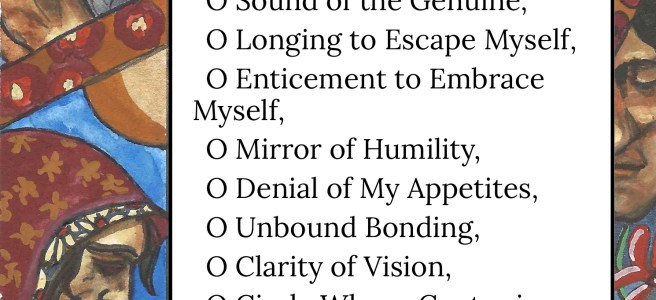
This Lent we are writing laments, as many of us feel that the entire world is lamenting, crying out to God in pain, uncertainty, and suffering. We are studying lament as a Biblical genre, and shaping our own lamenting to fit that genre. Trying to write in a poetic form that emerged in a very different culture, among people who saw the world in a very different way, is quite challenging. Yet it is a beautiful challenge, testing the bounds of what we think we know and believe, making us pause to consider other possibilities and ways of knowing and acting.
The Genre
Lindsay Wilson breaks the structure of Biblical lament into five parts: invocation; honest complaint; expressions of confidence; petition; and praise. As we write our laments, we spend a week on each of these five parts, and I will be writing a post about each of these parts throughout this season. Although we might need a schema of clearly delineated parts to approach the totality of a lament, the ideas and considerations that inform each of these parts overlap into all of the others, and so one cannot speak of invocation, for instance, without touching on ideas that I will expand on more fully when we come to speak of petition.
The Opening Question
As we meet each week to write laments together, we center ourselves in the room and grow in intimacy by responding, verbally, to a prompt. As leader of the group, I get to set the prompts, always aware that whatever I suggest will only gesture at what we’re going to talk about in depth, and that there are probably better ways to set the prompt that I haven’t thought of. I offer these prompts to you here, so that, in answering them, you might examine your own experience and bring your full self into the writing of your own lament.
The question that I posed for the first week, when we considered invocations, is:
What is the prevailing metaphor that you use for God? When you speak to God, what language to you use to describe God?
A Teaching about Invocation
After we’ve all had a chance to answer the question, and, hopefully, after you have paused to answer it while reading this, I offer a teaching on the focus of the day. I invite scholars, mystics, and theologians into our circle of conversation, so that we might benefit from their wisdom.
In The Theology of the Old Testament, Walter Brueggemann says the following about the structure of Biblical invocations and the spirituality that informs them:
- Invocation presumes that God can, and does, act in history. Theodicy is the attempt to understand why evil exists if the God of love is active in our lives. J.T. Butler wrote that “‘Theodicy’ is what relatively healthy people think about in the face of suffering. Lament is what sufferers must do – it is the voice of theodicy in life.”
- An invocation is a full sentence, centered around an active verb that “bespeaks an action that is transformative, intrusive, or inverting.” This verb creates a new situation or a changed circumstance.
- God is the subject of the active verb, the one who acts “in decisive and transformative ways.”
- The active verb has a direct object, which is changed or transformed.
- The “sentence” of lament can be diagrammed like this:
- Description of God → transformative action → person/thing/condition that will be or is being transformed
- This simple sentence structure encompasses all of reality. God acts to change and transform settled structures. God holds the initiative. The object (us, the world we inhabit) is not autonomous. God’s actions bind divinity to the things of this earth.
I must admit that I have long resisted this understanding of God’s action, mostly out of a desire to avoid blaming God when things go wrong. If God gave us freewill, than God necessarily withdrew from controlling our actions. We are free to act evilly. God’s omnipotence exists in the fact that God could turn off the cosmos at any moment. But as long as life is allowed to persist, God is limited by the divine choice to give us, and everything, free will. I am probably influenced by Simone Weil when I think this. Weil wrote that “on God’s part, creation is not an act of self-expansion but of restraint and renunciation.” In her understanding, God had to step back and cede space for creation if anything at all was to exist. As Mac Loftin puts it, “Weil sees that the existence of finite creation requires the lessening of God’s infinitude.”
But this isn’t Biblical theodicy. Brueggemann rightly points out that the Bible speaks of a present, active God. A challenging thought for people like me, who are allergic to ideas of shallow providence and anyone saying that God works in mysterious ways while following a divine plan for all creation that we cannot know or glimpse. I struggle with this idea, as it’s usually a platitude that allows us to dismiss suffering or diminish its impact. But I can’t deny that it’s at least part of the Biblical witness.
To write an invocation that is predicated on God, the subject, acting on some object in the world is, for me, fraught with danger. But maybe that’s the point. In writing such invocations, I am trying to pray in a way that stretches my understanding and makes me uncomfortable. Both of which are good inward feelings to carry into the writing of a lament.
Invocations in the Midst of Lament
There are many, many examples in the Bible of people invoking God at the beginning of a lament. Here are a few:
“My God, my God, why have you forsaken me?” -Psalm 22
“How long, O Lord? Will you forget me forever?” – Psalm 13
“O God, you rule forever; Your judgment seat lasts till the end of time. Why have you utterly forgotten us, and abandoned us these many days?” -Lamentations 5:19-20
Psalm 22 names God as an intimate of the speaker (“my God”), chooses forsaken as its active verb, and the speaker as its subject. When we met as a group to write our laments, we spent some time discussing whether God’s act of withdrawing from us (forsaking us) is in keeping with our usual understanding of a loving God. I tried to draw on other examples of loving withdrawal. A parent dropping their kid off at college. A friend watching someone they love make a horrible mistake and knowing that their intervention might not be welcome in the moment, although they’re willing to be there to help pick up the pieces. These examples are in keeping with Simone Weil’s thoughts about God. God has to step back from the world to practice creative love. Weil writes that God “stays far away from us, because if He approached He would cause us to disappear.” Parents often have this sense. Their children need room to try to new things, try out being new personalities. If they’re not given space, they’ll make it by pushing their parents away. Yet at least a few of our group members thought that this was too easy of an analogy. Psalm 22 is what Christ says while on the cross. He is not like a kid starting college. He is crying out in agonized suffering, and it is hard not to hear him insist that if God were present the pain would be bearable. The psalm says that God forsakes us not just in the moments when we need our freedom, but in the moments when we want divine comfort. What are we to do with that?
Psalm 13 is even worse, for here God forgets. As if we are mere incidents in a busy divine life, not even worth noting down in a journal. My understanding of God includes an idea of eternity as being different from the temporal life that we experience. Eternity sits outside of time, and every moment is observed and remembered in God’s eternal mind. Every hair on our head, every wing of a dove, is known. Even if God is necessarily absent so that we can exist, that doesn’t mean that we’re forgotten. Yet the psalmist insists on divine forgetting, even if that forgetting is only temporary and we have hope of a future remembering. The psalmist describes a temporal God, but I choose to believe that the psalmist is not making a profound theological statement about God’s capacity to remember, but is instead expressing the feeling of being forgotten. Like a person who is being written to every day, but doesn’t know it because the letters keep getting lost in the mail.
Lamentations asserts somethings about God right at the beginning. God is not absent, but actively ruling and judging. Yet the author is experiencing a period of abandonment. As if God’s docket is full, and the author’s case keeps getting pushed back. Again the active verbs are “forgotten” and “abandonment,” which implies that all of this negligence is intentional on God’s part.
Before we started writing, we considered these things. The invocations in these laments refer to God’s active inaction, more than to God’s robust movement in the world. Biblical laments seem to be worried that we’ve gotten our facts wrong. That the things we think we know about God are in fact untrue. They start by breaking down comfortable and established categories.
The Ignatian term for this worry, and the cry of pain it engenders, is “desolation.” In times of desolation all of our descriptions and categories fall apart. We come face to face with the limitations of our knowing. The pain of this experience might lead us, eventually, into “indifference,” Ignatius’s term for what a Buddhist might call non-attachment. Once you’ve come to hold your understanding of God loosely, it becomes easier to hold loosely to your understanding of everything else. We learn to hold our desires and needs lightly. It’s a natural and healthy spiritual process, but wow, is it hard. Biblical laments bring us, immediately, into such desolating struggles.
Writing Our Own Invocations
To help us write our own invocations, I broke the process down in a way that proved to be a little confusing. Here’s what I asked people to do:
- Describe God (God of the…God who does…God who is…God who isn’t…God who can be found in…God who can’t be found in…)
- Describe or comment on God’s transformative action (You have done this…you haven’t done this…you are doing this…you are distant…you are close…you are inactive in this way…you are present in this way…)
- Name the person/thing/condition that will be or is being transformed (This/these people…an emotion…a place…an assumption about life…a relationship…a form of community…a hope or desire)
The confusion came from people’s desire to strictly obey the grammatical rules. They found, when trying to describe God’s transformative action, that they needed an object in order to do so. Then they felt guilty about working ahead. Is it okay for an invocation to have two objects, or even two subjects? Here, for example, is one of the invocations I wrote as we sat together:
You whom I forget when I read the news, use photographs as reminders, headlines as heralds, break open my indifference.
I describe God in terms of my forgetting, and in that first clause God is the subject, my own forgetting is the active verb, and the news is the object. So I’ve already made a complex sentence just in my first movement towards invocation. I should pause here to admit that I’m bad at grammar, and those who are good at grammar are slapping their foreheads in frustration at my fumbling my way through grammatical rules. But you get my point. My second clause of this invocation is no better. The active verb is “use” but then I mention photographs and headlines as the object of such using. When I get to the third clause I introduce another active verb (break open) and another object – my indifference, the true object of the sentence. People struggled with the fact that I introduced invocation as a strict grammar, but then suggested that they might express themselves best by getting loosey-goosey with the rules.
One could, of course, write very simply sentences. It really doesn’t matter. Words are meant to express the heart’s deepest longings and despair. Even the structure of these invocations can be held lightly.
Some More Examples
I have, of course, been writing laments in preparation for teaching about them, so I’ll end this post by sharing two.
from a poem entitled “Lamentation, The Masked Men”
Doxed Divinity,
naked-faced agitator caught in a camera’s eye,
strip away the bully’s costume,
pull the mask down from his face,
send him reeling back in nakedness,
bring him to his knees.
from a poem entitled “Lamentation, Pharaoh’s Silos”
Grain of spirit milled for bread,
fill the children who hide inside,
sharpen their minds,
give freedom to their play,
remind them, through your buried taste,
that they will emerge into daylight,
that the world is always being remade.
Next week we will move to the next part of a lamentation, the complaint itself. I will, each week, add to these two poems, so that you can see my full lamentations develop. Hopefully you, too, will build your lamentations week to week. Please add them to the comments of this post, if you wish to share them.
 KPB Stevens