
If anyone objects to this union
let them know that I will not touch you
until the child is born.
Let no one say that he is mine,
and not the offspring of a vision.
Everyone will look at us strangely.
They will whisper “his new wife
has seduced him with her ecstasies,
he is enticed by mania.”
Even my friends will say
“You are not yourself.
She has changed you.
You are not who you were to me.”
And I will say, “The wind blows where it will.”
I will say, “It’s a different kind of love.”
They won’t believe me.
So I might make recourse to angelic visitations.
I might claim that I received a commanding dream.
But really it was your face when you told me.
The fragile certainty in your gaze.
The way you often look beyond me
to some horizon I cannot see.
The gentle specificity
with which you do everything –
knit a blanket for the cot,
let onions fry in the bottom of the pot.
I am a man who measures twice,
who is careful with a join.
But you are careful beyond all belief,
as if everything is alive, is fragile, as if
the whole world is an infant
pleading for your care.
I am already seeing with your eyes.
Let all others stare.
Illumination
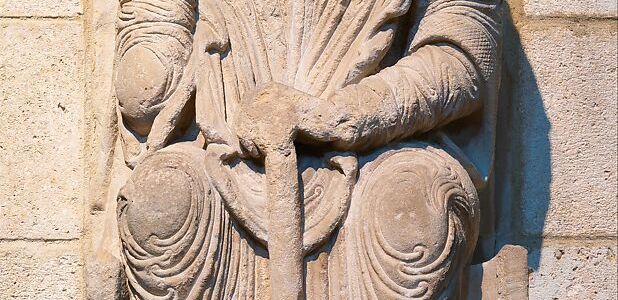
A friend told me about a cathedral in Europe that has a pillar carved with a depiction of the Three Magi arriving at the stable in Bethlehem. They are on one side of the pillar. St. Joseph sits on another side, pouting. A similar image is displayed at the Met Cloisters. Joseph, sitting with his eyes half-closed, resting a cheek on a fist. Is he unhappy? Indifferent? Just sleepy? Two of the magi adore Mary, who sits with a damaged carving of the infant Christ in her lap. Time and, perhaps, vandalism, has removed her nose, making it hard to read her expression. Her eyes, also, are half-closed.
The medieval mind was not the first to relegate Joseph to the sidelines and offer some sly commentary about his place in the story. The Gospels themselves present him as a kind of upright dullard, willing to do the right thing without bothering to have much of an opinion about it. His marriage to Mary is never cast in a romantic light. He’s older than she is. He’s offering his protection, helping her out. It’s easy to imagine that he’s patronizing, that he seeks the economic arrangement of a family without seeking love.
I want to subvert this image. I want Mary to have more impact on his life, to be an active player in the small drama of their marriage. If we imagine him actually falling in love with Mary, then we also must spend time wondering about the qualities in her that drew his affections. I refuse to see her as a kind of puppy in the snow, a waif in need of a savior. I don’t want him to love her in a way that feeds his ego.
My poem is an attempt at reversing our assumptions. What if it is Mary, and not Joseph, who guides and shapes the relationship? The angel appears to her first. It is her great “yes” that leads to the incarnation. That “yes” must have been infectious. It must have given her a deep charisma. If we exalt her, why wouldn’t Joseph exult her as well? Let us imagine that he falls in love with her vision. That he is a disciple to her teachings.
Those teachings might be mostly domestic. She doesn’t get up on a box in the public square and start declaiming. She doesn’t start healing people or casting out demons. She knits. She cooks. She prepares the nursery. She offers these simple acts as forms of healing, of protection. The savior of the world will be safe within the sphere of her labor and influence. She will be a good mother.
And she will teach Joseph to be a good father. He can still be a simple man. He won’t write a book, or sing a majestic song. He won’t petition the king or collect a band of followers who will go with him as he makes his daily rounds. He’ll make good furniture. He’ll be careful and attentive in his relationships. He’ll pay attention to dreams, and learn to see the world as Mary sees it.
It is enough. It is beautiful. It is the kind of marital love that anyone would be happy to have.
 KPB Stevens
My wonderment: how do Mary and Joseph get to the place where none of the stereotypes apply? Neither is weak, dullard-ly, passive, needing to be rescued or, on the other hand, overbearing. whatever their reasons or feelings about being married to one another, which of course they be fulfilled until heaven or at least some habit of being- almost -enlightened. where one is still not understanding or otherwise knowing/ loving, the other knows how to be insightfully himself or herself in some way that serves their spouse. and they are filled with wonderful.
I love this, Claire. So well said.
My understanding is blocked by the Ways of this website. “Strain on the brain of the small folk…” I loved the poem.
>
one of my students once described the Immaculate Conception in this way: Mary , from her beginning, could pay attention to God in such a way that she wisely could raise Jesus to recognize himself as the son of God.
Out of the mouths of 16-year-old babes.
hello Karl, I have enjoyed your writings, this one
Thank you so much, Geralyn. It’s lovely to hear from you!