
Published on Substack on October 23, 2023
The terror and anger of the last two weeks might make us want to turtle up and hide away. Hamas’s barbaric terrorist attack on Israel and the indifference to civilian death in Israel’s military response creates such overwhelming moral confusion in me that it’s hard to look at the news. I would like, at this time, to take refuge in my faith, to treat it as a door I could close or a blanket I could pull over my head. But I can’t, because my faith isn’t private, and it can’t be, almost by definition.
During the past week I’ve returned to a book that I find myself reading again and again. Dorothee Soelle’s The Silent Cry: Mysticism and Resistance may very well be the most important thing I’ve read in the last ten years.
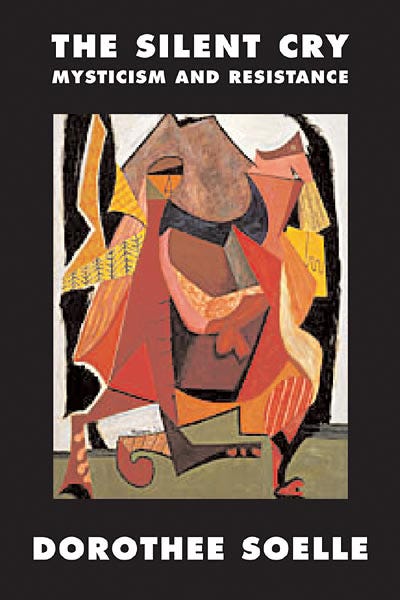
I fell in love with the Christian mystical tradition a decade ago, and read many of the great mystics. I learned the traditional prayer practices and benefited from them. But I was taught to approach these practices and to read the mystics through the lens of private devotion. That is, I was taught that the mystics were mostly talking about things that could only be experienced in the depths of one’s own soul during daily, prayerful, withdrawal from the world. Yes, it’s true that Teresa and John ran around reforming the Carmelites, and that Meister Eckhart was the Provincial Superior for Saxony and in charge of forty-seven convents, but we talked about them as if this was somehow separate from their real life with God. Mysticism was something that kept them balanced and sane, and we would often imply, when we told their stories, that it was quite a pity that they also had to contend with hectic work schedules.
Soelle’s book doesn’t accept this narrative. She is interested in ora et labora, the unity of the active and contemplative life. The entire biblical story is about people encountering God and this encounter leading to action, or about people encountering God in the midst of action. Moses encounters God and is sent to free the Hebrews from Egypt. He encounters God as he leads the people through the wilderness, and struggles with God and in cooperation with God to bring them to the promised land. God becomes incarnate in human life and spends his time healing and teaching, not sitting quietly in prayer. He does some of that, of course, but Jesus’s tendency to go off somewhere to pray is always proceeded or followed by action. Soelle asks what we can truly know of God, and comes to the conclusion that “God’s being, that which we can know of God, is the divine will to build up the the reign, the Kingdom of God.” That is, God is forever pointing us towards an idealized version of the life of the world, where we live with plenty and every tear is wiped away from our eye. And God is always insisting that we not only share this ideal, but work for it.
But our very encounter with that vision of a perfected world tends to alienate us from the world as we experience it now. We are given a vision of what the world should be, then we see the world as it presently is, and we want to retreat from it. Only God won’t let us. True mysticism, true experience of the divine force that pervades all life, fills us with such compassion that we can’t just let things suffer and die. Filled with love for everything that is, able to see all of creation as precious, we are moved to act.
Mysticism and action go hand in hand. Soelle makes this point by telling the story of a young woman. She writes:
At the theological seminary in New York where I used to teach, we were once asked about our religious experiences. There was an embarrassed silence; it was as if we had asked our grandmothers about their sex life. A young woman eventually spoke up and offered to present, in a week’s time, an extensive report on her experiences. Accordingly, she told us that as a very young girl in the American Midwest, she had spent many hours reading in bed at night, without permission. One winter’s night, she woke up at four in the morning, went outside, and looked at the stars in the clear, frosty sky. She had a once-in-a-lifetime feeling of happiness, of being connected with all of life, with God; a feeling of overwhelming clarity, of being sheltered and carried. She saw the stars as if she had never seen them before. She described the experience in these words, “Nothing can happen, I am indestructible, I am one with everything.” This did not happen again until about ten years later when, in a different context, something similar took place. The new context was a huge demonstration against the Vietnam War. There, too, she knew that she was sheltered, a part of the whole, “indestructible,” together with the others. Struggling for words and with her own timidity, she brought both experiences together under the rubric of religious experience.
Such different experiences, yet, at their heart, touching on the same sense of mystery, arising from the same source of outpouring empathy, and filled with the same sense of participation in divine immensity.
The young woman’s second experience came in the midst of action, but more than that, it came as she was immersed in community. Soelle emphasizes the need for community in The Silent Cry. Acting out of a sense of what the world could be while also carrying a sense of disappointment and alienation from the world as it, well, that requires a tremendous sense of balance. Faith communities are meant to give that balance. This is, in fact, the New Testament model. Disciples don’t try to change the world as lone individuals. Nor does Jesus spark a massive protest movement that ends in successful revolution. Instead, the New Testament shows us how groups of people set out to confront the brokenness of the world by living together in a new way. These groups of people form the churches. Soelle is understandably upset that the meaning of church has changed. Instead of being a collaborative of people who share a common vision and are truly willing to change their lives in pursuit of that vision, churches have become places where we are taught how to privatize our beliefs and conform to the demands of empire. But it doesn’t have to be that way.
Even now, there are many churches that demand a change of life from their members. Some of these changes might seem very small. Treat others with more respect. Give more of your resources away. Go to an occasional protest or write an occasional letter to a lawmaker. For many people, this isn’t enough. It seems shallow, even hypocritical. I might make a faith commitment to reduce my reliance on single-use-plastics. But no individual effort will end the climate crisis. Shouldn’t the change of life be more total, not a series of small protests, but one great and continual protest?
Perhaps it should, but then we have to ask why we see so few examples of this, and why those examples that we do have are often so disturbing. Religious groups that try to control every aspect of their members’ lives are in danger of becoming cults, even if they start in a place of authentic love for the world and honest desire for change. Or they turn to repressive measures to control their members behavior and stamp out ideas and practices that they consider false, to inquisitions and witch hunts and civil war. There is a paradox, here. Alienation from the world leads people to try to change it, but if they try to change it too quickly and act too stringently, they lose the sense of compassion and the vision of God that alienated them in the first place. True change seems to result from some combination of alienation and acceptance. When the Civil Rights leaders in Montgomery were rallying people for the bus boycott, they went to both the gin joints and the churches.
Soelle uses the term “revolutionary patience” to describe this strange admixture of alienation and acceptance. She writes:
However radically mystical consciousness practices and strives for changes in conditions based on possessions and violence, the connection to those who think otherwise is steadfastly maintained. No one is excluded or eliminated.
Revolutionary patience doesn’t require one to give up deep-seated beliefs or the desire to change the world. It does require one to try to invite perceived enemies into the vision of a changed world, and into the community that works to change it. A funny thing happens whenever Jesus is confronted by the Sadducees, the Scribes, or the Pharisees. He responds to them with a parable or aphorism that is meant for his disciples. But most of the time, the meaning of his response is clear, and his enemies get to hear it, too. He invites his enemies to consider the alternatives that he embodies.
Dorothee Soelle died in 2003, so we cannot know what she would say about events in Israel/Palestine today. But in The Silent Cry she gestures at what our response might be. To remain engaged, in spite of the cost. To allow ourselves to feel alienated from the violence and horror. To find other people who are also alienated by the state of the world and who have had experiences of God that allow them to see the heartbreaking beauty and fragility of people on both sides of the conflict. To work in community to bring a just end to the violence. Not just an end that restores an unjust status quo. But an end that reveals a new way of living in the world, a new vision of the world that we are called to inhabit. And to do so with revolutionary patience, refusing to exclude or eliminate those who oppose that new vision.
This work might be done in the church, which has tried, despite its many flaws, to carry this mystical consciousness through the centuries. It might be done by other groups, among other communities that are committed to pray and work on behalf of the world. But what makes it unique is that it involves both prayer and work, ora et labora, the mystical consciousness and engagement in the world understood to be one thing, capable of carrying the attitudes of prayer into encounters with other people and hearing the call to work in our encounters with God.
 KPB Stevens